
Nissaka, Kakegawa, Fukuroi, Mitsuke, and Hamamatsu, from the series "Famous Places on the Fifty-three Stations of the Tokaido, Five Stations (Tokaido gojusan eki goshuku meisho)"
- Date:
- c. 1830/35
- Medium:
- Color woodblock print; oban
- Source:
- Art Institute of Chicago
Description
Nissaka, Kakegawa, Fukuroi, Mitsuke, and Hamamatsu, five consecutive stations along the Tokaido in the modern prefectures of Shizuoka, are presented together on a single sheet from Utagawa Kuniyoshi's series Famous Places on the Fifty-three Stations of the Tokaido, Five Stations. Published around 1825 and held by the Art Institute of Chicago, this version of the series condenses groups of stations rather than devoting a separate sheet to each, producing a compact travel survey that complemented the more expansive Tokaido projects appearing across Edo print publishing. Kuniyoshi organises the composition as a sequence of vignettes, each tied to a recognisable local feature: the steep, root-clinging slope of Sayo-no-Nakayama near Nissaka, the castle town atmosphere of Kakegawa, the rural fields and pilgrim routes around Fukuroi, the busy crossings of Mitsuke, and the open coastal expanse of Hamamatsu, where Lake Hamana lay just beyond. The vignettes are integrated by a continuous landscape band that recalls horizontal handscroll convention. Although Kuniyoshi is more often celebrated for Edo ukiyo-e warrior prints, the series shows him working confidently in the meisho-e idiom that flourished in the Bunsei and early Tenpo eras. Topographical exactness mixes here with a clear love of the human anecdote, with small figures of porters, pilgrims, and palanquin-bearers populating the scene. The sheet also documents the day-to-day rhythm of overland travel between Edo and Kyoto in the late Edo period, when the Tokaido was both an arterial trade route and a stage for tourism, pilgrimage, and literary association.
More Prints by Utagawa Kuniyoshi
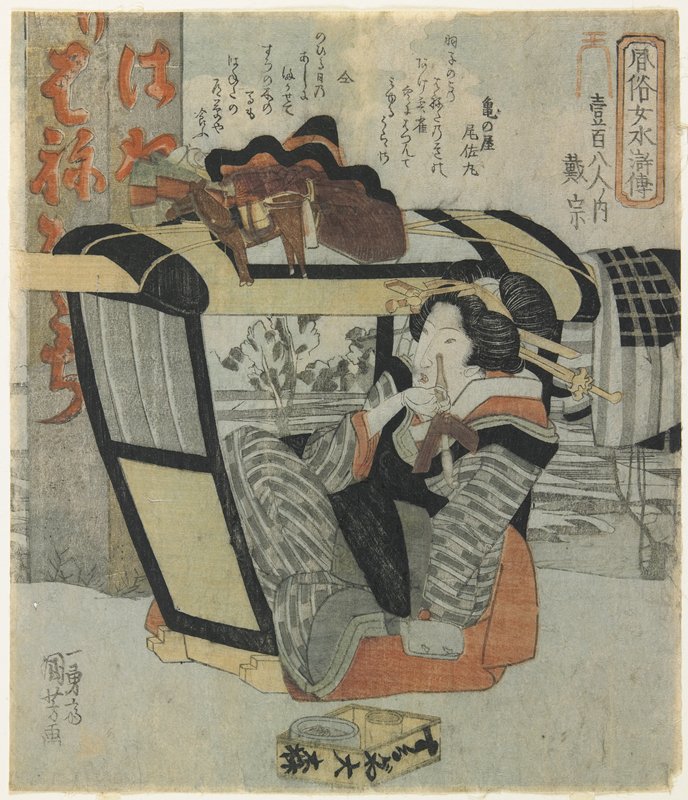
Woman as the Hero Taisō in Palanquin Holding a Pipe
c. 1830
Woodblock print (surimono), ink and color on paper

Yan Qing (Roshi Ensei), from the series "One Hundred and Eight Heroes of the Popular Water Margin (Tsuzoku Suikoden goketsu hyakuhachinin no hitori)"

Poem by Abe no Nakamaro, from an untitled series of One Hundred Poems by One Hundred Poets

Hu Sanniang (Ko Sanjo Ichijosei), from the series "One Hundred and Eight Heroes of the Popular Water Margin (Tsuzoku Suikoden goketsu hyakuhachinin no hitori)"
More Tōkaidō Prints

Rain at Maekawa in Sagami Province (Soshu Maekawa no ame), from the series "Selection of Views of the Tokaido (Tokaido fukei senshu)"
1932
Color woodblock print; oban

Mishima: Morning Mist (Mishima, asagiri), from the series "Fifty-three Stations of the Tokaido Road (Tokaido gojusan tsugi no uchi)," also known as the Hoeido Tokaido
c. 1833/34
Color woodblock print; oban

Totsuka: The Fork at Motomachi (Totsuka, Motomachi betsudo), from the series "Fifty-three Stations of the Tokaido Road (Tokaido gojusan tsugi no uchi)," also known as the Hoeido Tokaido
c. 1833/34
Color woodblock print; oban

Shinkawabata at Handa, Owari Province (Bishu Handa Shinkawabata), from the series "Selection of Views of the Tokaido (Tokaido fukei senshu)"
1935
Color woodblock print; oban
Frequently Asked Questions
Nissaka, Kakegawa, Fukuroi, Mitsuke, and Hamamatsu, from the series "Famous Places on the Fifty-three Stations of the Tokaido, Five Stations (Tokaido gojusan eki goshuku meisho)" was created by Utagawa Kuniyoshi (歌川国芳) in c. 1830/35.
Yes — Nissaka, Kakegawa, Fukuroi, Mitsuke, and Hamamatsu, from the series "Famous Places on the Fifty-three Stations of the Tokaido, Five Stations (Tokaido gojusan eki goshuku meisho)" is part of the Famous Places on the Fifty-three Stations of the Tokaido, Five Stations (Tokaido gojusan eki goshuku meisho) series by Utagawa Kuniyoshi.
Nissaka, Kakegawa, Fukuroi, Mitsuke, and Hamamatsu, from the series "Famous Places on the Fifty-three Stations of the Tokaido, Five Stations (Tokaido gojusan eki goshuku meisho)" depicts tōkaidō and famous places (meisho-e).