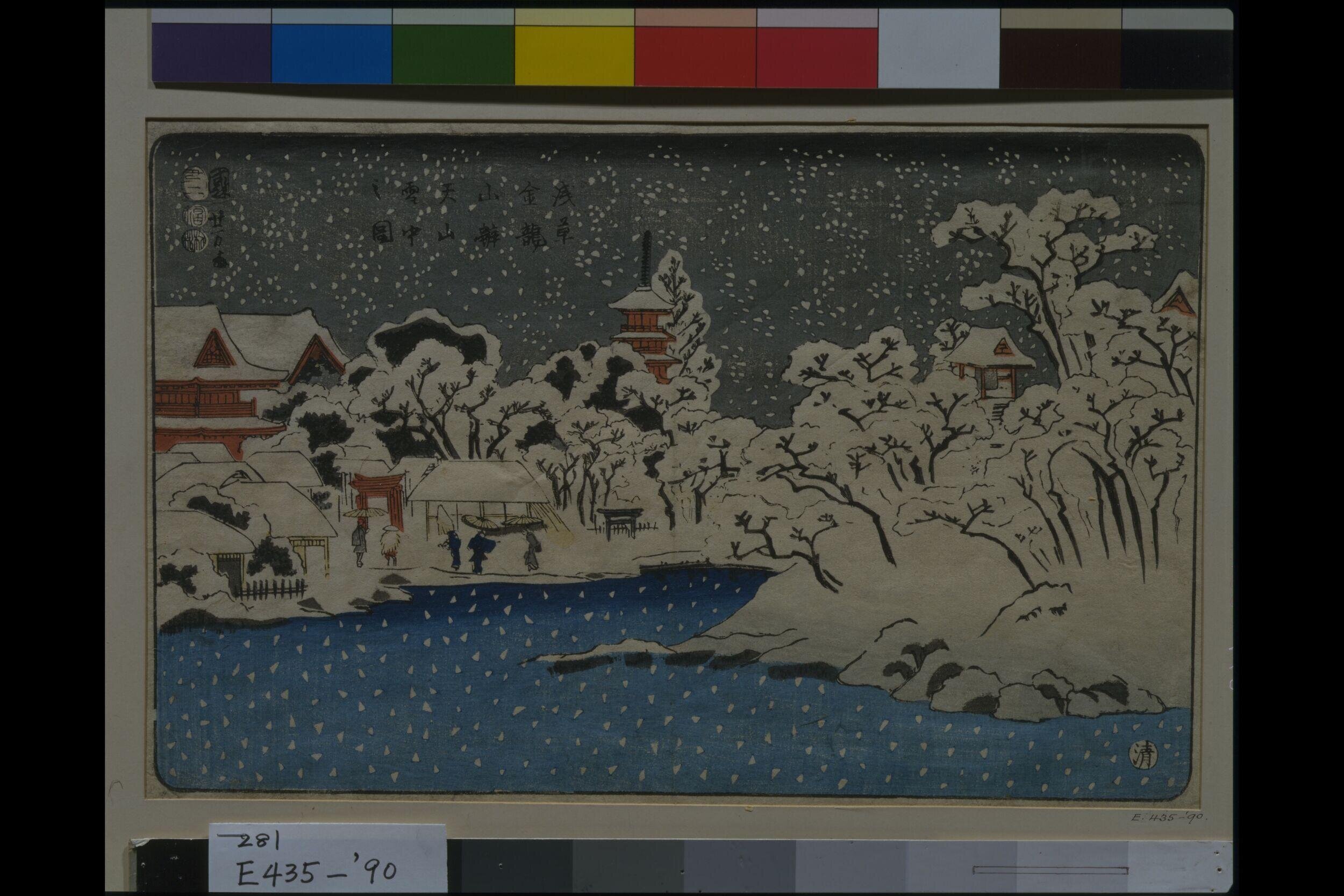
Snow at Senso-ji Temple in Asakusa
- Date:
- 19th century
- Medium:
- Source:
- Victoria and Albert Museum
Description
Snow at Sensō-ji Temple in Asakusa is an undated woodblock print by Utagawa Kuniyoshi held in the Victoria and Albert Museum, presenting one of Edo's most celebrated religious sites under a blanket of fresh snow. Sensō-ji, the great Buddhist temple in Asakusa dedicated to Kannon, was a defining landmark of the city, drawing pilgrims, performers, and shopkeepers throughout the year and serving as a recurring subject for Edo ukiyo-e designers from Hiroshige onward. Kuniyoshi, best known for his warrior prints and dramatic figural compositions, here turns to a quieter mode of landscape and seasonal observation. Snow falls gently across the temple's broad roofs, the surrounding lantern-lit precincts, and the foreground figures moving along the approach; the composition uses subtle gradations of grey, blue, and warm earth tones to evoke the muffled atmosphere of a winter day. The mineral pigments and careful registration typical of mid-nineteenth-century Edo workshops give the snow scene its distinctive luminosity. As a contribution to the established tradition of Edo meisho-e, or famous-place pictures, the print also reflects the city's pride in Sensō-ji as a religious and civic focal point. The Victoria and Albert Museum's broader Japanese print holdings make it possible to study this design alongside Kuniyoshi's other landscapes and his more familiar narrative subjects, illustrating the breadth of his work and his sensitivity to the moods of Edo's seasonal life.
More Prints by Utagawa Kuniyoshi
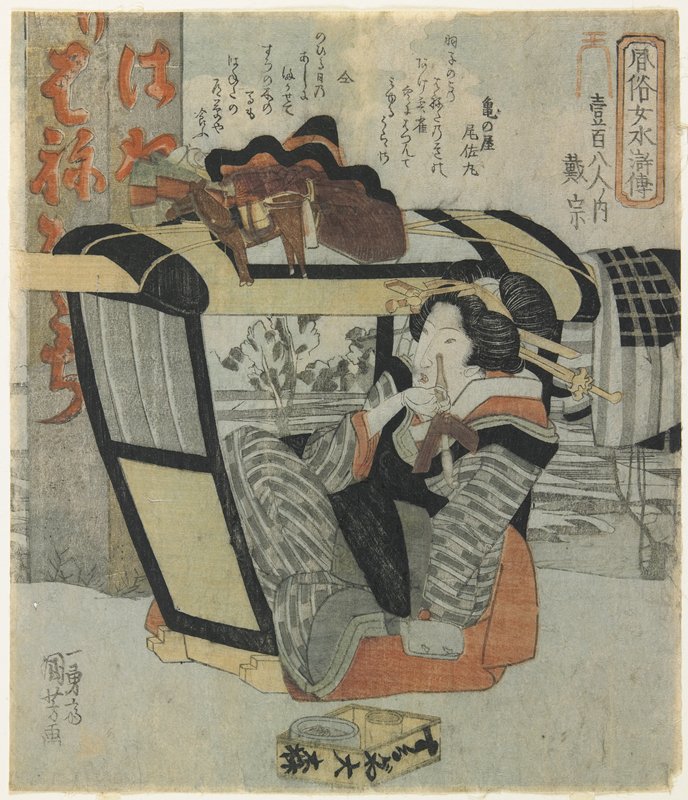
Woman as the Hero Taisō in Palanquin Holding a Pipe
c. 1830
Woodblock print (surimono), ink and color on paper

Yan Qing (Roshi Ensei), from the series "One Hundred and Eight Heroes of the Popular Water Margin (Tsuzoku Suikoden goketsu hyakuhachinin no hitori)"

Poem by Abe no Nakamaro, from an untitled series of One Hundred Poems by One Hundred Poets

Hu Sanniang (Ko Sanjo Ichijosei), from the series "One Hundred and Eight Heroes of the Popular Water Margin (Tsuzoku Suikoden goketsu hyakuhachinin no hitori)"
More Winter Prints
Frequently Asked Questions
Snow at Senso-ji Temple in Asakusa was created by Utagawa Kuniyoshi (歌川国芳) in 19th century.
Snow at Senso-ji Temple in Asakusa depicts winter.