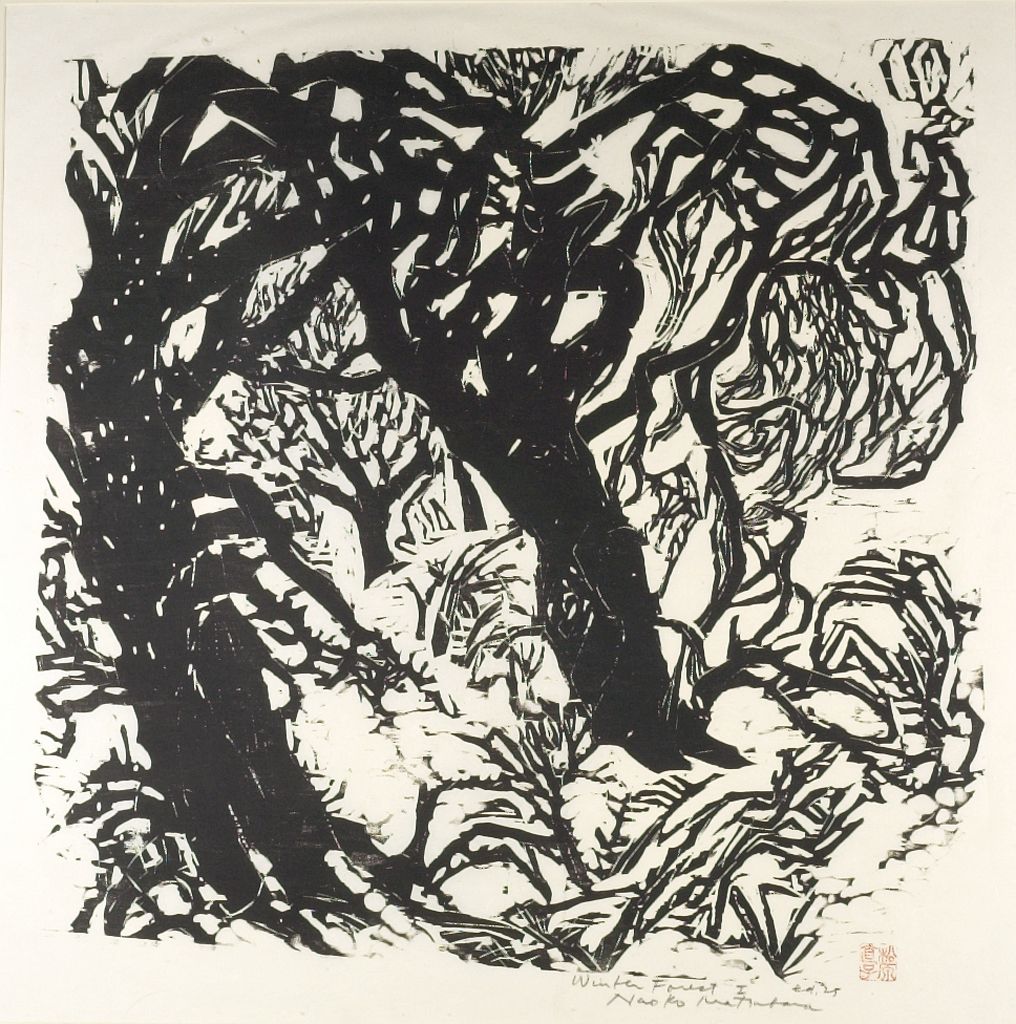
Winter Forest I, Shôwa period, circa 1967-1968
- Medium:
- Woodblock print
- Source:
- Harvard Art Museum
- Image courtesy of
- Harvard Art Museum
Description
This sosaku-hanga print depicts a winter forest rendered through Matsubara's characteristic bold, expressive carving. Bare or snow-laden trees likely fill the composition with strong vertical rhythms, their forms simplified into broad planes of ink that reveal the physical energy of gouge and chisel work on the block. Produced around 1967–1968, when Matsubara was establishing her independent printmaking practice in Canada, the work reflects her synthesis of Japanese woodblock technique with a graphic directness informed by Western modernism. The limited winter palette — likely deep blacks and cool whites drawn from the unprinted washi surface — creates stark contrast without decorative elaboration. As the first in a series, this print may establish a compositional grammar extended across subsequent states or variations. The forest as subject carries weight in Matsubara's broader practice, where the natural world frequently intersects with themes of solitude, spiritual attention, and the cycle of seasons, all rendered through the direct, hand-controlled process central to sosaku-hanga philosophy.
More Prints by Naoko Matsubara

More Snow Scenes Prints
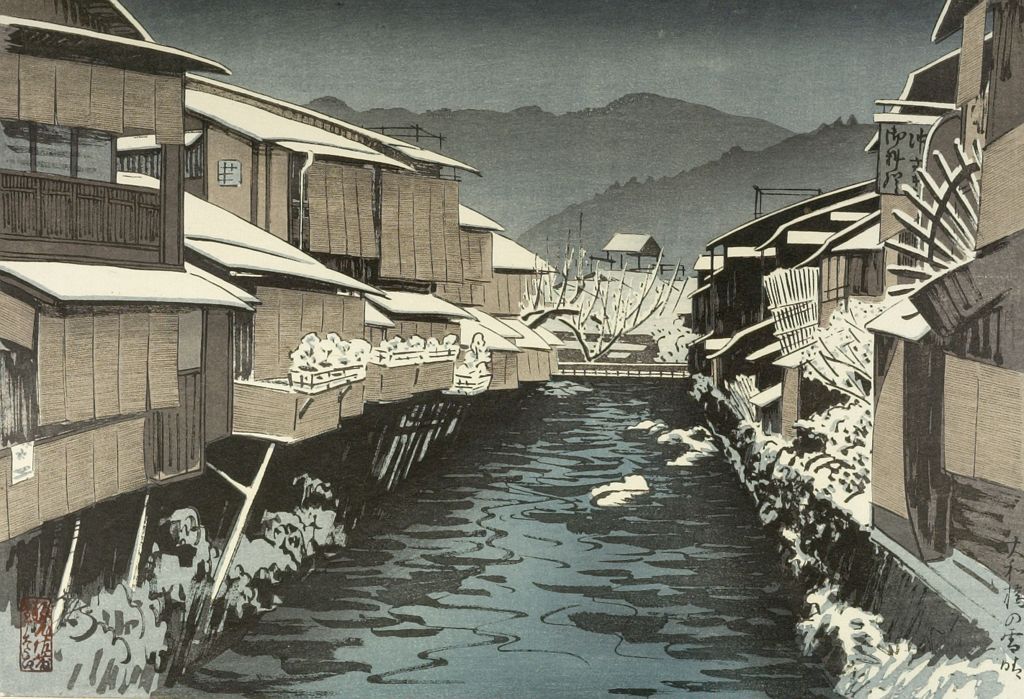
Fair Weather After Snow at Yamato Bridge, Kyoto (Yamato bashi no yukibare), Taishô period, dated 1924
Woodblock print

The Compound of the Tenman Shrine at Kameido in the Snow (Kameido Tenmangu keidai no yuki), from the series "Famous Places in the Eastern Capital (Toto meisho)"
c. 1832/38
Color woodblock print; oban

Miyajima in Snow (Yuki no Miyajima)
Yuki no Miyajima
1929
Color woodblock print; oban
Evening Snow at Shiha Park, Tokyo
1932
Woodblock print
Featured in Collections
Curated cross-cuts that include this print.
Frequently Asked Questions
Winter Forest I, Shôwa period, circa 1967-1968 was created by Naoko Matsubara (松原直子).
Winter Forest I, Shôwa period, circa 1967-1968 depicts snow scenes and winter.