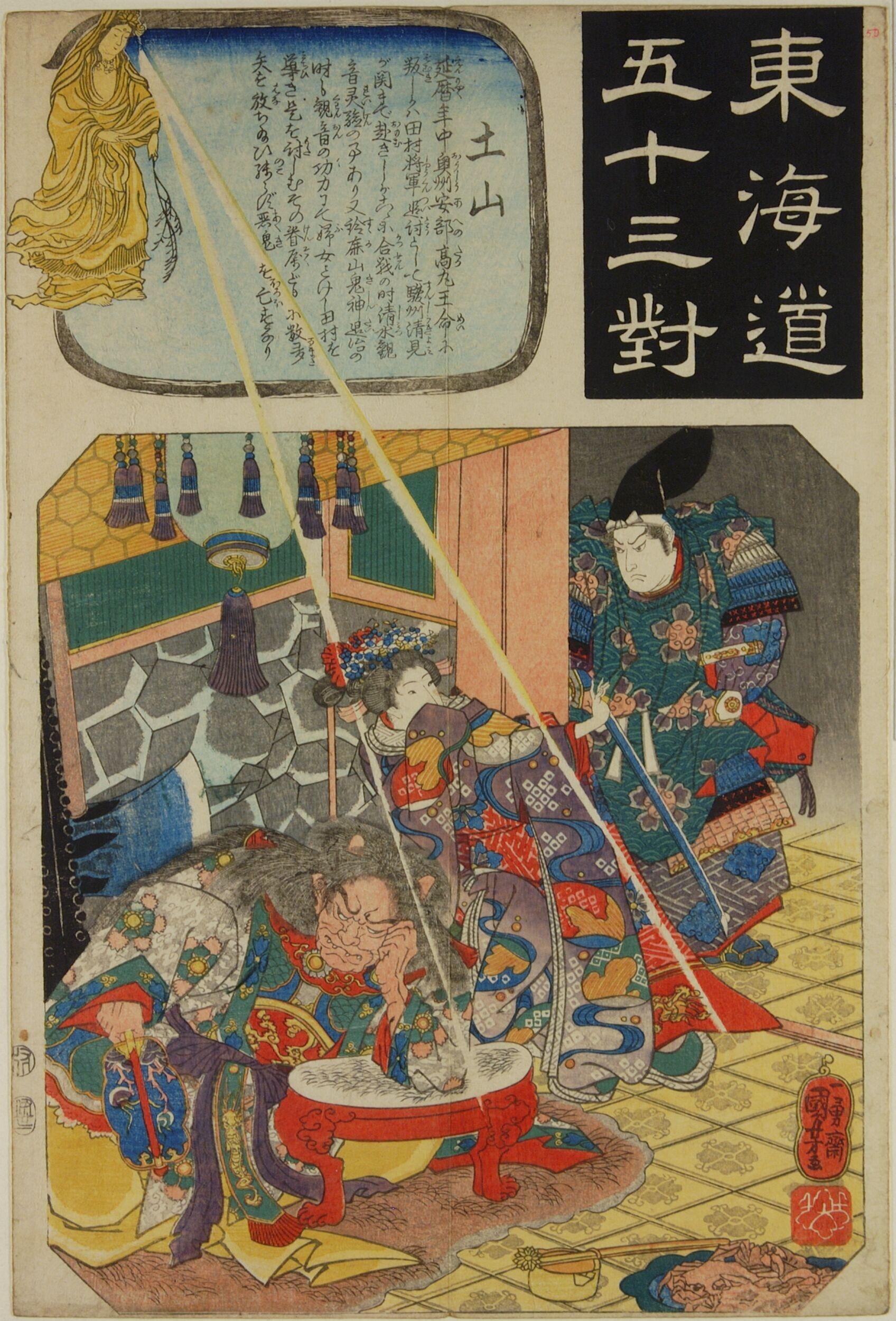
Tsuchiyama (Tsuchiyama)
- Medium:
- Source:
- Victoria and Albert Museum
Description
Tsuchiyama is a Tōkaidō-related print by Utagawa Kuniyoshi (1797-1861) preserved in the Victoria and Albert Museum. Tsuchiyama was the 49th station on the Tōkaidō highway, lying in the mountains between Suzuka and Minakuchi and famous in the literature of travel for its sudden rains and rugged scenery. Kuniyoshi designed numerous Tōkaidō prints in series that paired each station with figures from history, drama or local legend, and the Victoria and Albert Museum's record places this sheet within that body of work. The choice of Tsuchiyama, with its strong literary associations, allowed Kuniyoshi to play to his strengths as a designer who could bring the visual intensity of his warrior prints to a topographical subject. Trained in the Utagawa school under Toyokuni I, Kuniyoshi became, after the appearance of his Suikoden series in the late 1820s, one of the principal Edo ukiyo-e designers of the mid-nineteenth century; his Tōkaidō series complement his warrior prints by extending his interest in story-driven imagery into the geography of Japan's main highway. The museum's catalogue preserves the title of the print and its place in Kuniyoshi's oeuvre, and the description offered here follows that record. As with other Tōkaidō prints by Kuniyoshi, the sheet should be understood as part of a sequence in which place and narrative are bound together, with Tsuchiyama functioning both as a stop on the road and as the setting for the particular figural drama Kuniyoshi chose to associate with it.
More Prints by Utagawa Kuniyoshi

Yan Qing (Roshi Ensei), from the series "One Hundred and Eight Heroes of the Popular Water Margin (Tsuzoku Suikoden goketsu hyakuhachinin no hitori)"

Poem by Abe no Nakamaro, from an untitled series of One Hundred Poems by One Hundred Poets

Hu Sanniang (Ko Sanjo Ichijosei), from the series "One Hundred and Eight Heroes of the Popular Water Margin (Tsuzoku Suikoden goketsu hyakuhachinin no hitori)"

Miya, Kuwana, Yokkaichi, and Ishiyakushi, from the series "Famous Places on the Fifty-three Stations of the Tokaido, Four Stations (Tokaido gojusan eki yonshuku meisho)"
Frequently Asked Questions
Tsuchiyama (Tsuchiyama) was created by Utagawa Kuniyoshi (歌川国芳).