
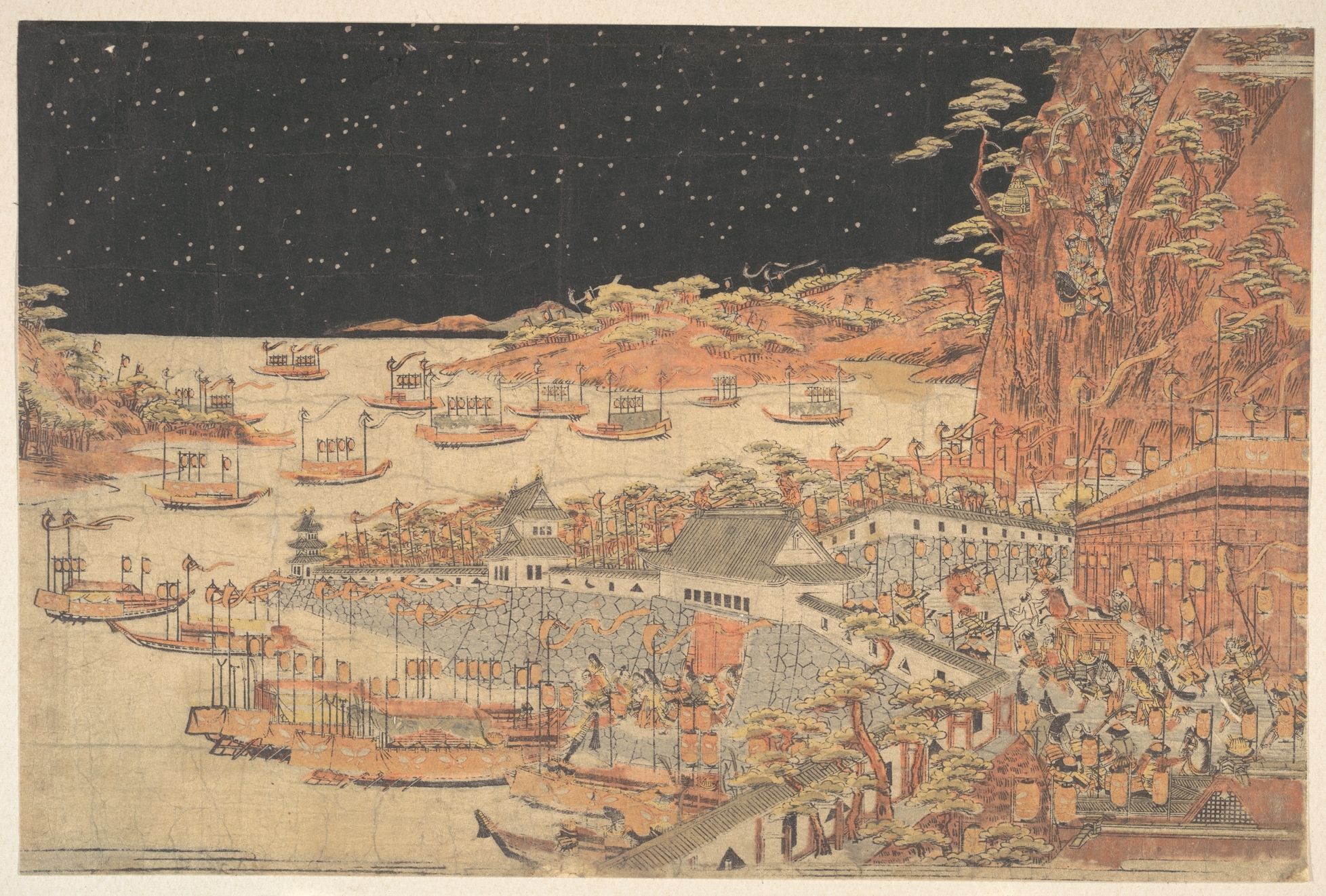
Battle Scene at Yashima-Dannoura
- Date:
- c. 1780
- Medium:
- Color woodblock print; oban
- Source:
- Honolulu Museum of Art
Description
Battle Scene at Yashima-Dannoura, dated to around 1780, draws Utagawa Toyoharu into the cycle of musha-e or warrior prints depicting the closing battles of the Genpei War, the twelfth-century conflict between the Taira and Minamoto clans whose narrative was transmitted through the Heike monogatari and the Noh and Kabuki adaptations that followed. The battles of Yashima in 1185 and Dan-no-ura in the same year were the final defeats of the Taira clan and produced some of the most enduring images of Japanese military legend, including the drowning of the child emperor Antoku, the archery feat of Nasu no Yoichi, and the suicide of the Taira matriarch. Toyoharu's print stages the naval combat in a composition that distributes vessels, mounted samurai, and arrow-shooting archers across the sheet in the active sequence of battle, with the converging diagonals of ship lines and the diminishing scale of distant vessels producing a perspectival recession derived from his absorption of Chinese reproductions of European engravings and from the Dutch optical views distributed through Nagasaki. As founder of the Utagawa school, the lineage whose successors would carry the musha-e genre into the nineteenth century, Toyoharu shows here the warrior-print roots from which that later production would grow. The combination of perspective spatial construction with the inherited legendary subject demonstrates how his uki-e project extended into narrative scenes as well as documentary urban views. Color is held to a vigorous register suited to the subject, with patterned armor, banners, and the dark planes of the sea carrying the principal visual interest. The Honolulu Museum of Art preserves this impression (http://www.honolulumuseum.org/art/10930) as a representative document of Toyoharu's musha-e production drawn from the Genpei War narrative.
More Prints by Utagawa Toyoharu

Frequently Asked Questions
Battle Scene at Yashima-Dannoura was created by Utagawa Toyoharu (歌川豊春) in c. 1780.