Biography
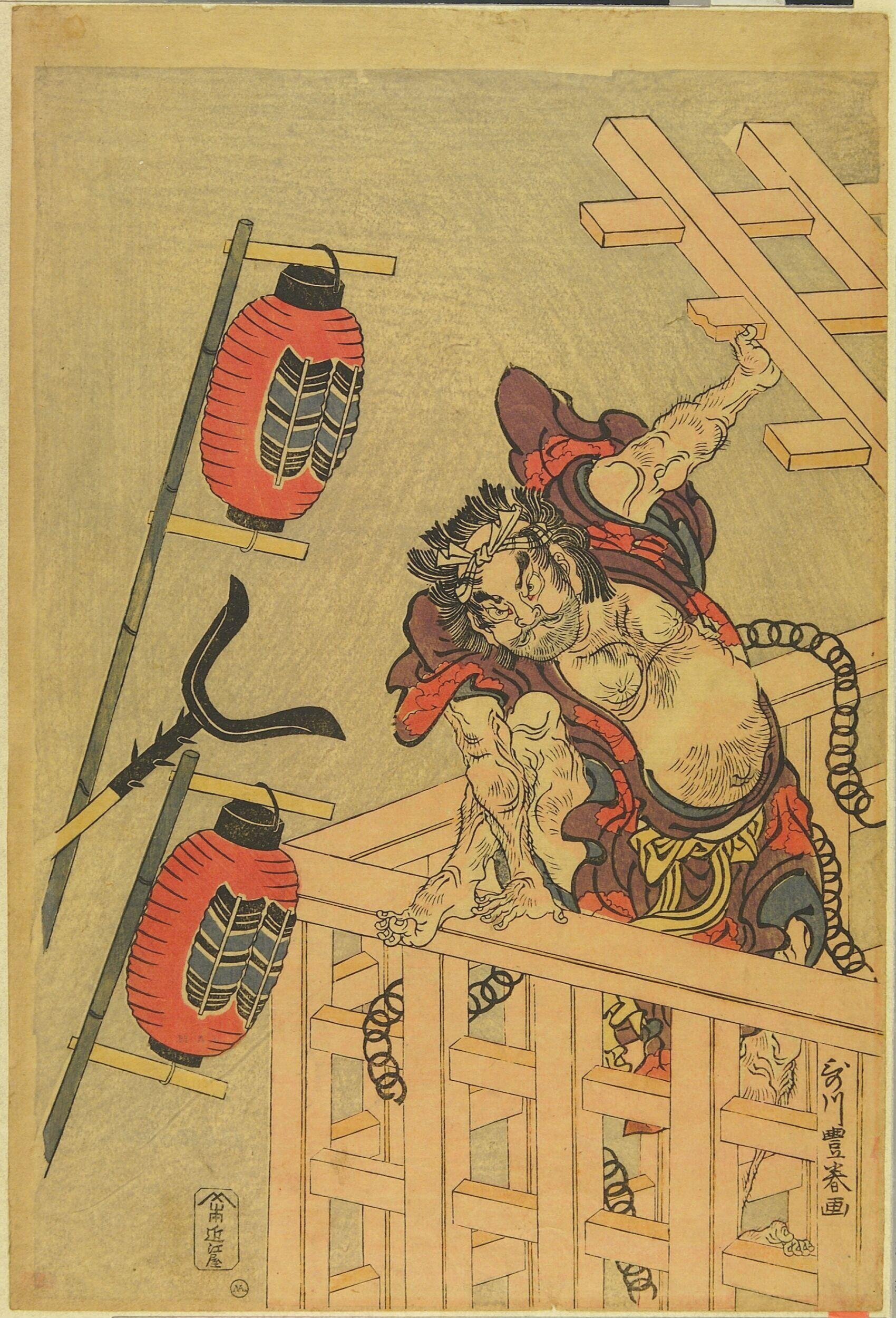
Utagawa Toyoharu (c. 1735-1814) was the founder of the Utagawa school, the dynasty of Edo ukiyo-e designers that would come to dominate Japanese woodblock prints throughout the nineteenth century. While his own surviving output is modest compared with that of his pupils, his historical importance is enormous: he gave Japan its single largest and longest-lasting print lineage, and he is the artist most responsible for translating European perspective into a fluent Edo idiom through the genre known as uki-e, or 'floating pictures.'
Toyoharu was born around 1735 in Toyooka, in Tajima Province (modern Hyogo Prefecture). His training followed the pattern common to ambitious artists of the mid-eighteenth century: he is reported to have studied first in Kyoto within the orbit of the Kano school of painting, and then, after moving to Edo around 1763, with Toriyama Sekien, the eccentric scholar-painter best known today as the teacher of Kitagawa Utamaro and as the compiler of the illustrated yokai catalogues. Through Sekien, Toyoharu absorbed both the discipline of brush painting and a curiosity about pictorial systems that lay outside the conservative Kano canon, including the Western techniques being imported by way of Dutch books at Nagasaki.
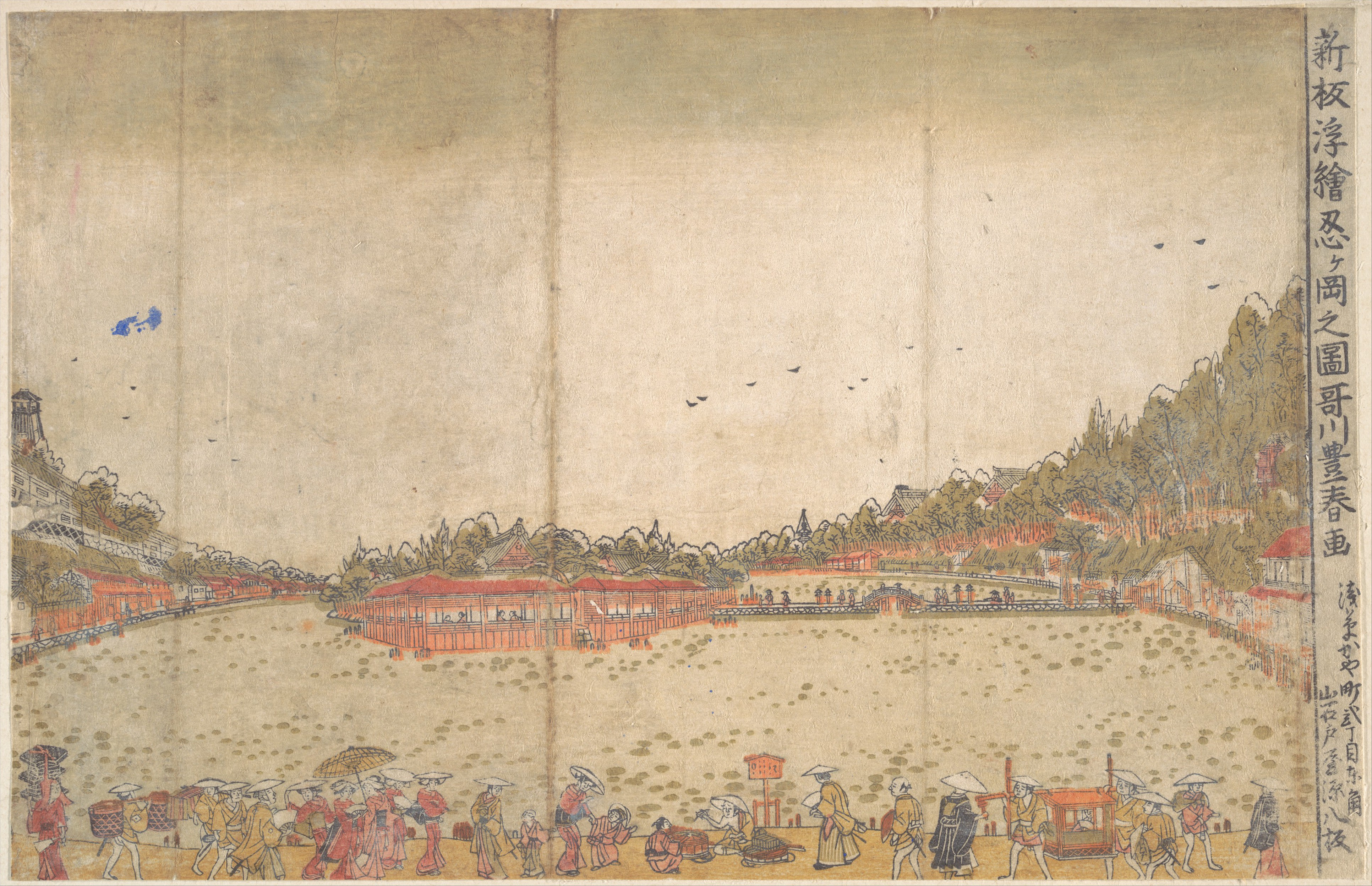
By the 1760s Toyoharu had emerged in the Edo print market under the Utagawa name, taking the studio designation that would become the most recognizable brand in nineteenth-century ukiyo-e. The Edo ukiyo-e world he entered was in transition. The full-color nishiki-e print had just been perfected by Suzuki Harunobu and his collaborators in 1765, and the appetite of urban customers for new visual experiences was sharper than at any time since the form's beginnings. Toyoharu seized on one of the most novel of those experiences: linear perspective. Japanese artists had been experimenting since the early eighteenth century with megane-e, or 'spectacle pictures,' meant to be viewed through optical devices that produced a heightened sense of depth, and with the related uki-e tradition pioneered by earlier artists such as Okumura Masanobu. Toyoharu pushed this experiment further than anyone before him.
His uki-e prints set Edo's kabuki theatres, Yoshiwara reception rooms, famous scenic spots, the crowded river-opening festivals at Ryogoku Bridge, and even imagined foreign cities into convincing recessions of orthogonals and vanishing points, all organised by a perspective grid that was unusual in Japanese painting up to that moment. He issued series of such perspective prints, among them sheets labelled 'Newly Published Perspective Pictures' (shinpan uki-e), and openly advertised the Dutch and European source of his method to a fashion-conscious public. Most strikingly, he adapted imported European copperplate engravings directly into ukiyo-e: surviving prints by Toyoharu include a view of the Roman Forum, reworked from Western engravings that had reached Edo through the Dutch trade. These pictures sit at the cosmopolitan edge of the Edo print, and they are some of the earliest direct visual quotations from European art to be marketed openly to Japanese audiences.
Toyoharu was not only a perspective specialist. He designed bijin-ga of courtesans and Yoshiwara beauties, kabuki-related subjects, and pillar prints (hashira-e) of paired figures, working across the range of ukiyo-e genres current in his day. From around the 1780s he increasingly turned away from prints toward painting, producing fine hand-painted hanging scrolls and screens, and it is partly because of this turn that his print oeuvre is smaller than that of many contemporaries. By the end of the eighteenth century he had become a senior figure in the Edo art world, respected enough to head the team of painters entrusted with the 1796 restoration of the mausoleum paintings at Nikko, the Tokugawa shrine complex.
The lasting consequence of Toyoharu's career, however, was the school he founded. Two of his pupils in particular shaped what came next. Utagawa Toyokuni I (1769-1825) inherited the Utagawa name in print design and became the leading designer of kabuki actor prints (yakusha-e) of the late eighteenth and early nineteenth centuries, training in turn the next wave of major artists including Kunisada and Kuniyoshi. Utagawa Toyohiro (1773-1828) developed the school's quieter, more lyrical landscape and bijin-ga line, and was the teacher of Utagawa Hiroshige, whose tokaido and meisho landscapes redefined the genre. Through these two branches the Utagawa school produced more designers, prints, and named pupils than any other ukiyo-e workshop in history.
Toyoharu died in 1814, in the same decade that his pupils' pupils were emerging at the centre of the Edo print market. By then, the perspective experiments he had championed in the 1760s and 1770s had been thoroughly absorbed into the visual habits of Japanese print designers. The dramatic deep space in Hokusai's and Hiroshige's landscapes of the 1830s, the architectural recessions in Kunisada's theatre scenes, and the elaborate interiors of late-Edo illustrated books all rest in part on Toyoharu's earlier insistence that European perspective could be made to feel like an Edo idiom rather than an exotic import. As founder of the Utagawa school and as the bridge between Edo ukiyo-e and the imported European conventions that would shape its modern manner, Toyoharu remains one of the pivotal figures of eighteenth-century Japanese woodblock printing.
Key Facts
- Active Period
- 1735–1814
- Nationality
- 🇯🇵Japan
- Movement
- Ukiyo-e
- Subjects
- FishSpringMount Fuji
- Works Indexed
- 22
Frequently Asked Questions
Utagawa Toyoharu (c. 1735-1814) was the founder of the Utagawa school, the dynasty of Edo ukiyo-e designers that would come to dominate Japanese woodblock prints throughout the nineteenth century. While his own surviving output is modest compared with that of his pupils, his historical importance is enormous: he gave Japan its single largest and longest-lasting print lineage, and he is the artist most responsible for translating European perspective into a fluent Edo idiom through the genre known as uki-e, or 'floating pictures.'
Utagawa Toyoharu was active from 1735 to 1814. They were associated with the Ukiyo-e movement.
Utagawa Toyoharu's work was shaped by the Ukiyo-e tradition in Japanese woodblock printmaking. Ukiyo-e: ## What is ukiyo-e? Ukiyo-e ([浮世絵](/glossary/ukiyo-e)) — literally "pictures of the floating world" — is the Edo-period Japanese print and painting tradition that flourished from roughly 1660 to 1868, depicting the pleasures of urban life in Edo (modern Tokyo): courtesans, kabuki actors, sumo wrestlers, famous landscapes, and seasonal beauties.
Utagawa Toyoharu's prints frequently feature fish, spring, mount fuji.
Original prints by Utagawa Toyoharu can be found in collections including Metropolitan Museum of Art, Art Institute of Chicago, Victoria and Albert Museum, Honolulu Museum of Art.
Woodblock Prints by Utagawa Toyoharu (22)
Perspective Print: Shinobazu Pond
Woodblock print; ink and color on paper
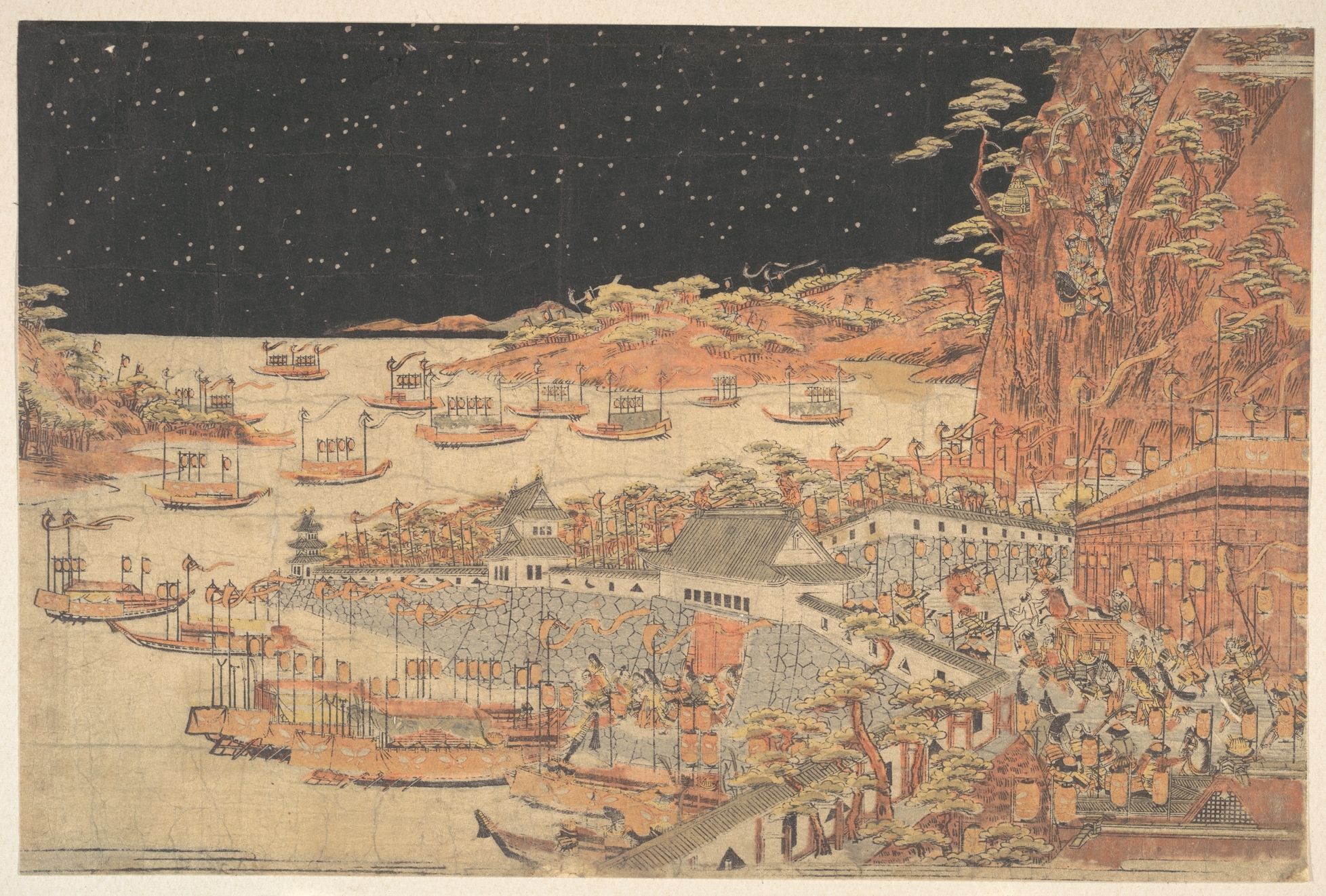
Battle of Ichi–no–tani, March 21, 1184
Woodblock print; ink and color on paper

A Beauty Looking Down upon a Young Man Reading a Love Letter
ca. 1771
Woodblock print (pillar print); ink and color on paper

Fishing (Senadori no zu), from the series "Dutch Perspective Pictures (Oranda uki-e)"
c. 1768
Color woodblock print; oban

Jo and Uba Greeting the Rising Sun
c. 1770/81
Color woodblock print, chuban

Views of Reception Rooms in Japan - Entertainments on the Day of the Rat in the Modern Style (Uki-e wakoku keiseki ozashiki imayo ne no hi no asobi no zu)
c. 1771/76
Color woodblock print; oban

Newly Published Perspective Picture of Mount Fuji in Spring from Tagonoura (Shinpan uki-e Tagonoura haru no Fuji)
c. 1772/89
Color woodblock print; oban

Newly Published Perspective Picture of the Gate of the Palace of the Dragon King (Shinpan uki-e Ryugu karamon no zu)
c. 1772/89
Color woodblock print; oban

Painting (Ga), from an untitled series of the four accomplishments
c. 1772/75
Color woodblock print; o-oban

Shōki, the Demon Queller
1770
Woodblock print (sumizuri-e), ink on paper

Young Man and Woman with a Kite
c. 1770s
Color woodblock print; hashira-e
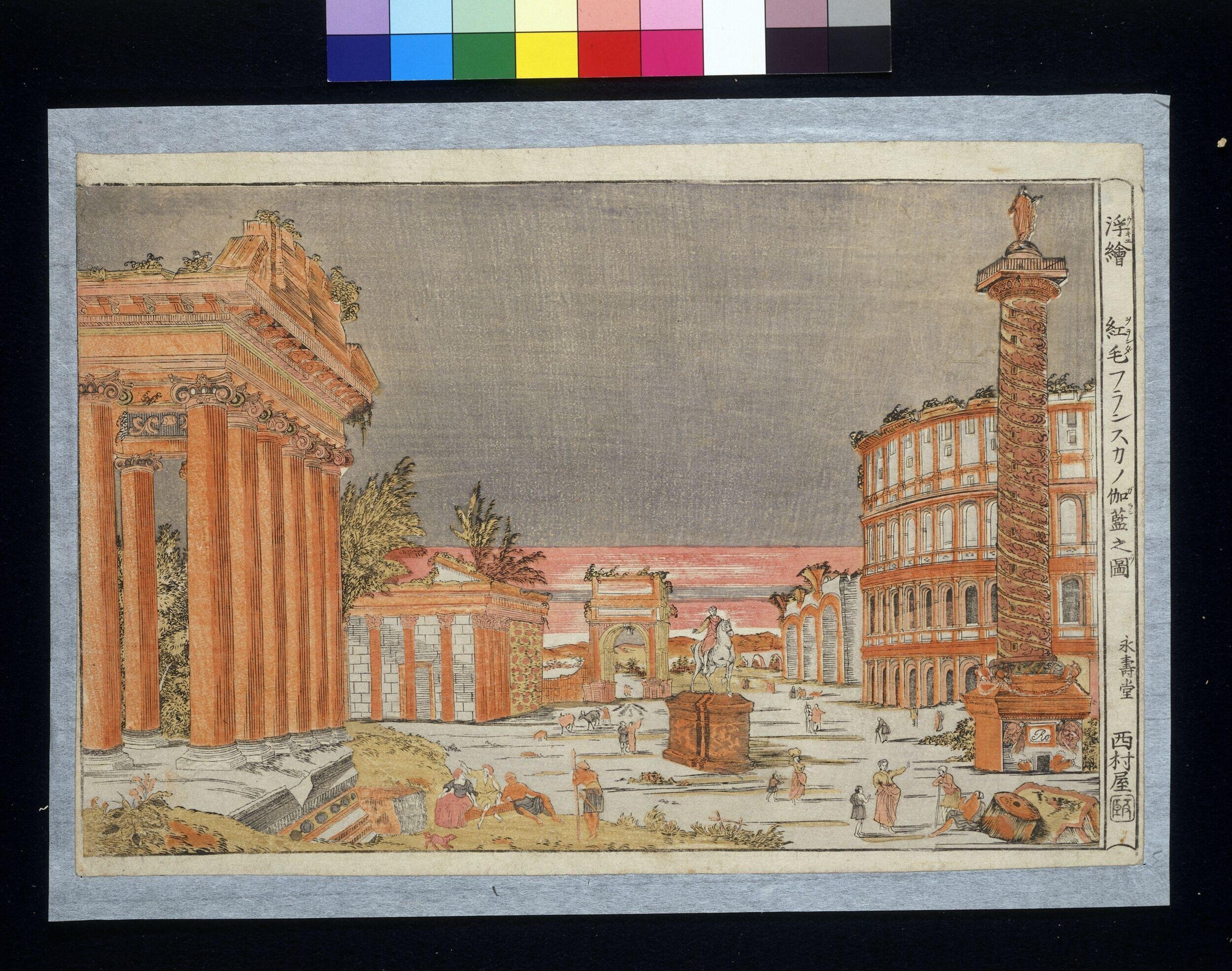
View of the Forum in Rome
1770-1790
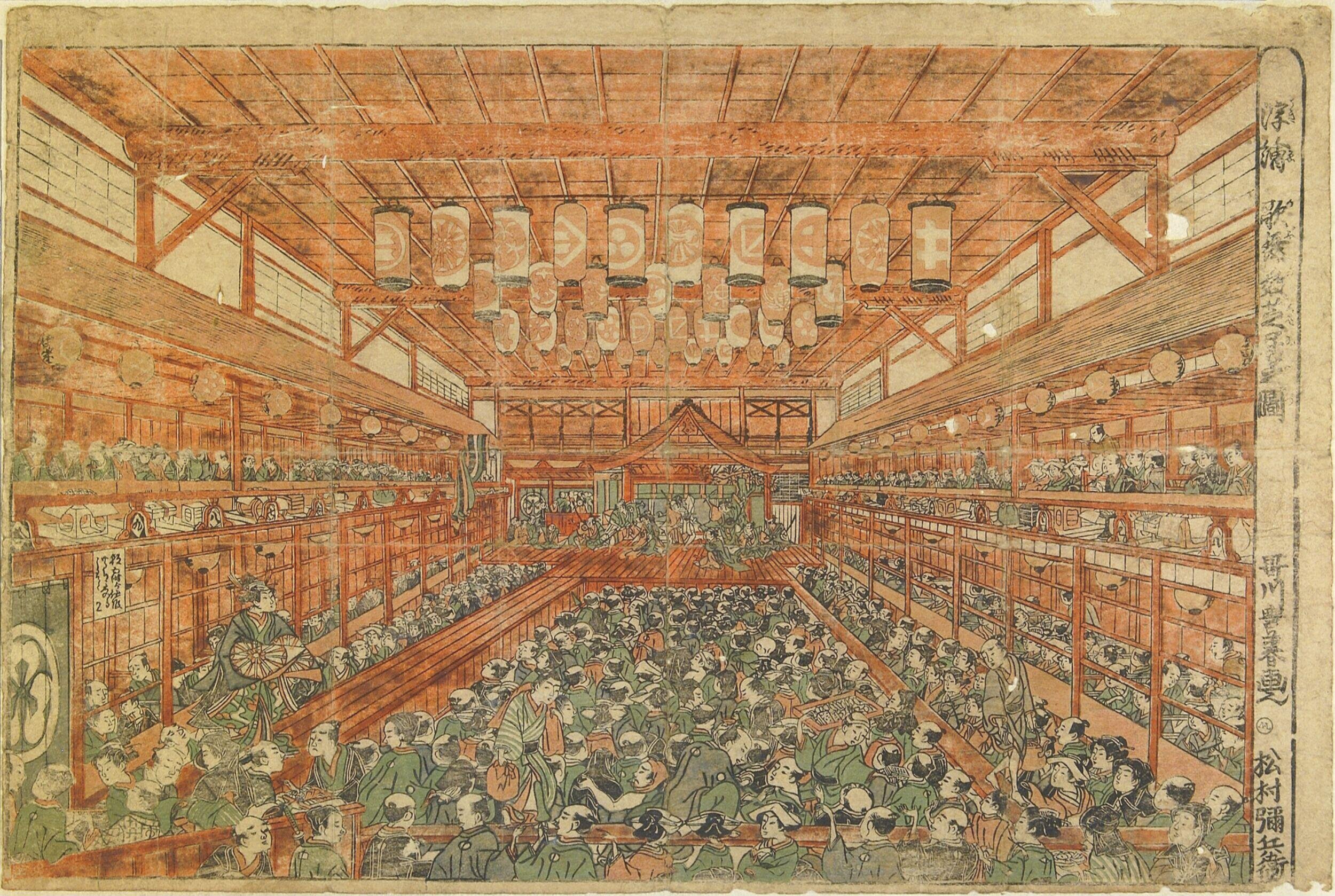
Interior View of a Kabuki Theatre in Edo
early 1770s

Six Famous Views
1770s
Color woodblock print

Perspective Picture of a Kabuki Theater (Uki-e Kabuki shibai no zu)
c. 1776
Color woodblock print; oban
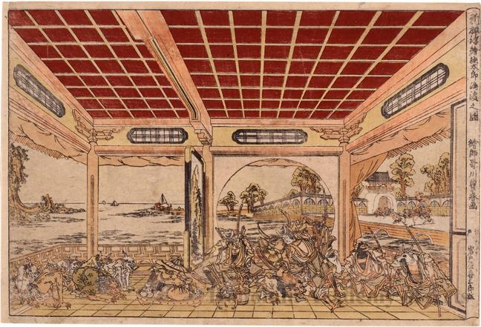
Momotarō at the Ōu Ferry Crossing
1770s
Color woodblock print; oban

Battle Scene at Yashima-Dannoura
c. 1780
Color woodblock print; oban
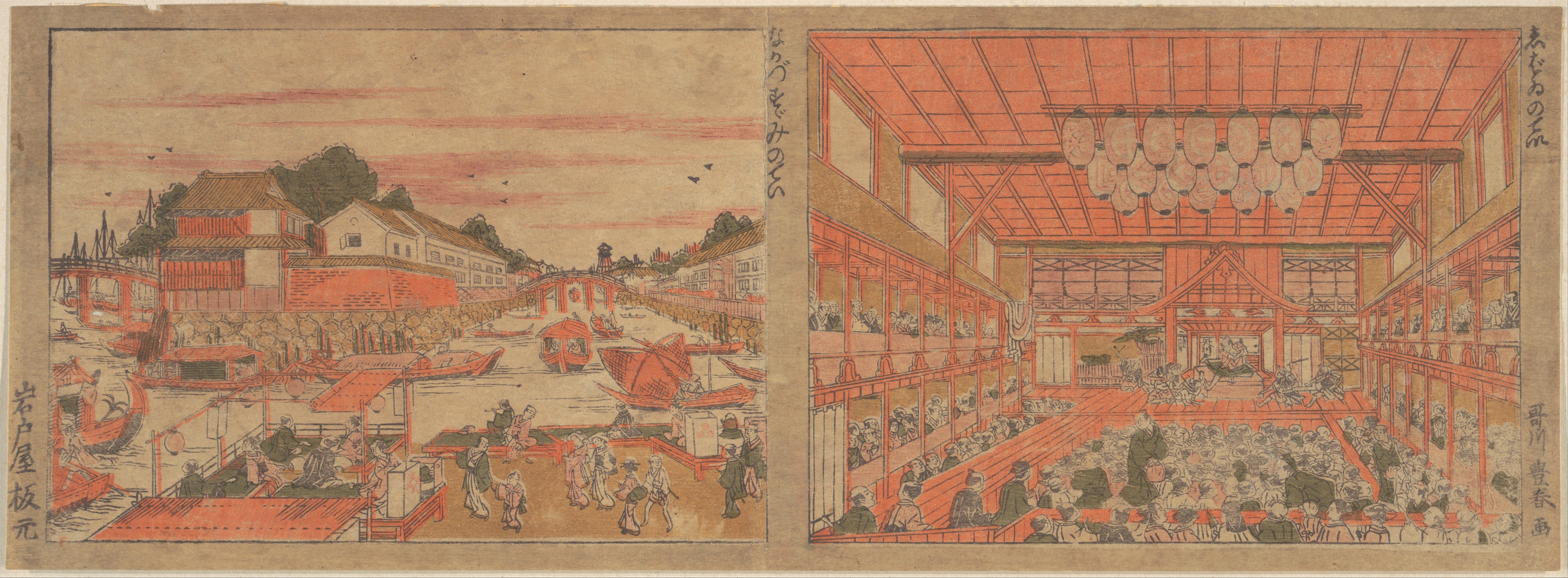
Cooling at Nakazu / Kabuki Theater
ca. 1780
Woodblock print; ink and color on paper
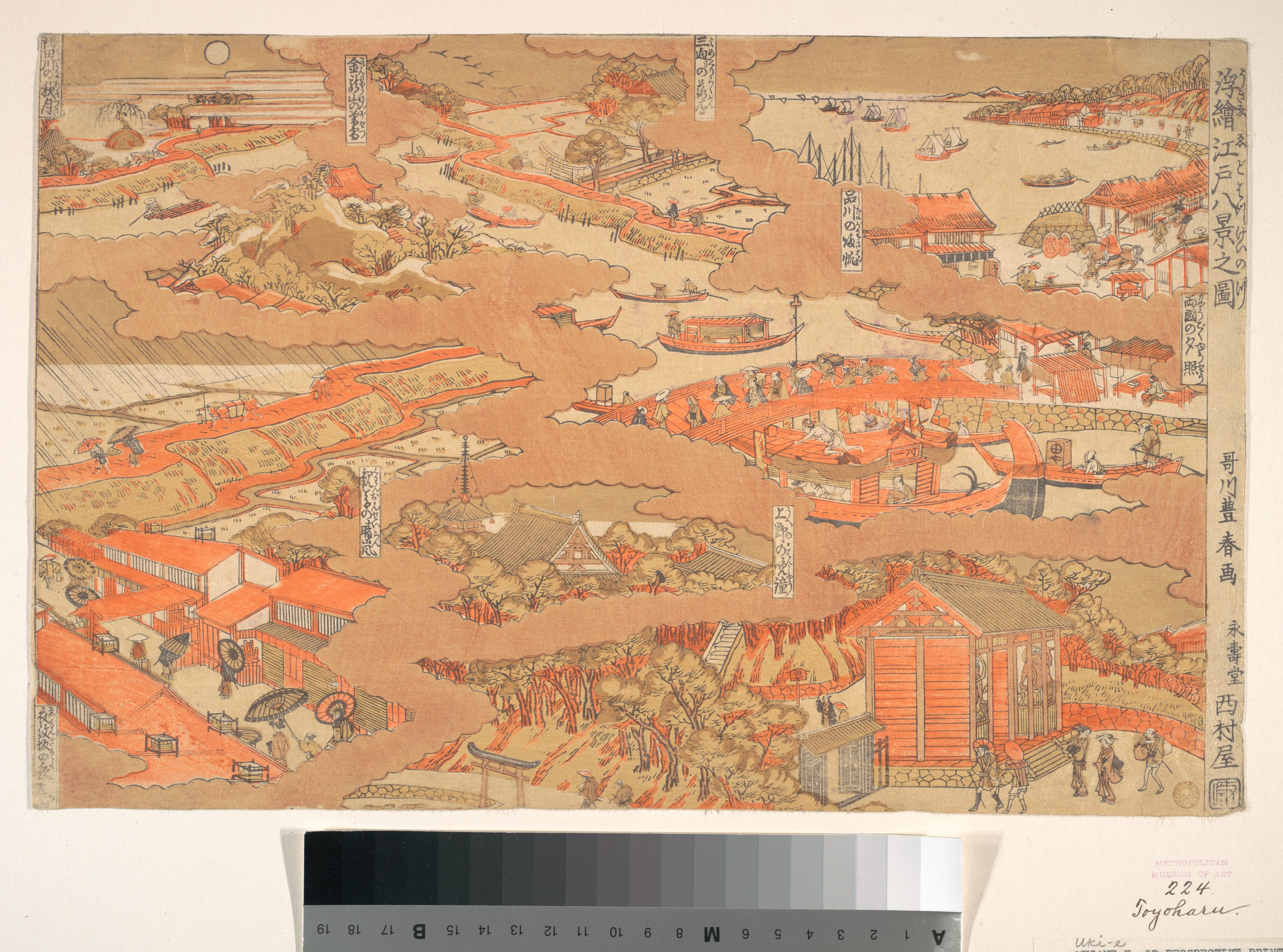
Edo Hakkei no Zu
江戸八景図
ca. 1780
Woodblock print; ink and color on paper
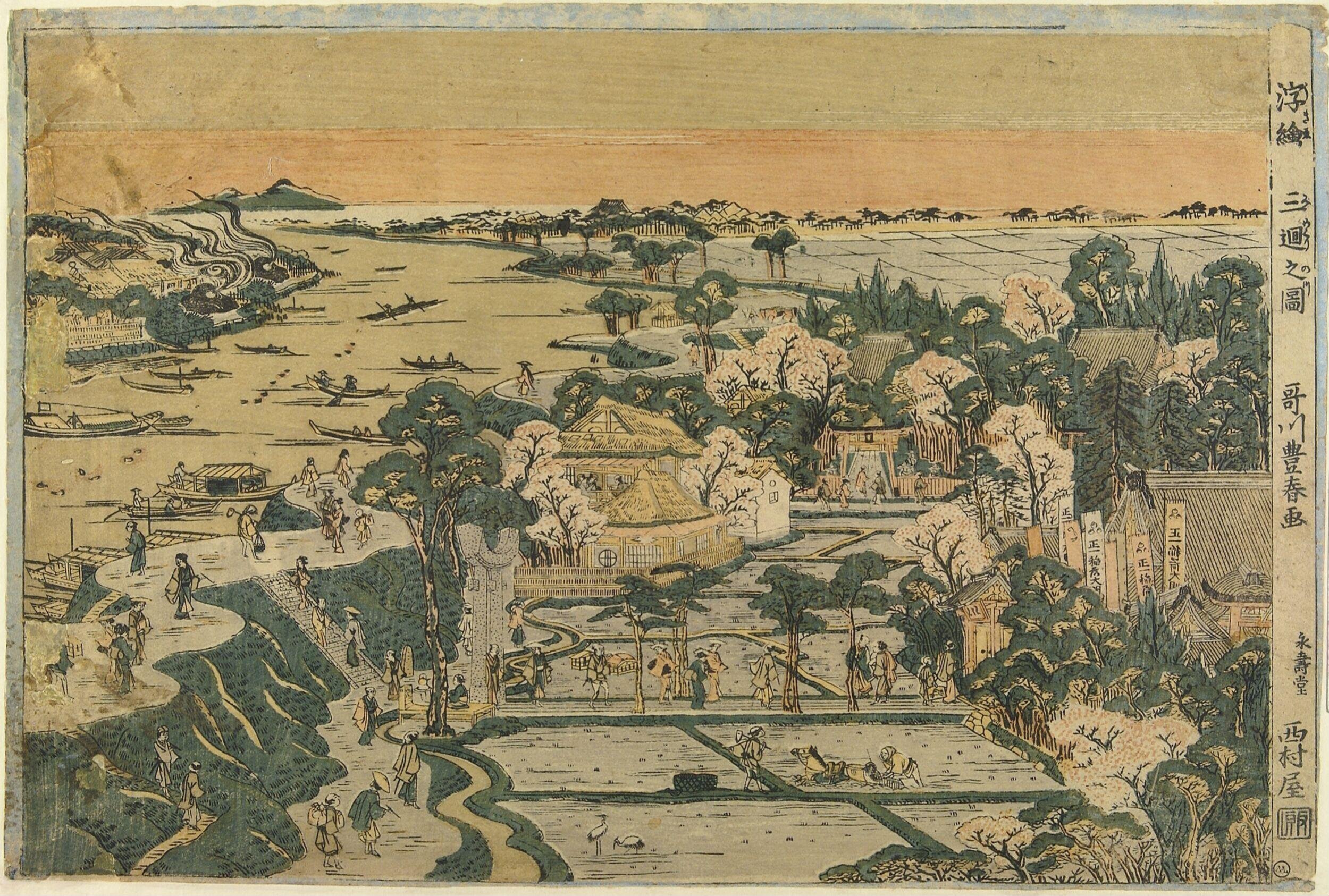
Picture of Mimeguri (Mimeguri no zu)
ca. 1780
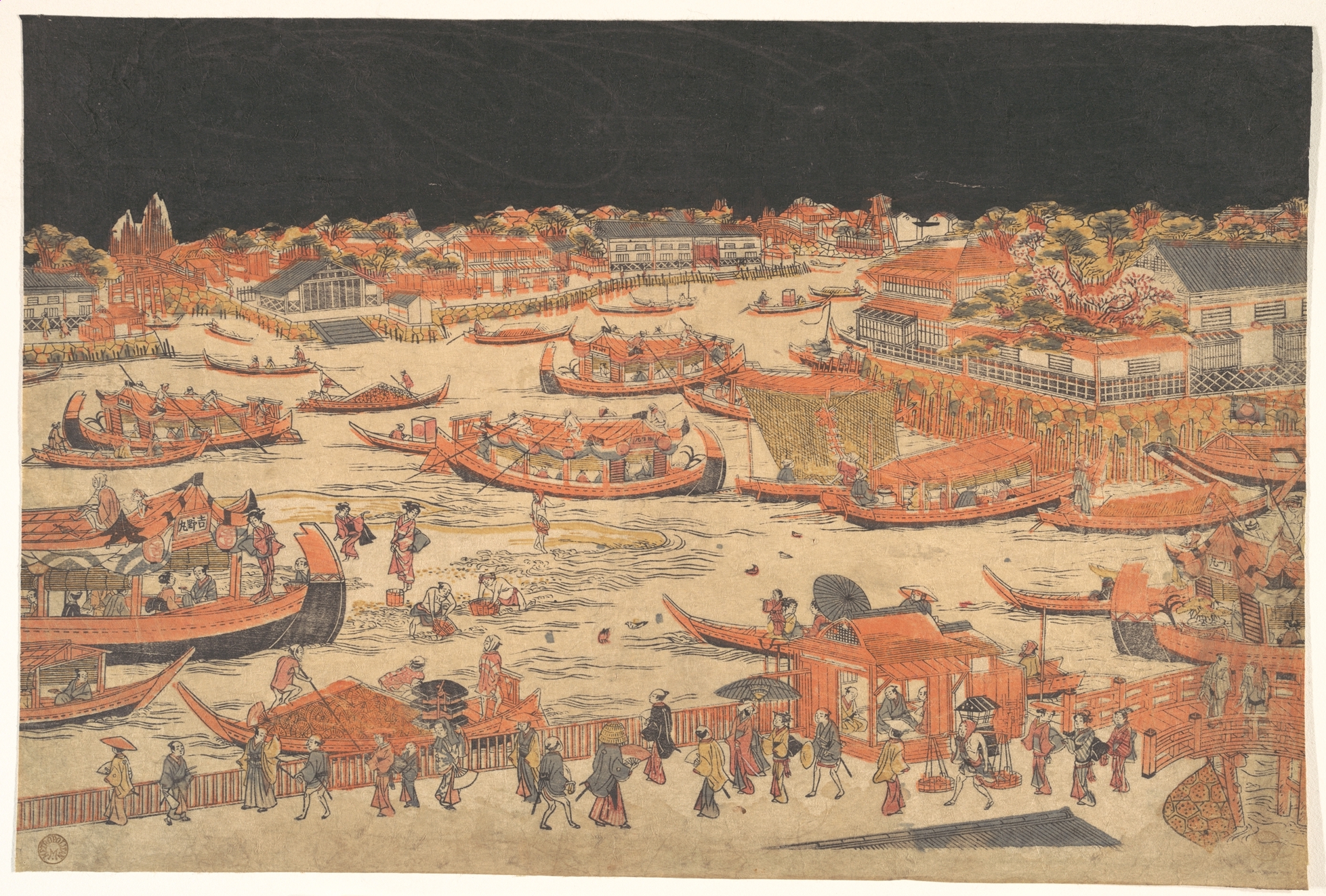
Kawabiraki
ca. 1805
Woodblock print; ink and color on paper