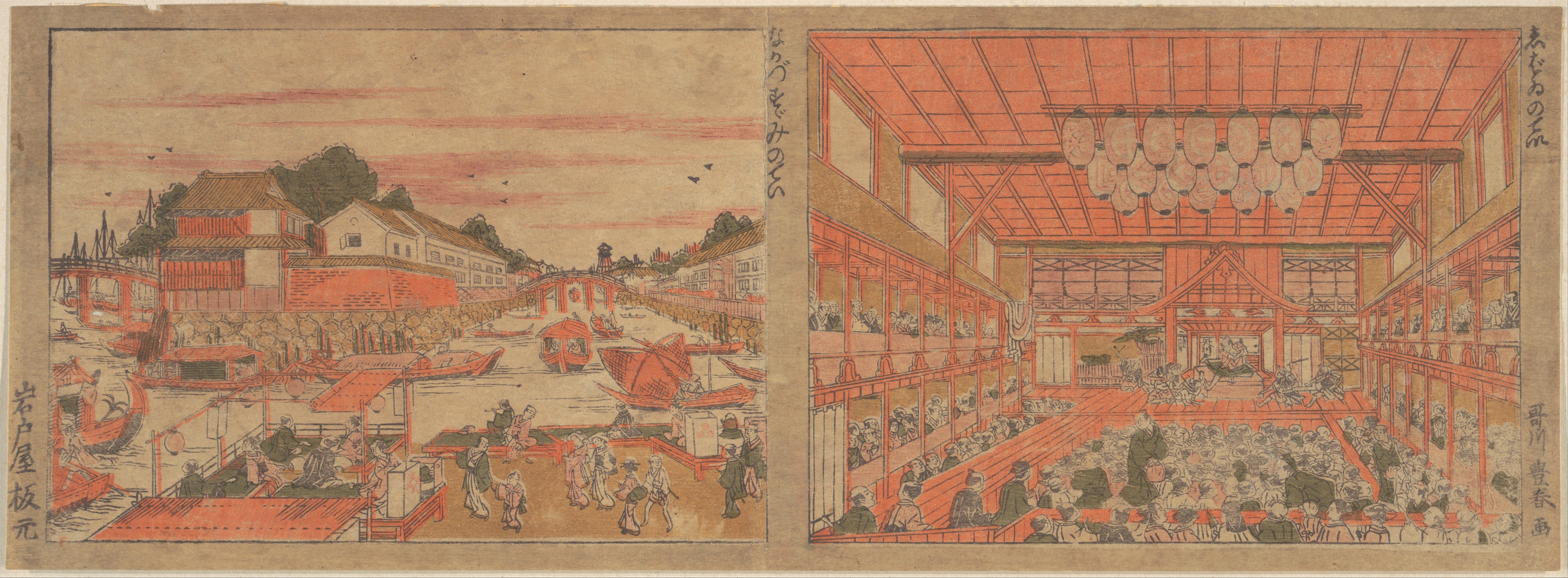
Cooling at Nakazu / Kabuki Theater
- Date:
- ca. 1780
- Medium:
- Woodblock print; ink and color on paper
- Source:
- Metropolitan Museum of Art
Description
Cooling at Nakazu / Kabuki Theater, dated to around 1780, applies Utagawa Toyoharu's uki-e or perspective-picture mode to one of the more transitory pleasure districts of An'ei-era Edo. Nakazu, an artificial island created in 1771 at the mouth of the Hakozaki River near the Shin-Ōhashi bridge, briefly flourished as a fashionable summer resort lined with restaurants, teahouses, and entertainment establishments before official order shut down the district in 1789. Toyoharu organizes his scene as a deep architectural interior, the framing posts, beams, and floor matting drawn in receding diagonal lines that converge toward a notional vanishing point in the distance and establish a fully perspectival space rarely seen in ukiyo-e before his generation. Within that constructed depth he arranges patrons cooling themselves in the summer evening, with theatrical performance signaled by the title's reference to the kabuki venue that operated within or alongside the resort. The composition demonstrates Toyoharu's defining contribution to ukiyo-e: the adaptation of Western linear-perspective convention, which he had absorbed from imported Chinese reproductions of European engravings and from Dutch optical views distributed through Nagasaki, into a Japanese print idiom capable of carrying contemporary urban subjects. As founder of the Utagawa school, the lineage that would dominate nineteenth-century ukiyo-e through Toyokuni, Hiroshige, Kunisada, and Kuniyoshi, he made uki-e a recognized print category, and these interior views of Edo's pleasure architecture stand among the most fully realized examples of his project. Color is restrained, the architectural geometry doing much of the structural work, and small figural accents are distributed through the deep space to activate the perspectival recession. The Metropolitan Museum of Art preserves this impression (https://www.metmuseum.org/art/collection/search/55768) as a witness both to Toyoharu's mature uki-e mode and to the ephemeral Edo pleasure district that briefly anchored the city's summer entertainment economy.
More Prints by Utagawa Toyoharu

Frequently Asked Questions
Cooling at Nakazu / Kabuki Theater was created by Utagawa Toyoharu (歌川豊春) in ca. 1780.