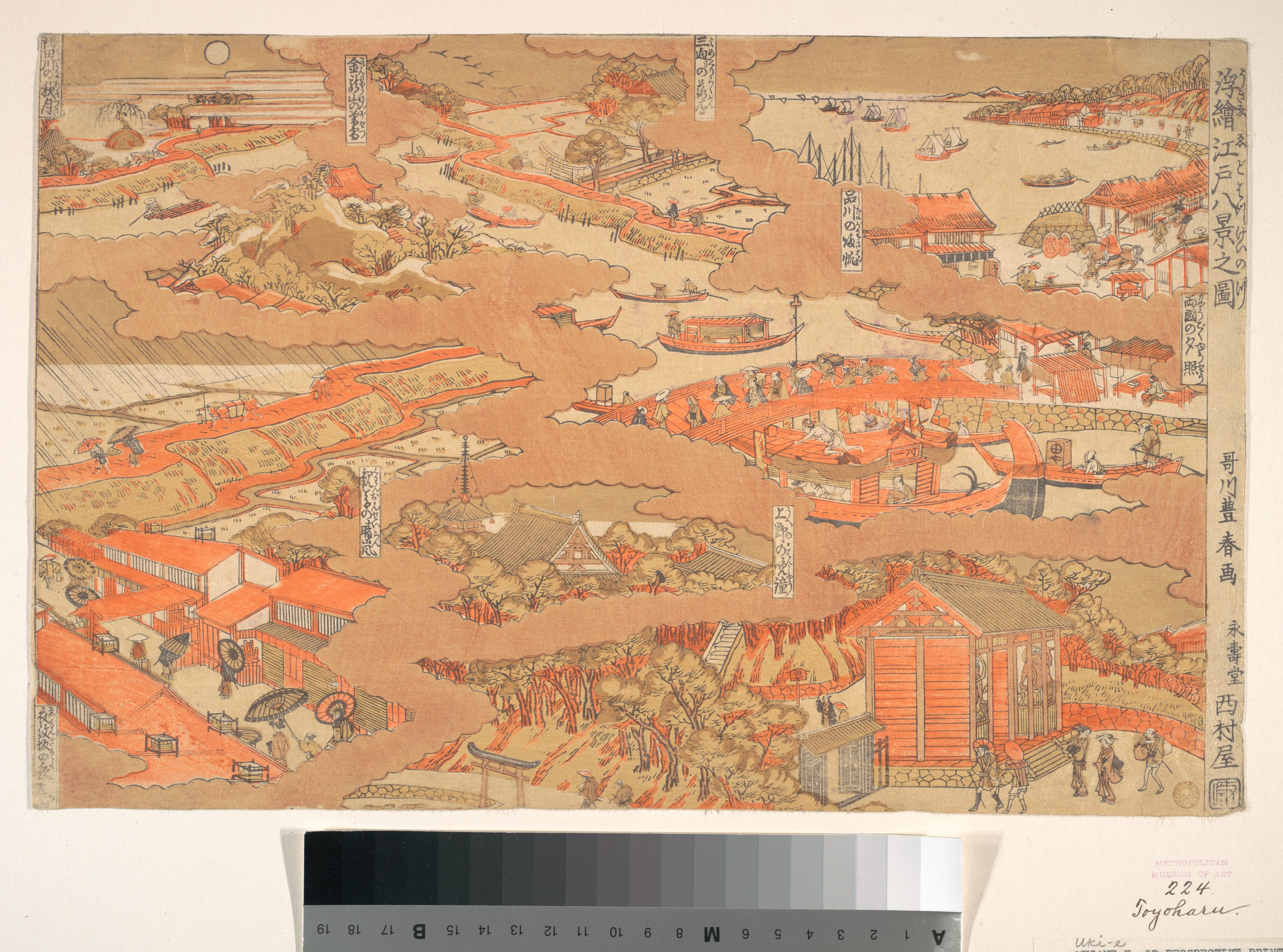
Edo Hakkei no Zu
江戸八景図
- Date:
- ca. 1780
- Medium:
- Woodblock print; ink and color on paper
- Source:
- Metropolitan Museum of Art
Description
Edo Hakkei no Zu, dated to around 1780, applies Utagawa Toyoharu's uki-e or perspective-picture mode to the literary tradition of the Eight Views, a Chinese landscape cycle that ukiyo-e adapted to celebrated sites in and around the shogunal capital. The original Eight Views of Xiao and Xiang, a touchstone of East Asian landscape culture, had been domesticated into Japanese variants for centuries, but Toyoharu's contribution recasts the Edo set in the linear-perspective vocabulary he had absorbed from Chinese reproductions of European engravings and from the optical views distributed through the Dutch trade at Nagasaki. The composition organizes its scene around converging orthogonals and a low horizon, with built forms, bridges, or topographical features drawn in receding diagonals that pull the eye toward a notional vanishing point. Figures of strollers, boatmen, and travelers populate the middle ground, their diminishing scale registering the perspectival recession in a way that the older asymmetric isometric mode of ukiyo-e could not match. As founder of the Utagawa school, Toyoharu was the artist most responsible for popularizing perspective in Japanese prints, and his Edo Hakkei series transposed an inherited literary subject into the new spatial idiom, demonstrating that uki-e could carry meditative landscape themes as readily as documentary street views and kabuki interiors. Color is held to a soft mineral palette so that the print's geometry and figural distribution carry the primary visual work. The series belongs to the moment when Toyoharu was extending his perspective project from urban architecture to scenic landscape, anticipating the meisho-e tradition that his school's successors, above all Hiroshige half a century later, would carry to its highest expression. The Metropolitan Museum of Art preserves this impression (https://www.metmuseum.org/art/collection/search/36698) as a representative document of how Toyoharu's uki-e treatment naturalized Western spatial convention into a Japanese literary-landscape framework.
More Prints by Utagawa Toyoharu

Frequently Asked Questions
Edo Hakkei no Zu (江戸八景図) was created by Utagawa Toyoharu (歌川豊春) in ca. 1780.