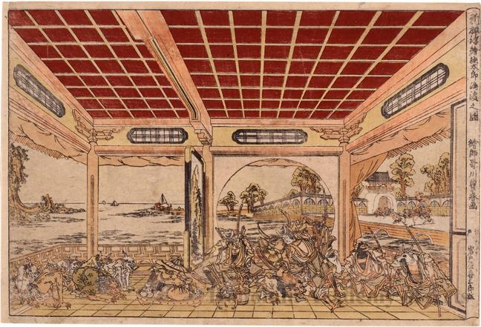
Momotarō at the Ōu Ferry Crossing
- Date:
- 1770s
- Medium:
- Color woodblock print; oban
- Source:
- Honolulu Museum of Art
Description
Momotarō at the Ōu Ferry Crossing, dated to around 1775, draws Utagawa Toyoharu into the folktale and legendary subject matter that ukiyo-e treated alongside its urban and theatrical genres. The story of Momotarō, the Peach Boy born from a giant peach to a childless elderly couple and reared to lead a campaign against the demons of Onigashima with the dog, monkey, and pheasant who joined him on the journey, was among the most enduring folktales of premodern Japan, transmitted orally and through printed picture books from the Edo period onward. The Ōu region in northeastern Honshū provided a wild legendary setting suitable for the hero's adventures, and Toyoharu's print stages the Peach Boy at a ferry crossing of the kind that organized travel through the Edo period road system. The composition draws on the artist's emerging uki-e or perspective-picture project, with the receding lines of riverbank, ferry, and shoreline establishing the spatial depth that he had absorbed from Chinese reproductions of European engravings and from the Dutch optical views distributed through Nagasaki. As founder of the Utagawa school, the lineage that would dominate nineteenth-century ukiyo-e, Toyoharu produced this sheet during the formative An'ei period when he was extending his perspective project across a wide range of subjects from urban architecture to folk narrative. Color is held to a restrained register, with figural and topographical detail carrying the principal visual interest. The Honolulu Museum of Art preserves this impression (http://www.honolulumuseum.org) as a representative document of Toyoharu's engagement with folktale subjects in his perspective mode and of the breadth of subject range he commanded as founder of what would become ukiyo-e's most influential school.
More Prints by Utagawa Toyoharu

Frequently Asked Questions
Momotarō at the Ōu Ferry Crossing was created by Utagawa Toyoharu (歌川豊春) in 1770s.