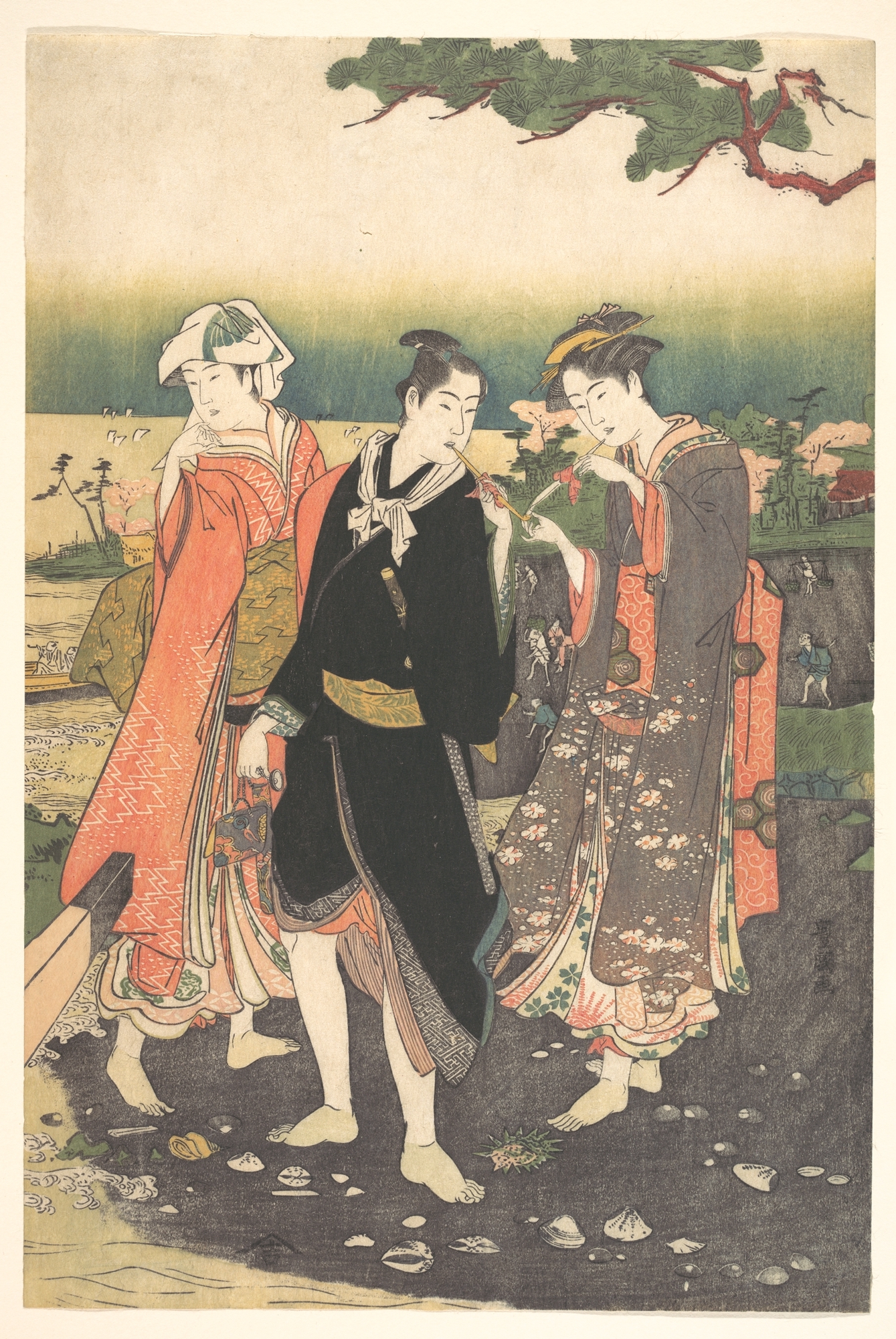
Actors Kataoka Gado II as Florist (Hanaya) Tokubei (R) and Nakamura Daikichi III as Tokubei's Wife (Tsuma) Ofusa (L)
- Date:
- 1855
- Medium:
- Color woodblock print
- Source:
- Art Institute of Chicago
Description
Actors Kataoka Gado II as Florist (Hanaya) Tokubei (R) and Nakamura Daikichi III as Tokubei's Wife (Tsuma) Ofusa (L), recorded by the Art Institute of Chicago with a date of 1786, is a classic Utagawa Toyokuni [yakusha-e](/glossary/yakusha-e) [diptych](/glossary/diptych) pairing two of the leading performers of the Edo and Kamigata stages. Tokubei and his wife Ofusa belong to the long-standing domestic drama tradition, in which ordinary working figures, here a flower seller and his spouse, become the protagonists of stories of jealousy, betrayal, and tragedy. Toyokuni's design treats the actors with the full apparatus of mature yakusha-e: identifying crests on their robes, characteristic facial expressions, and a strong sense of pose that signals the moment in the play. The right and left sheets are balanced so that the figures lean subtly toward one another while remaining anchored as independent portraits, a structure that allowed buyers to display either half alone or both sheets together. The Utagawa school's grip on actor prints rested on exactly this sort of design intelligence, and Toyokuni's work here demonstrates why his yakusha-e reshaped the Edo market. As Edo [ukiyo-e](/glossary/ukiyo-e), the print also functions as theatrical reportage, fixing a current performance in an inexpensive, widely circulated medium. The Art Institute of Chicago records the work as a Toyokuni I composition, preserving it as a document of late eighteenth-century kabuki casting and of the close working relationship between the Utagawa studio and the actors of the major Edo theatres.