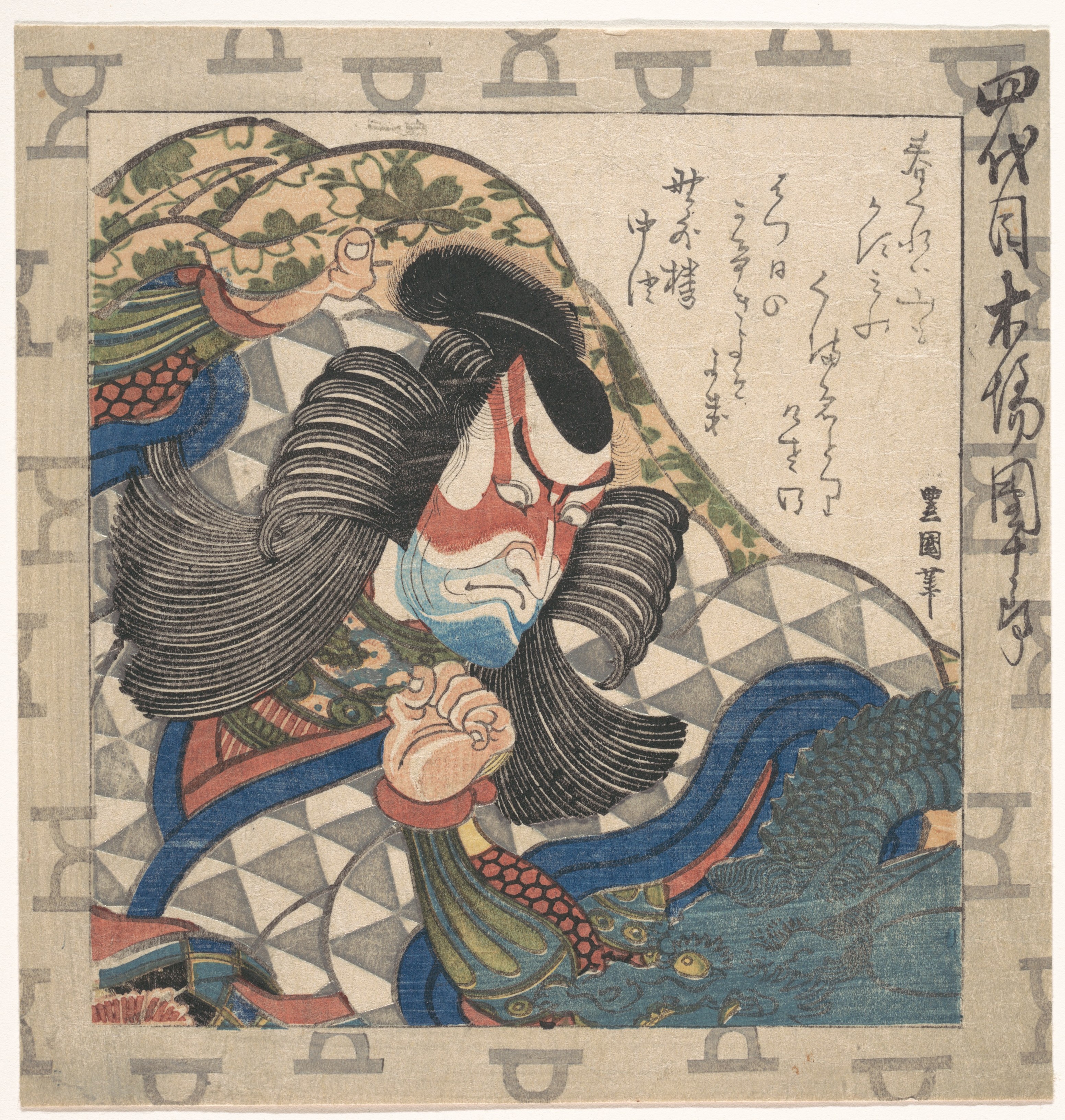
Ichikawa Danjuro IV in the Role of Kagekiyo in the Play Enlightenment from a Series of Portraits of Danjūrō
- Date:
- ca. 1834
- Medium:
- Woodblock print (surimono); ink and color on paper
- Source:
- Metropolitan Museum of Art
Description
From a memorial or commemorative series of portraits of Ichikawa Danjūrō, Utagawa Toyokuni I (1769-1825) here depicts Ichikawa Danjūrō IV (1711-1778) in the role of the warrior monk Kagekiyo, drawn from the dramatic cycle treating the Heike warrior Taira no Kagekiyo's enlightenment and self-blinding. The Ichikawa Danjūrō lineage was the dynastic core of Edo kabuki, and the Kagekiyo role—part of the canon of eighteen 'family plays' (kabuki jūhachiban) curated and codified by Danjūrō VII in the early nineteenth century—belonged to the aragoto rough-style tradition the line had originated. Posthumous and commemorative portraits of past Danjūrōs constituted a recognized subgenre of yakusha-e, allowing Edo audiences to consume the family's history as well as its current performances. Toyokuni's treatment shows Danjūrō IV in characteristic Kagekiyo costume and stance, integrating period verisimilitude (the actor had died in 1778, before Toyokuni's career began) with the visual conventions of contemporary aragoto portraiture. The Metropolitan Museum of Art's recorded date of 1824 places this print in the final year of Toyokuni's life and corresponds to the Bunsei era's intense interest in kabuki dynastic histories, encouraged by Danjūrō VII's then-recent codification of the kabuki jūhachiban. Toyokuni's late style retained the disciplined Utagawa-school draughtsmanship he had developed in the 1790s, transmitting it to his pupils Kunisada and Kuniyoshi. The impression is held in the Metropolitan Museum of Art.