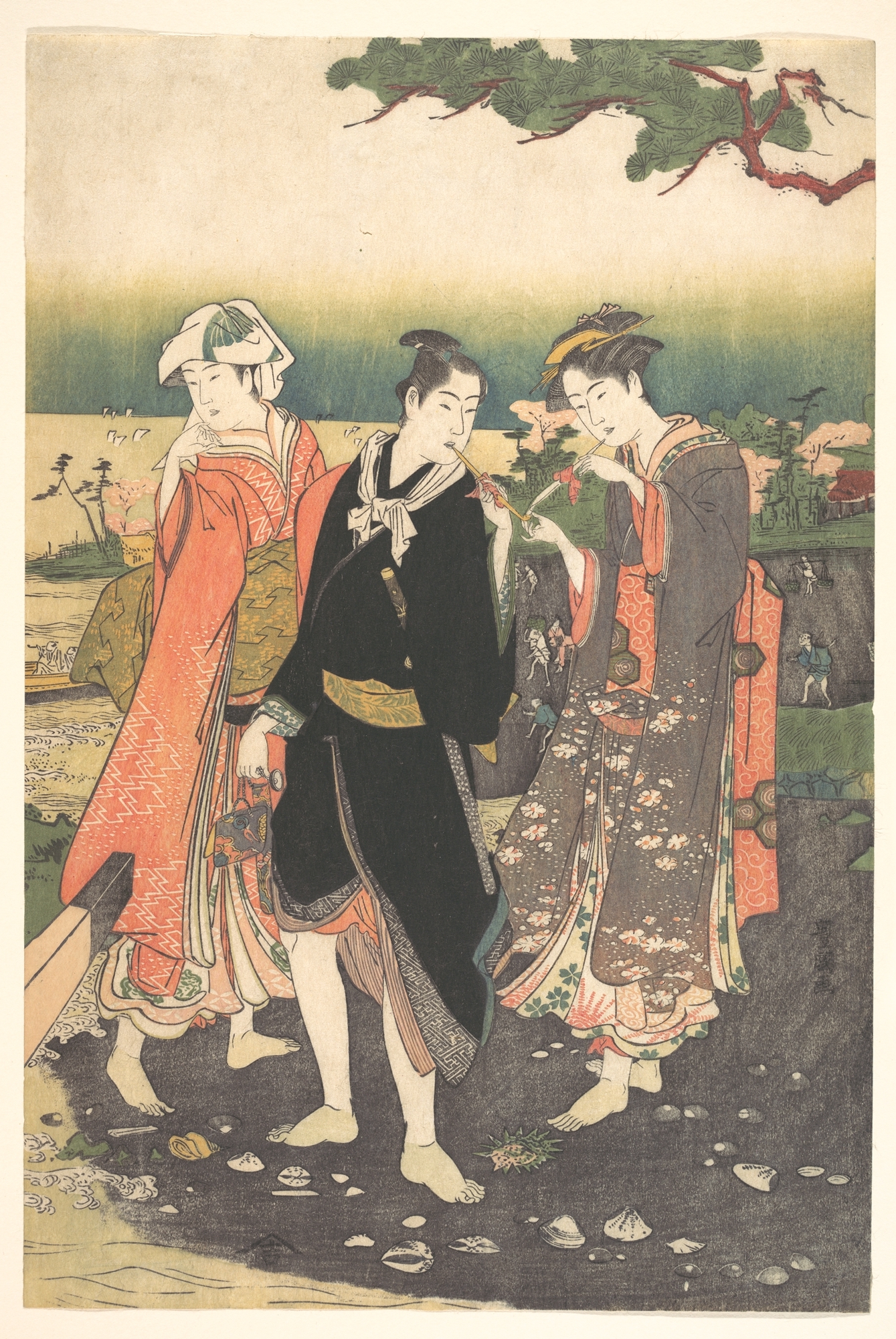
Image of a Japanese Woman (Fujo Yamato sugata)
- Date:
- c. 1830/35
- Medium:
- Color woodblock print; vertical oban diptych
- Source:
- Art Institute of Chicago
Description
This 1825 print by Utagawa Toyokuni, in the collection of the Art Institute of Chicago, presents an idealized image of a Japanese woman, identified by the inscription as Fujo Yamato sugata, or a portrait in the Yamato manner. Although Toyokuni's reputation was built primarily on Edo [ukiyo-e](/glossary/ukiyo-e) [yakusha-e](/glossary/yakusha-e), he was also a prolific designer of [bijin-ga](/glossary/bijin-ga), prints of beautiful women, and this sheet reflects that strand of his practice in its late phase. The figure is rendered in the elongated, slender proportions that came to define the 1820s ideal in Utagawa school bijin-ga, with a small face, attenuated neck, and gracefully cascading robe lines. Toyokuni handles the kimono pattern with restrained virtuosity, balancing geometric repeats against the curving sweep of the garment. The title's reference to Yamato sugata signals a deliberate appeal to indigenous aesthetic tradition, distancing the image from contemporary Chinese-influenced models and aligning it instead with a longer Japanese lineage of female portraiture. The composition isolates the figure against a relatively spare ground, giving full attention to the contour and the costume. As a piece of Edo ukiyo-e, the print would have circulated as a fashion image, a poetic emblem, and possibly a portrait keyed to a particular beauty of the day. Its presence in a major museum collection underscores how Toyokuni's late bijin-ga continued to extend the visual conventions he had helped define in his early career.