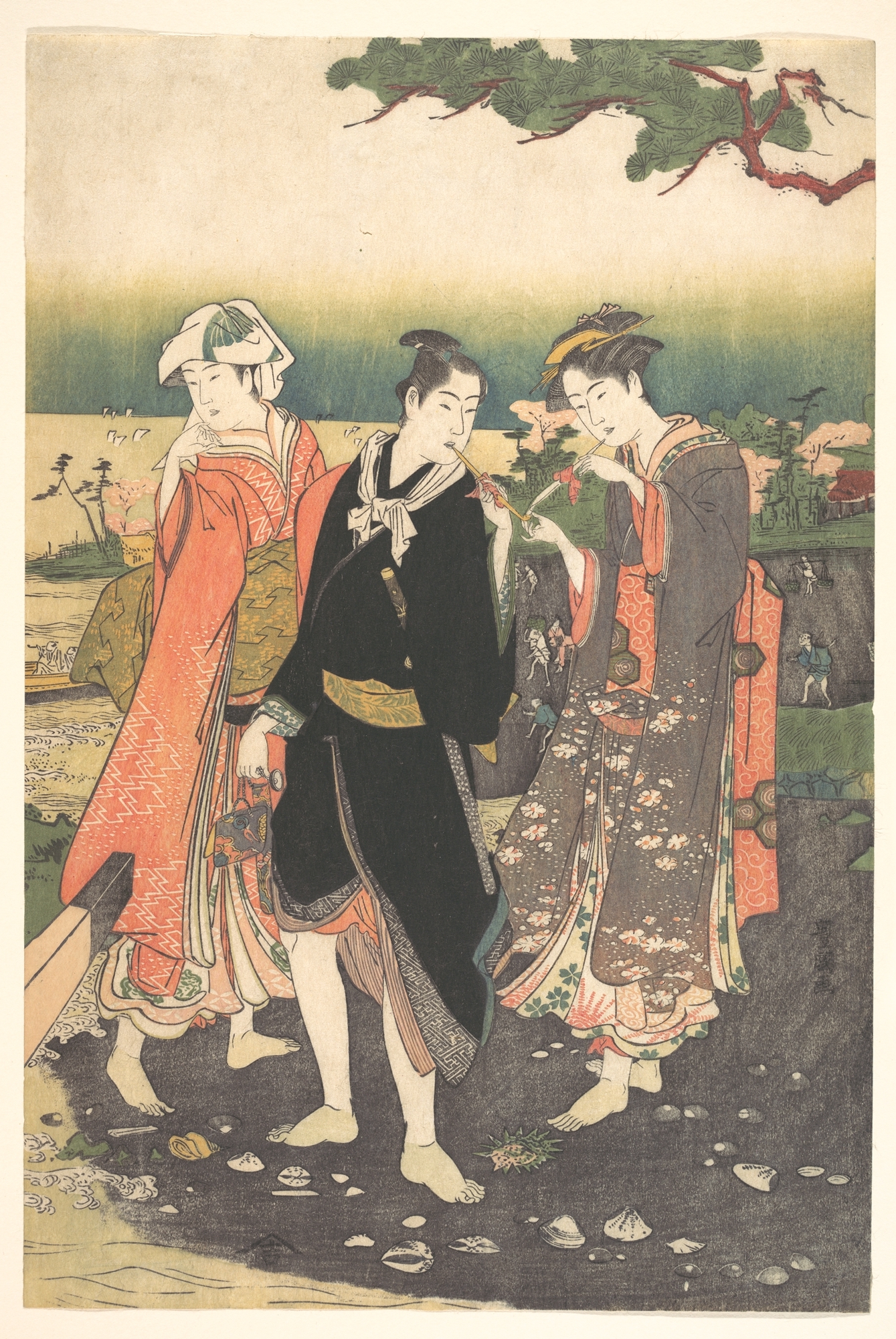
The actor Nakamura Shikan IV as Inada Kozo disguised as Yamagata Gyobunosuke
- Date:
- 1861
- Medium:
- Color woodblock print; chirimen-e
- Source:
- Art Institute of Chicago
Description
This 1861 yakusha-e woodblock print from the Utagawa Toyokuni lineage captures the kabuki star Nakamura Shikan IV in the role of Inada Kozo, who appears within the play disguised as the samurai Yamagata Gyobunosuke. The double identity is a staple of Edo ukiyo-e actor prints, and the design hinges on the tension between costume and character: the audience must read the disguise even as the actor sustains the underlying role. The figure is set against the flat patterned ground typical of late Edo yakusha-e, allowing the heavy folds of the outer kimono, the bold crest, and the carefully arranged hair to register as a portrait first and a stage moment second. Color is concentrated in saturated reds, deep indigo blues, and warm browns that were favored by Edo block-cutters and publishers working with the Utagawa school in its final decade. The face is treated in the half-realist, half-stylized manner that descends directly from Utagawa Toyokuni I, with thin black contour lines defining the brow, nose, and mouth and a pale ground left bare for the skin. The composition emphasizes the upper body, foregrounding the actor's likeness rather than narrative action, which is what theater-going Edo collectors expected from a single-sheet souvenir of a current production. Issued at a moment when kabuki publishing was tightly entwined with star culture, the sheet documents both an evening at the theater and the broader Utagawa house style at the close of the ukiyo-e era. The Art Institute of Chicago holds this impression and identifies it by actor, role, and date; their record provides the principal verifiable information about its production context.