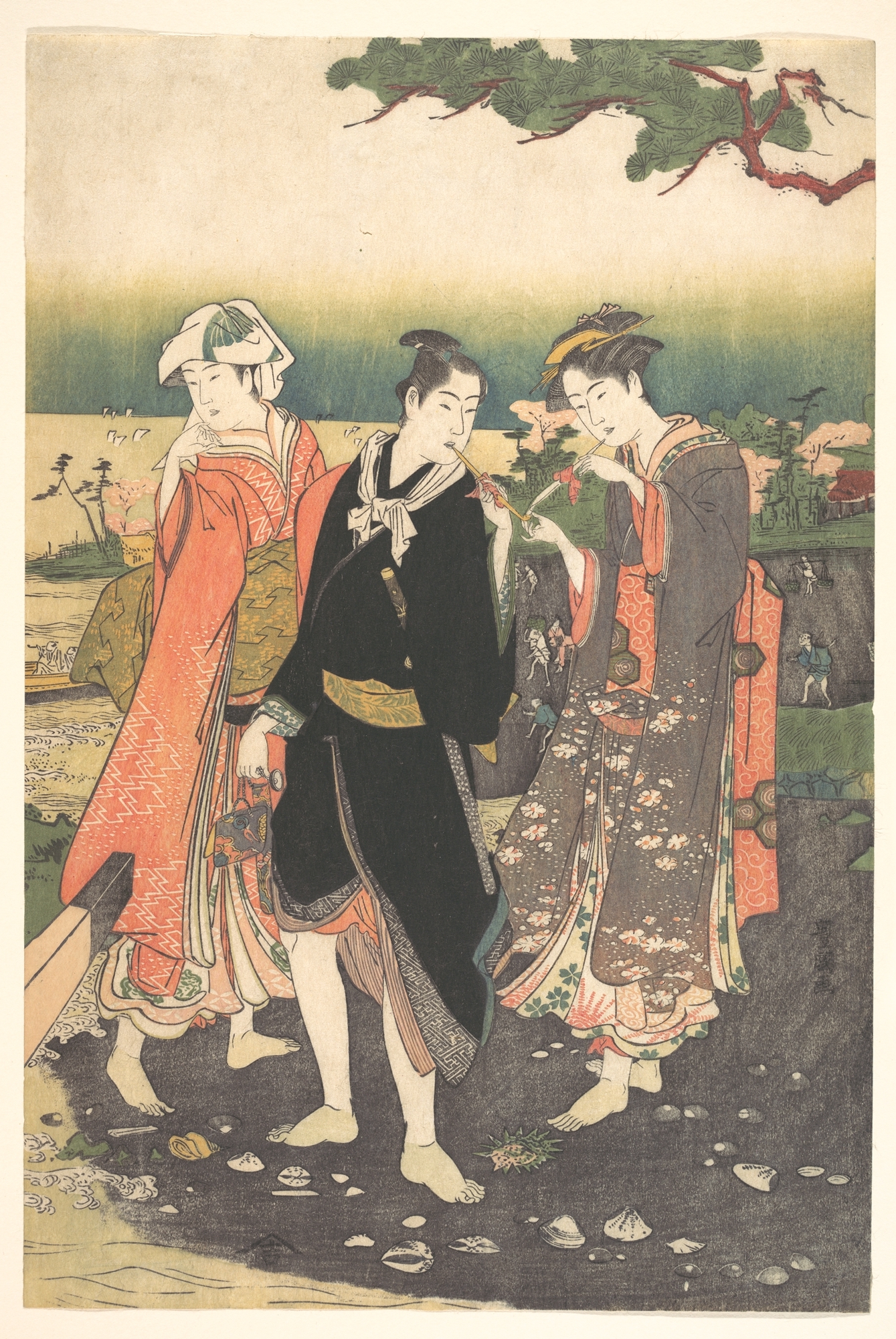
The actors Ichikawa Danjuro VII as Soga Goro and Bando Mitsugoro III as Kobayashi no Asahina
- Date:
- 1827
- Medium:
- Color woodblock print; shikishiban, surimono
- Source:
- Art Institute of Chicago
Description
Dated 1827 and in the collection of the Art Institute of Chicago, this Utagawa Toyokuni print presents Ichikawa Danjuro VII as Soga Goro alongside Bando Mitsugoro III as Kobayashi no Asahina. The Soga brothers' vendetta was one of the most enduring narratives in Japanese theater, retold annually in New Year productions and reimagined repeatedly within Edo [ukiyo-e](/glossary/ukiyo-e) [yakusha-e](/glossary/yakusha-e). Goro, the younger and fierier brother, was a signature role for the Ichikawa line and an obvious match for Danjuro VII's aragoto style, while Kobayashi no Asahina functioned as the comic and earthy foil. Toyokuni stages the two performers in vivid contrast: Danjuro VII shown with the kinetic, outward energy that defined his Goro, and Mitsugoro III given a sturdier, more grounded posture appropriate to Asahina. The two costumes are rendered with the dense pattern and saturated palette that characterized Toyokuni's late work, and the figural overlap creates a strong diagonal that activates the entire sheet. Such print pairings were both commercial and ceremonial: they advertised a specific production at the same time as they affirmed the continuing centrality of the Soga story in Edo cultural life. The work demonstrates how thoroughly Toyokuni's mature style had absorbed decades of theatrical observation and how readily he could harness it for canonical material.