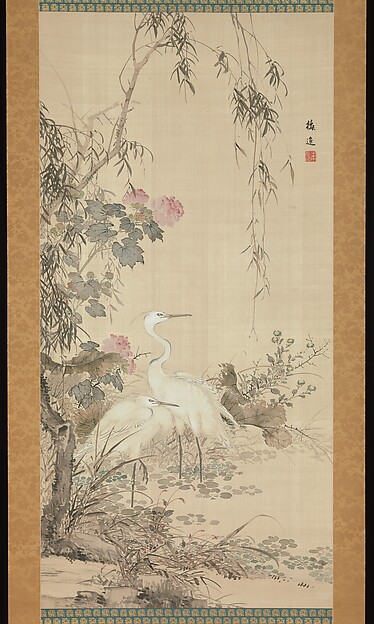
Egrets, Peonies, and Willows
白鷺牡丹柳図
- Date:
- early 19th century
- Medium:
- Hanging scroll; color on silk
- Source:
- Metropolitan Museum of Art
Description
Egrets, Peonies, and Willows is an early-nineteenth-century hanging scroll by Yamamoto Baiitsu in color on silk, held by the Metropolitan Museum of Art (accession 1975.268.109). The composition pairs two of the canonical bird-and-flower subjects of the Chinese painting tradition — egrets (or herons) wading in shallow water beneath the drooping branches of a willow, with peonies in bloom to one side — in a tall vertical format that allowed Baiitsu to deploy the long diagonal compositions favored by the Ming bird-and-flower painters whose work he had studied in Nagoya as a young man. The painting belongs to Baiitsu's earlier maturity, when he had absorbed Chinese literati models through the Kamiya Tenyū collection and the printed Mustard Seed Garden Manual and was mingling with the Kyoto literati circles of Tanomura Chikuden and Rai San'yō; the Met's curatorial entry notes that he sought varied artistic influences and transformed what he learned into an idiosyncratic style characterized by a sensuous surface quality and serene clarity. The work entered the Met as part of the Harry G. C. Packard Collection of Asian Art (1975.268), one of the foundational gifts of nanga painting to the museum, and is among the most often-reproduced examples of his bird-and-flower production.
More Prints by Yamamoto Baiitsu
Frequently Asked Questions
Egrets, Peonies, and Willows (白鷺牡丹柳図) was created by Yamamoto Baiitsu (山本梅逸) in early 19th century.