Yamamoto Baiitsu
山本梅逸
1783–1856
Japan
Biography
Yamamoto Baiitsu (山本梅逸, 1783–1856) was one of the leading nanga (literati, also called bunjinga) painters of late-Edo Japan, a celebrated specialist in bird-and-flower painting (kachō-ga) and in Chinese-inflected landscape who carried the scholar-painter tradition from his native Nagoya into the cultural metropolis of Kyoto and gave it, in his maturity, a sensuous and technically refined character distinct from the more rigorously textual nanga of his Edo-period predecessors. He is generally considered, together with his close friend Nakabayashi Chikutō (1776–1853), a dominant figure of the so-called Owari nanga school centered on Nagoya, and one of the nineteenth-century Japanese literati painters whose work entered Western museum collections in significant numbers from the early twentieth century onward.
Baiitsu was born in Nagoya in the third year of Tenmei (1783), the son of Yamamoto Yumigiemon, a sculptor in the service of the Tokugawa lords of the Owari Domain. The family's craft background gave him an early grounding in brushwork and technique, but his ambitions ran toward painting rather than sculpture: he studied first with the Nagoya painter Yamamoto Rantei and then, on Rantei's recommendation, with Chō Gesshō, while absorbing what Chinese painting and printed model books were available to a provincial student. The decisive event of his youth was his entry, together with Chikutō, into the circle of the Owari merchant, patron, and antiquarian collector Kamiya Ten'yū, who owned a fine private collection of Chinese paintings and coached the two young men until his death in 1802. Working from Ten'yū's holdings of Ming and early Qing scrolls — and from the printed model books such as the Mustard Seed Garden Manual (Jieziyuan huazhuan) that circulated through Edo-period Japan — Baiitsu and Chikutō were able, in effect, to teach themselves the Chinese literati tradition at a depth that no other Owari painter had access to.
After Ten'yū's death the two, by now inseparable, travelled together to Kyoto around 1802, and it was there that Baiitsu would spend much of his career. The Kyoto art world at the turn of the nineteenth century was dominated by the Maruyama-Shijō naturalistic school of Maruyama Ōkyo and Matsumura Goshun, by the pupils of the elderly Ike no Taiga, and by the rising generation of nanga painters — Uragami Gyokudō, Aoki Mokubei, Tanomura Chikuden — who were collectively defining the second great phase of Japanese literati painting. Working in this milieu, Baiitsu moved among the scholar-painters and intellectuals of the Kyoto literati world, including Chikuden and the Confucian historian and poet Rai San'yō, who gathered in the salons of wealthy merchants and at the temples of the eastern hills. His paintings from this period absorb the linear precision and dry brushwork of the older bunjinga tradition while gradually moving toward the rich color, careful composition, and sensuous surface treatment that would define his mature manner.
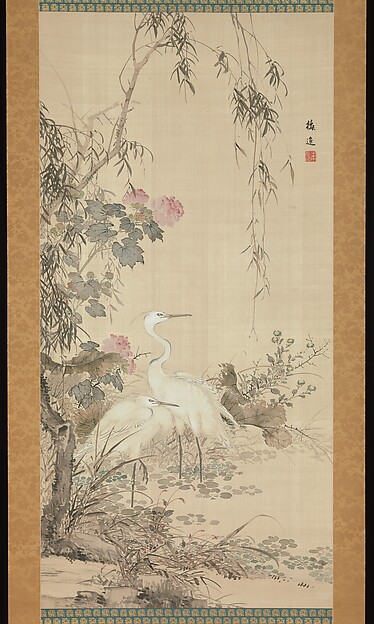
Baiitsu's reputation rested above all on bird-and-flower painting in the Chinese manner: peonies and magnolias, plum blossoms and bamboo, lotus pools with white egrets, hibiscus and chrysanthemums paired with finches and magpies. His handling of these subjects, especially from the 1830s on, was widely praised for combining the structural clarity of Ming bird-and-flower painting with a fluency of brush and color that registered as distinctively Japanese to contemporary viewers. He was a master of the so-called "boneless" technique (mokkotsu in Japanese, mogu in Chinese), in which forms are built up directly in washes of color or ink without preliminary outline, and his late kachō-ga from the 1840s and 1850s often exploit this method for the petals of flowers and the bodies of birds, producing a surface that reads as both observed and decorative. He returned periodically to Nagoya from Kyoto, maintaining ties to his Owari patrons, and a substantial body of his work survives in Nagoya-area temples and private collections; in 1854, at the age of seventy-one, he returned to his native city — where he had been named an official painter of the Owari Domain — and died two years later, in 1856.
Alongside the kachō-ga for which he is best known, Baiitsu produced landscapes in the literati manner — including sets of Four Seasons landscape scrolls, hanging scrolls of mountain villages and waterfall valleys after Yuan and Ming models, and small album leaves of plants, fruits, and Chinese gentleman's-study subjects such as peaches, pomegranates, and fingered citrons. He was also a skilled calligrapher and an accomplished poet in classical Chinese forms (kanshi), as a nanga painter was expected to be, and his signed and dated works allow much of his late output to be securely placed. The plum (bai, 梅) that supplies the first character of his art-name was the subject with which he was most closely associated: he produced many plum paintings, including the monumental 1834 Blossoming Plum Tree now in the Museum of Fine Arts, Boston, in which — following the Chinese literati tradition — he paid homage to the Yuan-dynasty master Wang Mian in the arrangement of the tree's magnificent twisted branches, while treating the ink and blossoms in a manner contemporaries recognized as distinctively Japanese.
Baiitsu's work is held in more than two dozen public collections. The Metropolitan Museum of Art holds his Landscapes of the Four Seasons, Egrets in a Lotus Pond, Insects and Grasses, and Plum Blossoms, among other bird-and-flower and landscape works; the Museum of Fine Arts, Boston, holds the monumental 1834 Blossoming Plum Tree (acc. 2007.105); and further works are held by the British Museum and by other major American and Japanese museums.
Within the larger history of Japanese painting, Baiitsu represents a particular late-Edo synthesis: he sustained, deep into the nineteenth century, the literati ideal of the scholar-painter who copies, reinterprets, and inhabits Chinese models, while simultaneously responding to the Japanese taste for color, decorative surface, and seasonal observation that the Maruyama-Shijō school had developed in the same city. He trained a following of Owari and Kyoto painters who carried his manner into the Meiji period, and he was ranked among the leading bunjinga of his generation. Modern collectors of nanga painting — beginning with American collectors in the early twentieth century and continuing with the major museum curatorships of Japanese art in the decades that followed — treat him as one of the indispensable bridge figures between Edo-period literati painting and the modern nihonga of the late nineteenth century, and his bird-and-flower scrolls in particular remain central to any account of the second great phase of Japanese literati painting.
Key Facts
- Active Period
- 1783–1856
- Nationality
- 🇯🇵Japan
- Subjects
- Birds & FlowersAutumn Foliage
- Works Indexed
- 10
Frequently Asked Questions
Yamamoto Baiitsu (山本梅逸, 1783–1856) was one of the leading nanga (literati, also called bunjinga) painters of late-Edo Japan, a celebrated specialist in bird-and-flower painting (kachō-ga) and in Chinese-inflected landscape who carried the scholar-painter tradition from his native Nagoya into the cultural metropolis of Kyoto and gave it, in his maturity, a sensuous and technically refined character distinct from the more rigorously textual nanga of his Edo-period predecessors. He is generally considered, together with his close friend Nakabayashi Chikutō (1776–1853), a dominant figure of the so-called Owari nanga school centered on Nagoya, and one of the nineteenth-century Japanese literati painters whose work entered Western museum collections in significant numbers from the early twentieth century onward.
Yamamoto Baiitsu was active from 1783 to 1856.
Yamamoto Baiitsu's prints frequently feature birds & flowers, autumn foliage.
Original prints by Yamamoto Baiitsu can be found in collections including Metropolitan Museum of Art, Cleveland Museum of Art.
Woodblock Prints by Yamamoto Baiitsu (10)
Egrets, Peonies, and Willows
白鷺牡丹柳図
early 19th century
Hanging scroll; color on silk
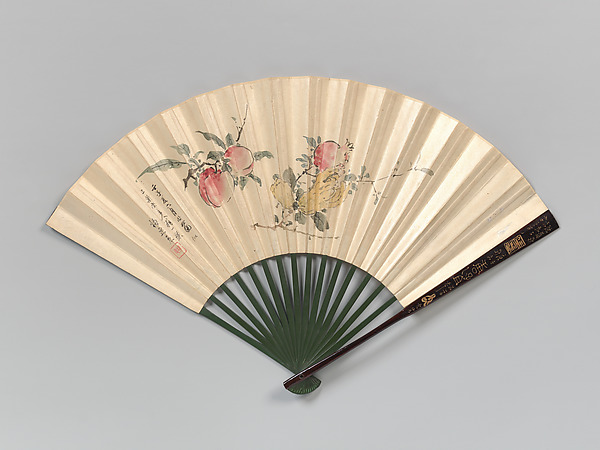
Peaches, Pomegranate, and Fingered Citron
桃石榴仏手柑図扇面
1832
Folding fan; ink and color on paper
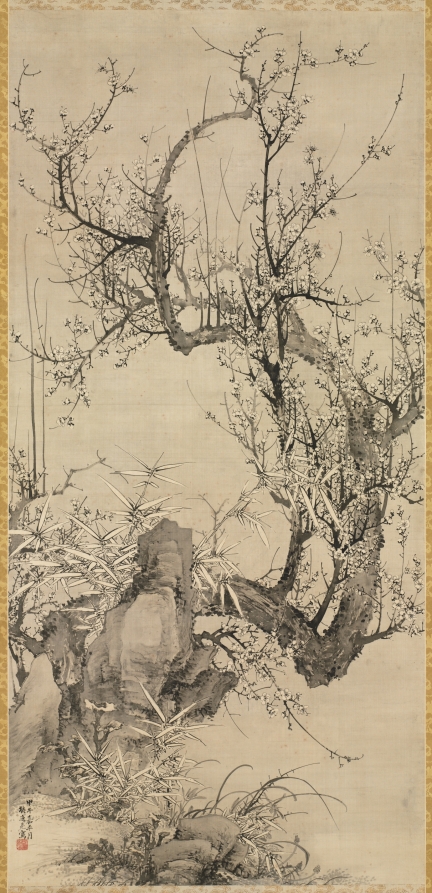
Plums, Bamboo, and Orchid
梅竹蘭図
1834
Hanging scroll; ink on silk
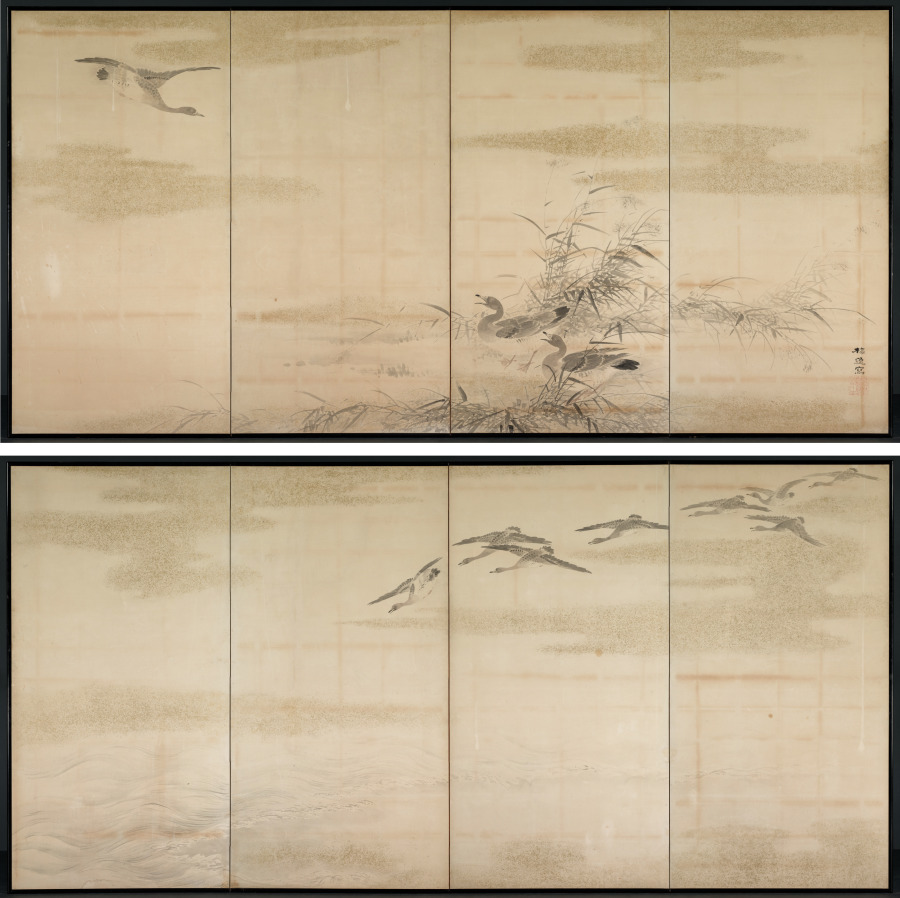
Geese, Reeds, and Water
葦雁図
1800s
Pair of four-panel folding screens; ink, color, and cut gold foil on paper
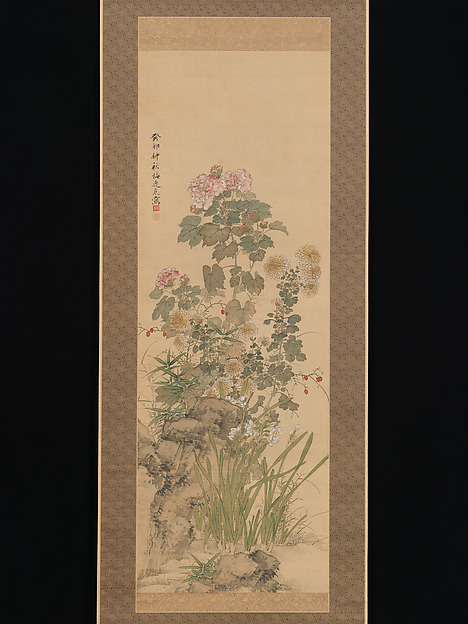
Flowers and Grasses of Autumn
秋草図
1843, 8th month
Hanging scroll; ink and color on silk
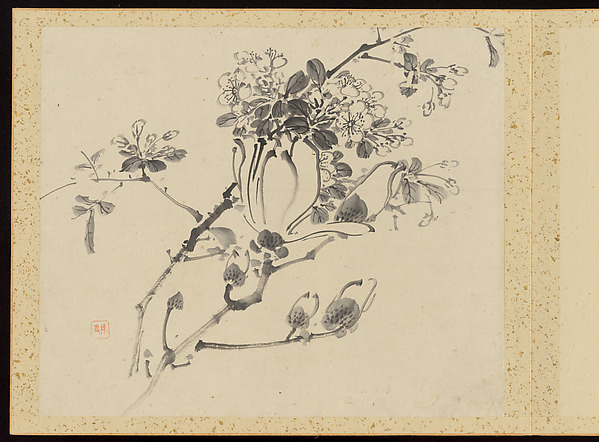
"Refined Elegance in the Four Seasons" (Shiji seiga), Album of Flower Paintings
四時清雅
1844
Album of twelve leaves; ink on paper
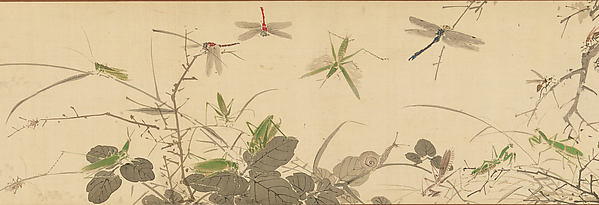
Insects and Grasses
草虫図
dated 1847
Handscroll; ink and color on silk
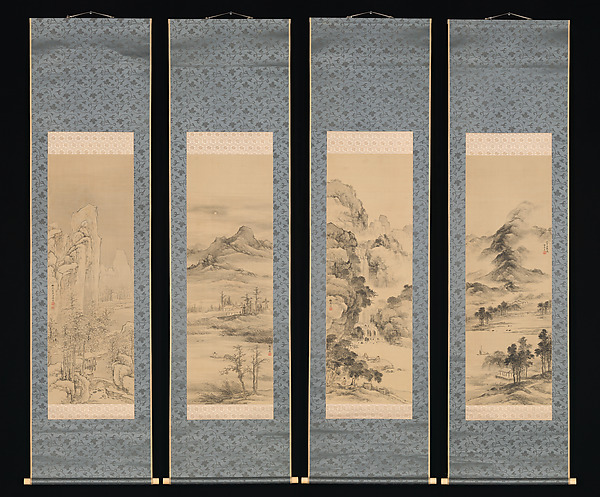
Landscapes of the Four Seasons
四季山水図
1848
Set of four hanging scrolls; ink and color on silk
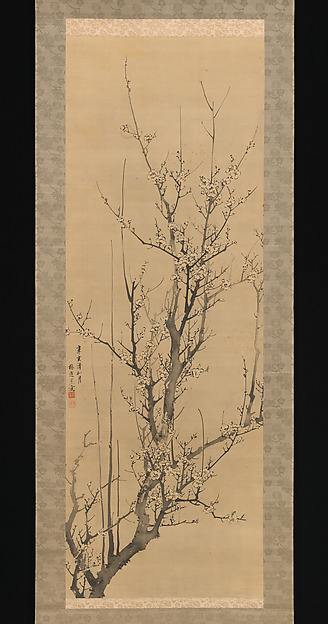
Plum Blossoms
梅花図
dated 1851
Hanging scroll; ink on silk
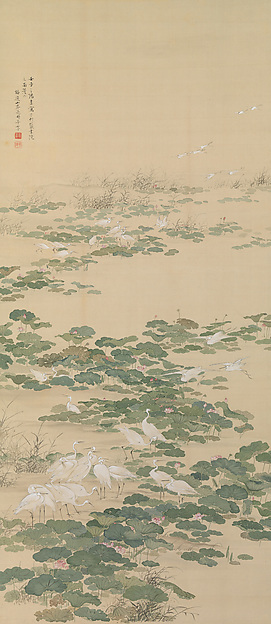
Egrets in a Lotus Pond
蓮池白鷺図
1852
Hanging scroll; ink and color on silk