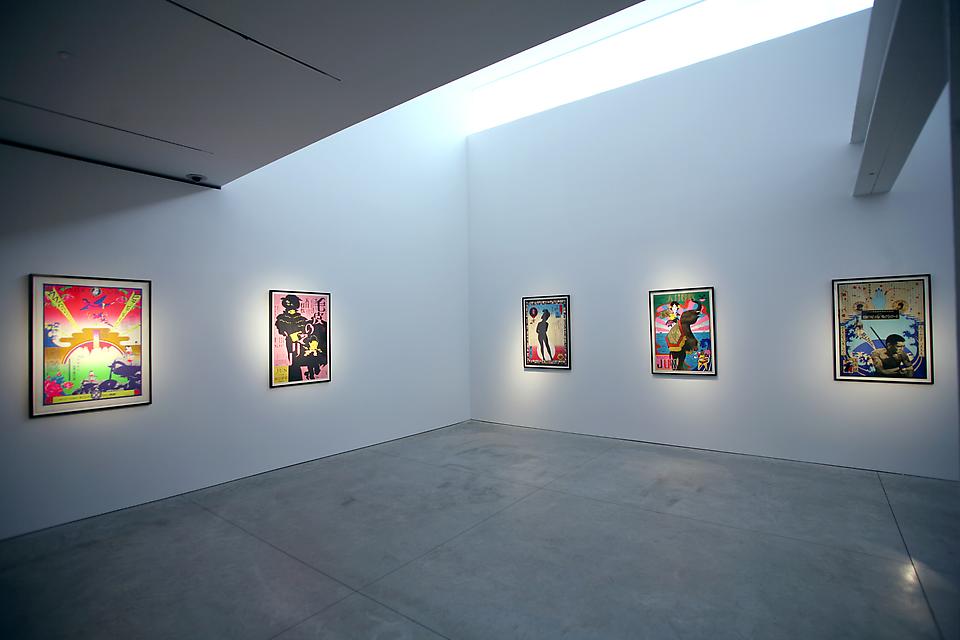
À la Maison de M. Civeçawa (Rose-Colored Dance) — installation view
腰巻お仙
- Date:
- 1965
- Medium:
- Silkscreen poster (commercial silkscreen process)
- Dimensions:
- 73 × 103 cm
- Image courtesy of
- Friedman Benda — The Aesthetics of End: Early Silkscreens 1965-1971
Description
This silkscreen poster was produced for Tatsumi Hijikata's butoh performance Bara-iro Dansu — À la Maison de M. Civeçawa (Rose-Colored Dance, At Mr. Shibusawa's House), staged at Sennichidani Public Hall in Tokyo on November 26, 1965. The piece is among Yokoo's earliest and most decisive silkscreen posters and helped fix the visual grammar of Tokyo's underground theater scene during the angura years. The composition characteristically combines a vermilion rising-sun disc derived from late-Edo woodblock conventions with photographic portraits, decorative borders cribbed from Meiji ephemera, and bold sans-serif lettering, all printed in a flat, high-saturation palette permitted by commercial silkscreen rather than traditional baren-pulled woodblock. The hand-drawn 腰巻お仙 ('Koshimaki Osen') title cartouche references Kara Jūrō's 1966 play, illustrating the close circulation of motifs between Yokoo's commissions for Jōkyō Gekijō and Hijikata's Asbestos-kan dance troupe. The work is reproduced in Hanga Jungle (Kokushokankokai, 2018).
More Prints by Tadanori Yokoo
Frequently Asked Questions
À la Maison de M. Civeçawa (Rose-Colored Dance) — installation view (腰巻お仙) was created by Tadanori Yokoo (横尾 忠則) in 1965.
À la Maison de M. Civeçawa (Rose-Colored Dance) — installation view uses Silkscreen, on silkscreen poster (commercial silkscreen process).
À la Maison de M. Civeçawa (Rose-Colored Dance) — installation view measures 73 × 103 cm.