
Untitled work by Yoshitoshi Mori
- Source:
- ukiyo-e.org
Description
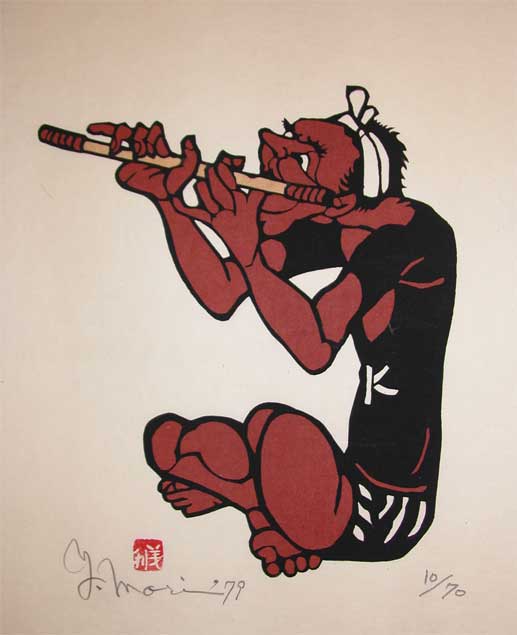
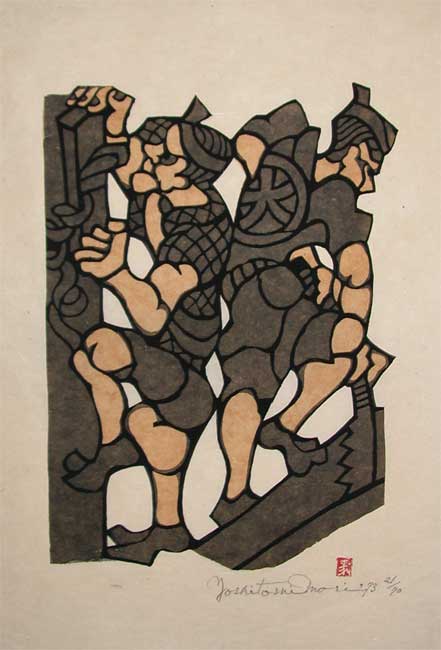
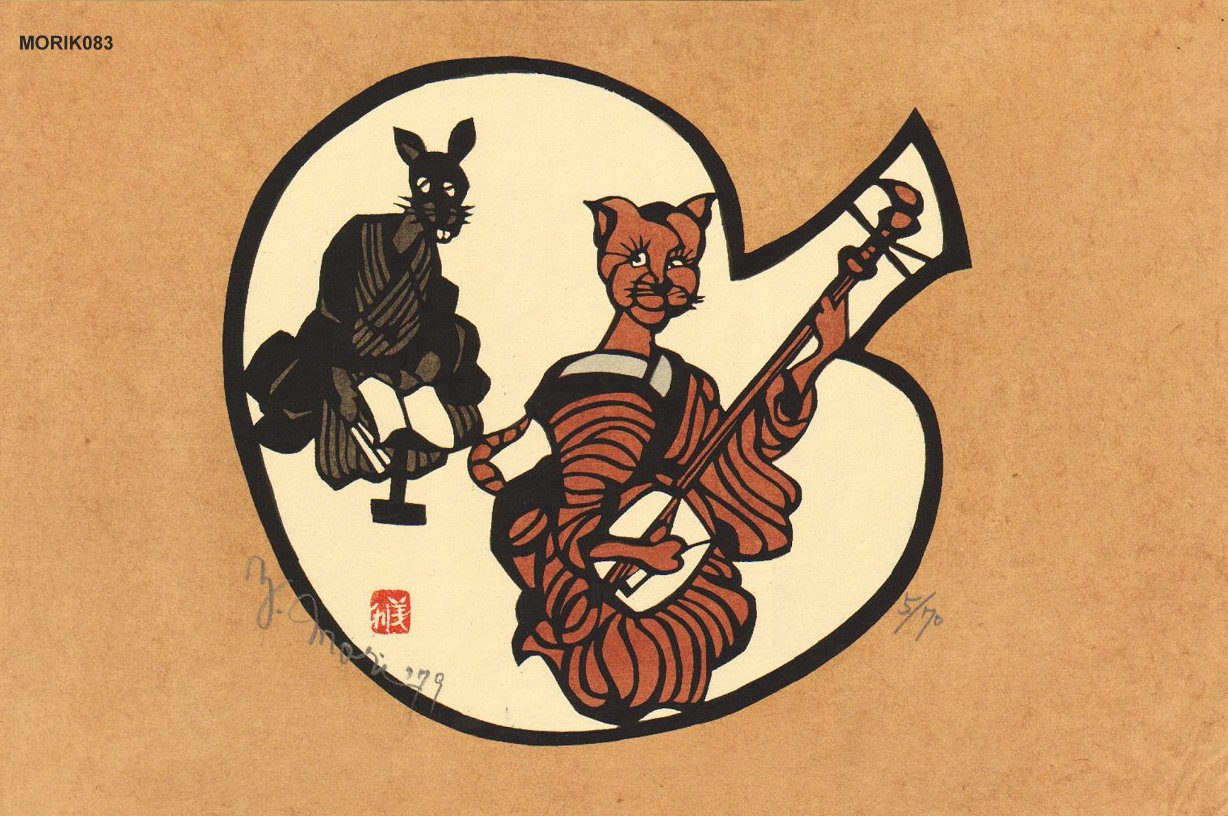
This untitled work by Yoshitoshi Mori exemplifies the bold visual language he brought to twentieth-century Japanese printmaking. Mori (1898-1992) is celebrated as a leading practitioner of kappazuri stencil prints, a technique rooted in folk textile dyeing that he elevated to a fine-art medium within the sosaku-hanga (creative print) movement. Where traditional ukiyo-e relied on a division of labor between designer, carver, and printer, sosaku-hanga insisted that the artist conceive and execute every stage of the work alone. Mori embraced that creed completely, hand-cutting his own stencils and pulling each impression himself. His mature style is marked by emphatic black silhouettes, generous unmodulated color fields, and a sense of decorative flatness inherited from the otsu-e folk paintings and katagami textile stencils he studied in his youth. Even in an undated, untitled sheet such as this, the hallmarks of his practice are legible: the resist-paste-and-stencil method that yields slightly grainy, fibrous color edges; the confident graphic structure that compresses figure and ground into a single ornamental plane; and the willingness to let washi paper texture remain visible beneath pigment. Mori trained at the Kawabata Painting School and apprenticed under the folk-art champion Serizawa Keisuke, whose advocacy for mingei aesthetics shaped Mori's lifelong belief that craft traditions could carry contemporary expressive weight. By the 1950s his prints had entered major Japanese and Western museum collections, and his work continued to evolve through subjects drawn from kabuki theater, samurai legend, and seasonal festivals. This sheet is documented through the ukiyo-e.org aggregation of the Museum of Fine Arts, Boston holdings, where it survives as a record of Mori's restless graphic experimentation across the sosaku-hanga decades.
More Prints by Yoshitoshi Mori

Featured in Collections
Curated cross-cuts that include this print.
Frequently Asked Questions
(untitled) was created by Yoshitoshi Mori (森義利).