Kinkaku-ji (金閣寺)
3 prints by 2 artists
About Kinkaku-ji
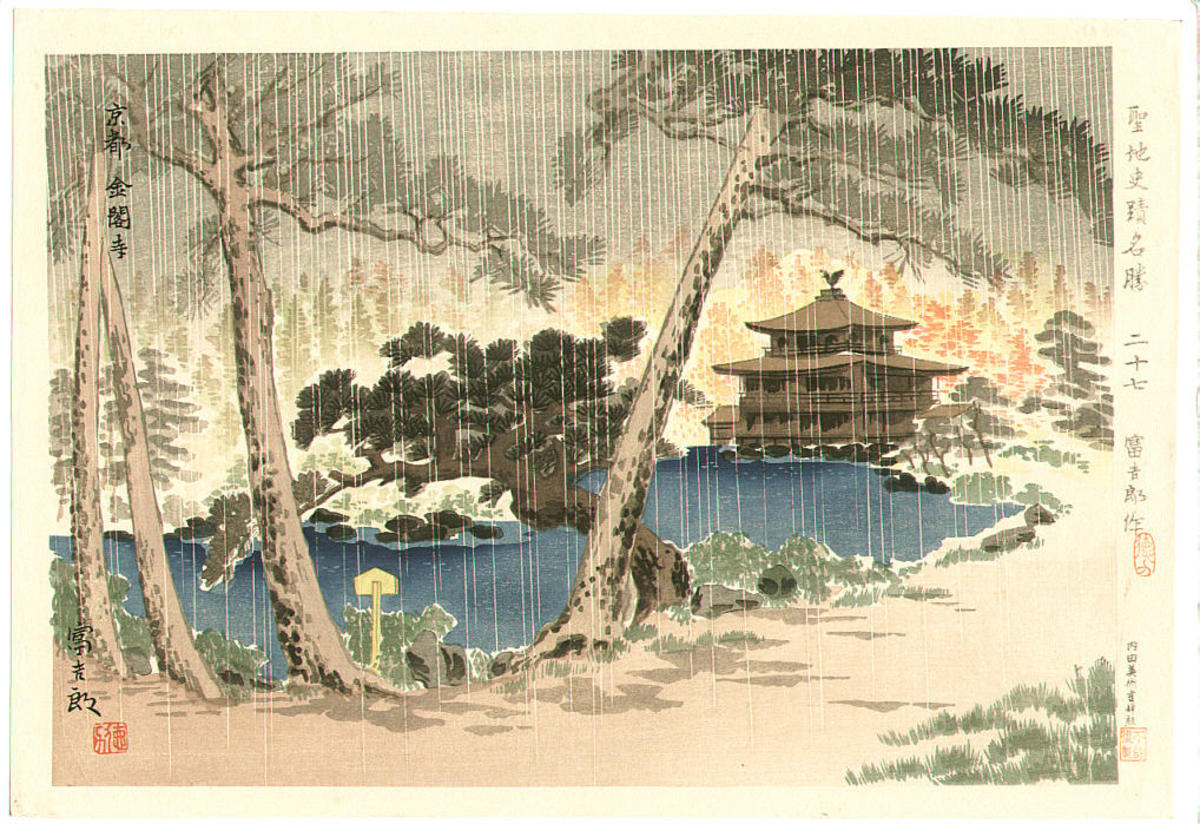
Kinkaku-ji, formally Rokuon-ji and known popularly as the Golden Pavilion, is a Zen Buddhist temple of the Rinzai sect's Shokoku-ji branch in northwestern Kyoto, in present-day Kita Ward. The temple originated in the late fourteenth century when the shogun Ashikaga Yoshimitsu (1358-1408) acquired the site in 1397 from the Saionji family and developed his retirement villa, called Kitayama-den, as an opulent estate combining Buddhist architecture with aristocratic and bushi residential traditions, and the property was converted to a Zen temple of the Rinzai school upon Yoshimitsu's death in 1408 according to the terms of his will. The principal building, the Shariden reliquary hall whose three stories integrate three different architectural styles (the first floor in shinden-zukuri aristocratic style, the second in samurai bukke style, and the third in Chinese Zen Buddhist Karayo style with a phoenix finial), is set on a pond such that its reflection is visible in the still water before it and the upper two stories are covered in gold leaf, which served as a symbolic statement of the Ashikaga regime's economic and cultural prominence at its high point. The original Shariden survived multiple fires and the upheavals of the Onin War and the medieval period in its original form but was destroyed by arson committed by a 21-year-old novice monk on 2 July 1950, an event that drew international attention and inspired Mishima Yukio's 1956 novel Kinkakuji (The Temple of the Golden Pavilion). The present building is a faithful reconstruction completed in 1955 based on the historical documentation and the surviving photographs of the original, with the gold leaf renewed in 1987 in a more lavish application than the prewar building. The pond garden, called Kyoko-chi (Mirror Pond) and dating from the Yoshimitsu period, the surrounding wooded slope, the small Sosei waterfall, and the secondary structures including the Sekkatei tea pavilion form one of the most visited Zen temple compounds in Japan. For Japanese printmaking Kinkaku-ji belongs to the canonical Kyoto meisho. The pavilion is included in Edo-period printed guidebooks to Kyoto and in individual sheets of the late Edo period by Hiroshige and others, but it became most prominent through the shin-hanga revival, in which Kawase Hasui, Tsuchiya Koitsu, Asano Takeji, and Tokuriki Tomikichiro all produced compositions of the pavilion and its reflection under seasonal conditions including snow, autumn maple, and the calm of summer evening. Hasui's snow Kinkaku-ji compositions and his evening compositions are among the most reproduced of his Kyoto sheets, and Tsuchiya Koitsu's gold pavilion in snow is similarly canonical. Tokuriki Tomikichiro included the temple in his Kyoto-centered series across multiple decades, and Yoshida Hiroshi treated the pavilion in his individual sheets in his characteristic variant-impression practice with versions under different light conditions. The visual character of Kinkaku-ji in prints is built on the gilded surface of the pavilion catching the pond surface, the inverted reflection in the water below producing a doubled image, the foreground pine, snow, or maple foliage of the surrounding garden, and the dark wooded slope of the mountain rising behind, with the seasonal phenomena providing the principal compositional variable. The seasonally most striking views are the snow-covered pavilion in midwinter and the autumn maple reflected with the pavilion in mid-November. Contemporary visitors approach the temple from the western edge of central Kyoto via the Kyoto City Bus from Kyoto Station or the surrounding districts, with the pavilion remaining one of the most heavily photographed and visited monuments in Japan, viewed along a single one-way walking circuit around the pond and through the upper garden.
Prints Depicting Kinkaku-ji (3)


Artists Who Depicted Kinkaku-ji (2)
Frequently Asked Questions
Kinkaku-ji, formally Rokuon-ji and known popularly as the Golden Pavilion, is a Zen Buddhist temple of the Rinzai sect's Shokoku-ji branch in northwestern Kyoto, in present-day Kita Ward. The temple originated in the late fourteenth century when the shogun Ashikaga Yoshimitsu (1358-1408) acquired the site in 1397 from the Saionji family and developed his retirement villa, called Kitayama-den, as an opulent estate combining Buddhist architecture with aristocratic and bushi residential traditions, and the property was converted to a Zen temple of the Rinzai school upon Yoshimitsu's death in 1408 according to the terms of his will. The principal building, the Shariden reliquary hall whose three stories integrate three different architectural styles (the first floor in shinden-zukuri aristocratic style, the second in samurai bukke style, and the third in Chinese Zen Buddhist Karayo style with a phoenix finial), is set on a pond such that its reflection is visible in the still water before it and the upper two stories are covered in gold leaf, which served as a symbolic statement of the Ashikaga regime's economic and cultural prominence at its high point. The original Shariden survived multiple fires and the upheavals of the Onin War and the medieval period in its original form but was destroyed by arson committed by a 21-year-old novice monk on 2 July 1950, an event that drew international attention and inspired Mishima Yukio's 1956 novel Kinkakuji (The Temple of the Golden Pavilion). The present building is a faithful reconstruction completed in 1955 based on the historical documentation and the surviving photographs of the original, with the gold leaf renewed in 1987 in a more lavish application than the prewar building. The pond garden, called Kyoko-chi (Mirror Pond) and dating from the Yoshimitsu period, the surrounding wooded slope, the small Sosei waterfall, and the secondary structures including the Sekkatei tea pavilion form one of the most visited Zen temple compounds in Japan. For Japanese printmaking Kinkaku-ji belongs to the canonical Kyoto meisho. The pavilion is included in Edo-period printed guidebooks to Kyoto and in individual sheets of the late Edo period by Hiroshige and others, but it became most prominent through the shin-hanga revival, in which Kawase Hasui, Tsuchiya Koitsu, Asano Takeji, and Tokuriki Tomikichiro all produced compositions of the pavilion and its reflection under seasonal conditions including snow, autumn maple, and the calm of summer evening. Hasui's snow Kinkaku-ji compositions and his evening compositions are among the most reproduced of his Kyoto sheets, and Tsuchiya Koitsu's gold pavilion in snow is similarly canonical. Tokuriki Tomikichiro included the temple in his Kyoto-centered series across multiple decades, and Yoshida Hiroshi treated the pavilion in his individual sheets in his characteristic variant-impression practice with versions under different light conditions. The visual character of Kinkaku-ji in prints is built on the gilded surface of the pavilion catching the pond surface, the inverted reflection in the water below producing a doubled image, the foreground pine, snow, or maple foliage of the surrounding garden, and the dark wooded slope of the mountain rising behind, with the seasonal phenomena providing the principal compositional variable. The seasonally most striking views are the snow-covered pavilion in midwinter and the autumn maple reflected with the pavilion in mid-November. Contemporary visitors approach the temple from the western edge of central Kyoto via the Kyoto City Bus from Kyoto Station or the surrounding districts, with the pavilion remaining one of the most heavily photographed and visited monuments in Japan, viewed along a single one-way walking circuit around the pond and through the upper garden.
Hanga catalogues 3 prints depicting Kinkaku-ji (金閣寺), by 2 different artists.
Hiroshi Yoshida and Tomikichiro Tokuriki are among the 2 artists who depicted Kinkaku-ji in our collection.
Want to rate prints from Kinkaku-ji?
Sign up to start rating