Pantheon of the Gandavyuha Sutra (Kegon-fu)
Kegon-fu
About This Series
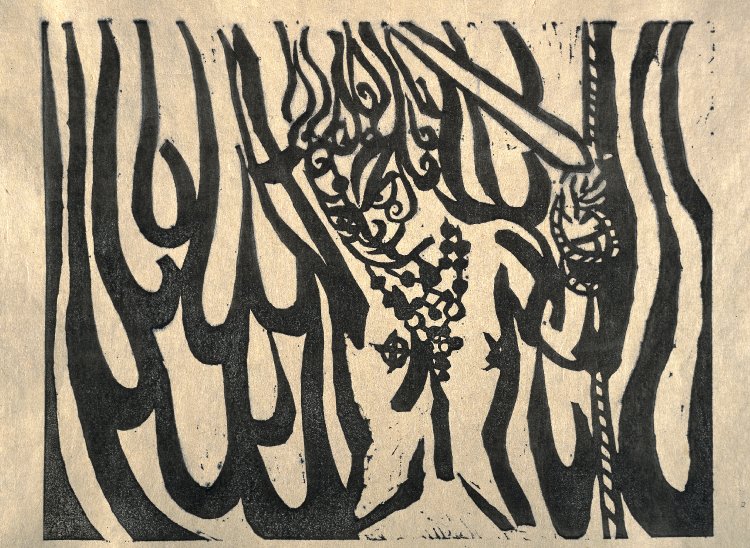
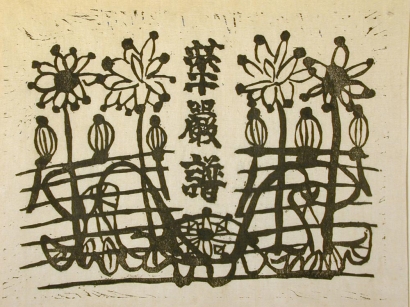
Kegon-fu, here glossed as Pantheon of the Gandavyuha Sutra, draws on the climactic narrative section of the Mahayana Avatamsaka or Kegon scripture, in which the youth Sudhana undertakes a pilgrimage through fifty-three teachers in pursuit of perfect awakening. The Gandavyuha pantheon offered Shiko Munakata an iconographic resource of unmatched richness, since each of Sudhana's teachers, bodhisattvas, gods, kings, householders, and laywomen alike, supplies a discrete figural subject suited to the columnar single-sheet format that he had developed for the Two Bodhisattvas and Ten Great Disciples cycle. Working in ita-e, with the block cut directly into yamazakura cherry without preparatory drawing and printed in sumi on washi, Munakata translated each pantheon figure into a frontal, near-iconic image set against densely carved ground and inscribed with the figure's name in his characteristic seal-script calligraphy. Several impressions are completed by uragashin verso-coloring, in which mineral pigments applied to the back of the translucent paper migrate forward as soft tints behind the saturated ink. The cycle belongs to the wartime and postwar phase of Munakata's career, the years in which his evacuation to Fukumitsu in Toyama Prefecture deepened his association with True Pure Land Buddhist temples and clarified the religious foundation of his practice, and it stands alongside the Two Bodhisattvas cycle as a cornerstone of his Buddhist printmaking. Impressions are documented in the Munakata Shiko Memorial Hall in Aomori, the National Museum of Modern Art Tokyo, the Museum of Modern Art New York, and other major postwar Japanese print collections.
Prints in This Series (5)
Complete series — all 3 prints catalogued.


Frequently Asked Questions
Kegon-fu, here glossed as Pantheon of the Gandavyuha Sutra, draws on the climactic narrative section of the Mahayana Avatamsaka or Kegon scripture, in which the youth Sudhana undertakes a pilgrimage through fifty-three teachers in pursuit of perfect awakening. The Gandavyuha pantheon offered Shiko Munakata an iconographic resource of unmatched richness, since each of Sudhana's teachers, bodhisattvas, gods, kings, householders, and laywomen alike, supplies a discrete figural subject suited to the columnar single-sheet format that he had developed for the Two Bodhisattvas and Ten Great Disciples cycle. Working in ita-e, with the block cut directly into yamazakura cherry without preparatory drawing and printed in sumi on washi, Munakata translated each pantheon figure into a frontal, near-iconic image set against densely carved ground and inscribed with the figure's name in his characteristic seal-script calligraphy. Several impressions are completed by uragashin verso-coloring, in which mineral pigments applied to the back of the translucent paper migrate forward as soft tints behind the saturated ink. The cycle belongs to the wartime and postwar phase of Munakata's career, the years in which his evacuation to Fukumitsu in Toyama Prefecture deepened his association with True Pure Land Buddhist temples and clarified the religious foundation of his practice, and it stands alongside the Two Bodhisattvas cycle as a cornerstone of his Buddhist printmaking. Impressions are documented in the Munakata Shiko Memorial Hall in Aomori, the National Museum of Modern Art Tokyo, the Museum of Modern Art New York, and other major postwar Japanese print collections.
The Pantheon of the Gandavyuha Sutra (Kegon-fu) series contains 3 prints, created by Shiko Munakata.
The Pantheon of the Gandavyuha Sutra (Kegon-fu) series was created by Shiko Munakata (棟方志功).
We currently have 5 of 3 known prints from the Pantheon of the Gandavyuha Sutra (Kegon-fu) series indexed in our collection. Browse them all on this page.
Want to rate prints from Pantheon of the Gandavyuha Sutra (Kegon-fu)?
Sign up to start rating