Biography
Adachi Ginkō (active c. 1874–1908) was a prolific Meiji-era ukiyo-e print designer whose career tracked, almost step for step, Japan's headlong transformation from an isolated feudal society into a modern industrial empire. Working in Tokyo during the four decades that bracketed the Meiji Restoration's middle and late phases, Adachi Ginkō produced historical narrative prints, sensō-e (war prints), kaika-e (enlightenment prints celebrating modernization), bijin-ga (pictures of beautiful women), and yakusha-e (actor portraits). His output is among the most useful visual archives of late nineteenth-century Japan: a society in which top hats sat beside chonmage haircuts, gas lamps lit streets where samurai had recently walked, and naval cruisers steamed where junks had sailed a generation earlier.
Little is known of Adachi Ginkō's early life. Born Adachi Heishichi, he is generally recorded as having been born in 1853, and he is conventionally counted among the last generation of the Utagawa school that produced so many Meiji print designers. He may have begun designing prints around 1870, but his earliest dated works appear from 1874 onward, the year he found success with a series of actor prints and took up the name by which he is now known. Over his career he signed with a succession of art names — among them Shōsetsusai Ginkō, Shinshō Ginkō, Shōsai Ginkō, and Shōunsai Ginkō — and his work was bound up with a high-volume publishing practice typical of the period: artists working closely with commercial publishers to keep pace with insatiable public demand for prints reporting on current events, government ceremonies, kabuki productions, and military campaigns.
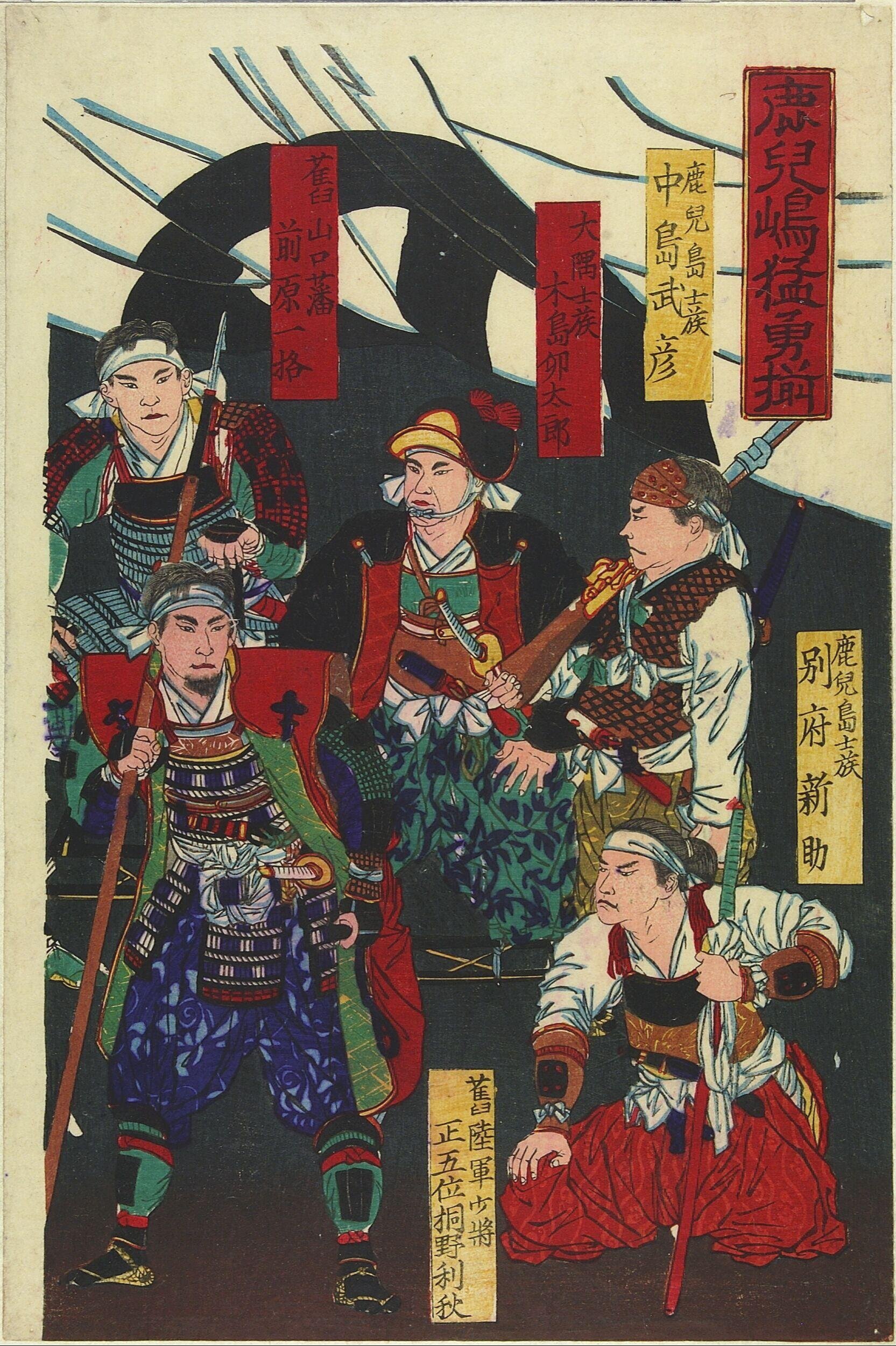
Adachi Ginkō's first body of significant work belongs to the genre of kaika-e, the enlightenment prints that celebrated Japan's adoption of Western technology, architecture, dress, and political institutions. These prints, with their stovepipe hats, brick buildings, steam locomotives, and gaslit streets, served a documentary and propagandistic function: they showed the citizens of a newly opened country what modernization looked like and persuaded them that it was desirable. His prints of the Satsuma Rebellion of 1877 — the revolt that pitted the modernizing imperial government against samurai loyalists in Kyushu, including scenes of the fighting around Kagoshima — reflect another current of Meiji print culture: the visual reporting of current military events. War reportage and government propaganda were inseparable in this period, and Adachi Ginkō was a fluent practitioner of both.
In 1879 he produced the imaginative series 'The Strange Tale of the Castaways: A Western Kabuki,' which dramatized the experience of Japanese travelers abroad in kabuki-stage compositions set along American train tracks and inside the Paris opera house. The Metropolitan Museum of Art holds sheets from this series. These prints are among the most interesting Meiji works to use kabuki conventions as a vehicle for representing the unfamiliar West: the resulting compositions are simultaneously theatrical and ethnographic, with kabuki posing and color palettes wrapped around steam locomotives, opera boxes, and European costume. The series anticipates the later vogue for prints depicting Japanese tours of Europe and America, and it sits cleanly inside the kaika-e tradition.
The 1880s brought commissions in several directions. Adachi Ginkō produced memorial portraits of kabuki actors (shini-e), including his 1882 'Memorial portrait of the actor Iwai Hanshirō VIII' now in the Art Institute of Chicago; refined bijin-ga such as 'Ladies Sewing (Kijo saihō no zu)' from 1887, a Metropolitan Museum triptych in which Meiji women are shown in a hybrid interior of Japanese and Western furnishings working at modern sewing tasks; and ceremonial documentary prints commemorating state occasions. His 1889 print 'View of the Issuance of the State Constitution in the State Chamber of the New Imperial Palace' records the promulgation of the Meiji Constitution, a foundational event in modern Japanese political history. The composition places the Emperor at the center of a hall filled with European-uniformed officials, articulating in pigment the constitutional bargain the new state had struck between native sovereignty and Western institutional forms.
Adachi Ginkō reached his largest audience as a sensō-e designer during the First Sino-Japanese War of 1894-95. War prints sold in vast numbers during this conflict, the first major test of Japan's modernized military, and publishers raced to issue triptychs faster than newspaper accounts could reach the provinces. Adachi Ginkō's triptychs in the Art Institute of Chicago, 'The Beginning of the Korean Incident (Sono hajime Chosen hottan),' 'Kabayama, the Chief of Naval Staff, Attacking Enemy Ships from onboard Saikyōmaru,' and 'Lieutenant Commander Sakakibara Fighting Bravely to the South of Ximucheng,' are characteristic examples. They depict identifiable Japanese officers in moments of disciplined bravery, set against atmospheric backdrops of smoke, surf, and shellfire, and they helped construct the public image of a modern Japanese military that could defeat a continental empire. The genre was lucrative, ideologically charged, and one of the last great commercial outlets for traditional woodblock printing before photographic reproduction overtook the field.
Adachi Ginkō continued to design prints into the early twentieth century, and his last known works are dated as late as 1908, though his output declined as photography and lithography displaced ukiyo-e from the news and propaganda market. His date and place of death are not securely recorded. Today his prints are held by major public collections, including the Art Institute of Chicago and the Metropolitan Museum of Art, among other museums in Japan, Europe, and the United States. For students of Meiji visual culture, Adachi Ginkō is an indispensable figure: his work documents the parade of Meiji modernization, the rituals of the new imperial state, the bloody campaigns that secured Japan's regional ambitions, and the everyday domestic lives that all of these upheavals reshaped.
Key Facts
- Nationality
- 🇯🇵Japan
- Movements
- Meiji/Taishō PrintsUkiyo-e
- Subjects
- Rain
- Works Indexed
- 9
Frequently Asked Questions
Adachi Ginkō (active c. 1874–1908) was a prolific Meiji-era ukiyo-e print designer whose career tracked, almost step for step, Japan's headlong transformation from an isolated feudal society into a modern industrial empire. Working in Tokyo during the four decades that bracketed the Meiji Restoration's middle and late phases, Adachi Ginkō produced historical narrative prints, sensō-e (war prints), kaika-e (enlightenment prints celebrating modernization), bijin-ga (pictures of beautiful women), and yakusha-e (actor portraits). His output is among the most useful visual archives of late nineteenth-century Japan: a society in which top hats sat beside chonmage haircuts, gas lamps lit streets where samurai had recently walked, and naval cruisers steamed where junks had sailed a generation earlier.
Adachi Ginkō's work was shaped by the Meiji/Taishō Prints and Ukiyo-e traditions in Japanese woodblock printmaking. Meiji/Taishō Prints: Meiji and Taishō era prints (1868–1926) bridge the transition from traditional ukiyo-e to the modern shin-hanga and sosaku-hanga movements. Ukiyo-e: ## What is ukiyo-e? Ukiyo-e ([浮世絵](/glossary/ukiyo-e)) — literally "pictures of the floating world" — is the Edo-period Japanese print and painting tradition that flourished from roughly 1660 to 1868, depicting the pleasures of urban life in Edo (modern Tokyo): courtesans, kabuki actors, sumo wrestlers, famous landscapes, and seasonal beauties.
Adachi Ginkō's prints frequently feature rain.
Original prints by Adachi Ginkō can be found in collections including Metropolitan Museum of Art, Art Institute of Chicago, Victoria and Albert Museum.
Woodblock Prints by Adachi Ginkō (9)
'Kagoshima Mōyū Soroi'
1877

“Act II, Scene 2: Along Train Tracks in America,” from the series The Strange Tale of the Castaways: A Western Kabuki
1879
Woodblock print (nishiki-e); ink and color on paper; vertical ōban

“Act II, Scene 5: At the Opera in Paris,” from the series The Strange Tale of the Castaways: A Western Kabuki
1879
Woodblock print (nishiki-e); ink and color on paper; vertical ōban

Memorial portrait of the actor Iwai Hanshiro VIII
1882
Color woodblock print; oban
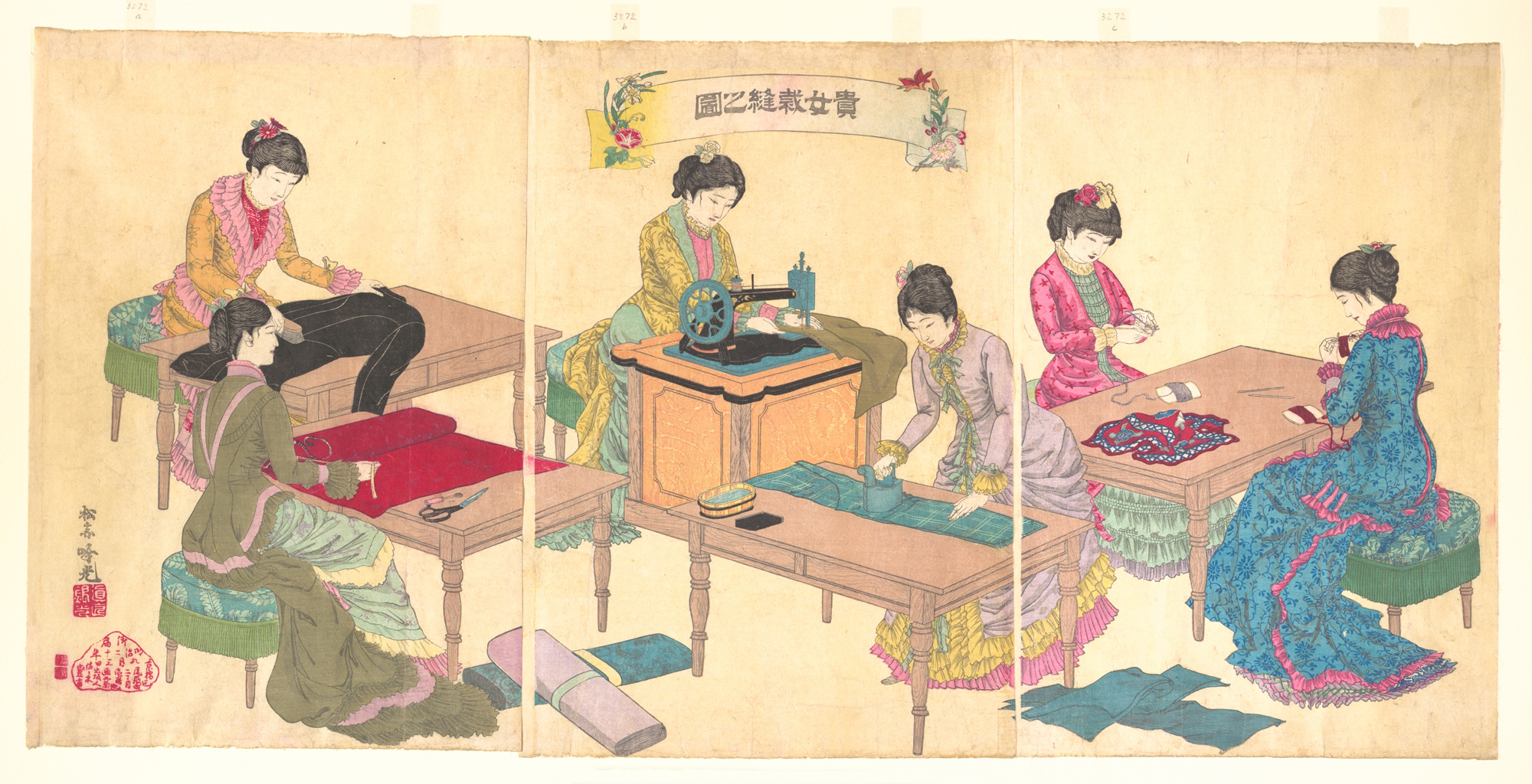
Ladies Sewing (Kijo saihō no zu)
September 3rd, 1887
Triptych of woodblock prints (nishiki-e); ink and color on paper
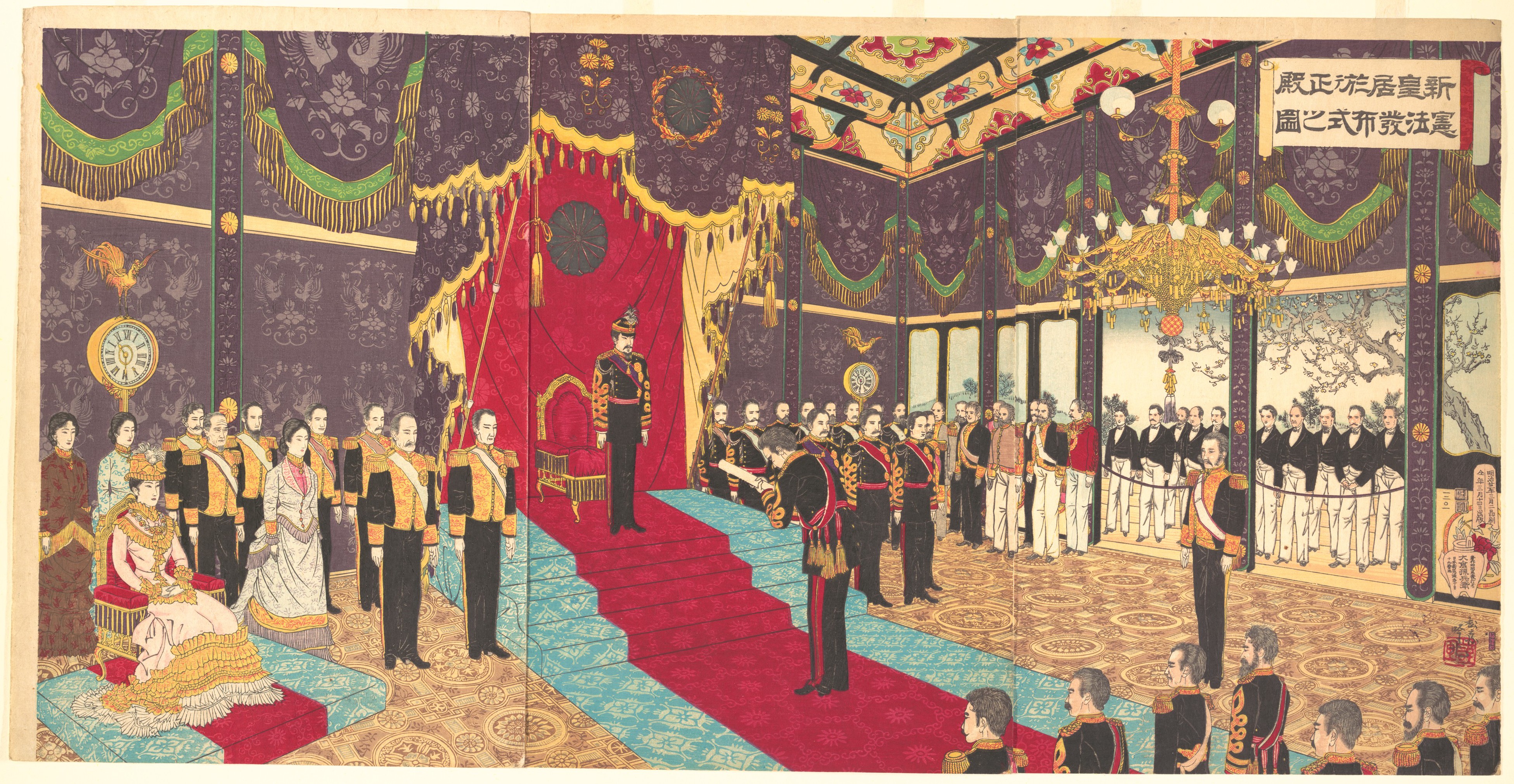
View of the Issuance of the State Constitution in the State Chamber of the New Imperial Palace
March 2, 1889 (Meiji 22)
One sheet of a triptych of woodblock prints; ink and color on paper

The Beginning of the Korean Incident (Sono hajime Chosen hottan)
1894
Color woodblock print; oban triptych

Kabayama, the Chief of Naval Staff, Attacking Enemy Ships from onboard Saikyomaru (Kabayama gunreibucho Saikyomaru o motte tekikan ni ataru)
1894
Color woodblock print; oban triptych

Lieutenant Commander Sakakibara Fighting Bravely to the South of Ximucheng (Takubokujo nan ni oite Sakakibara shosa funsen no zu)
1895
Color woodblock print; oban triptych