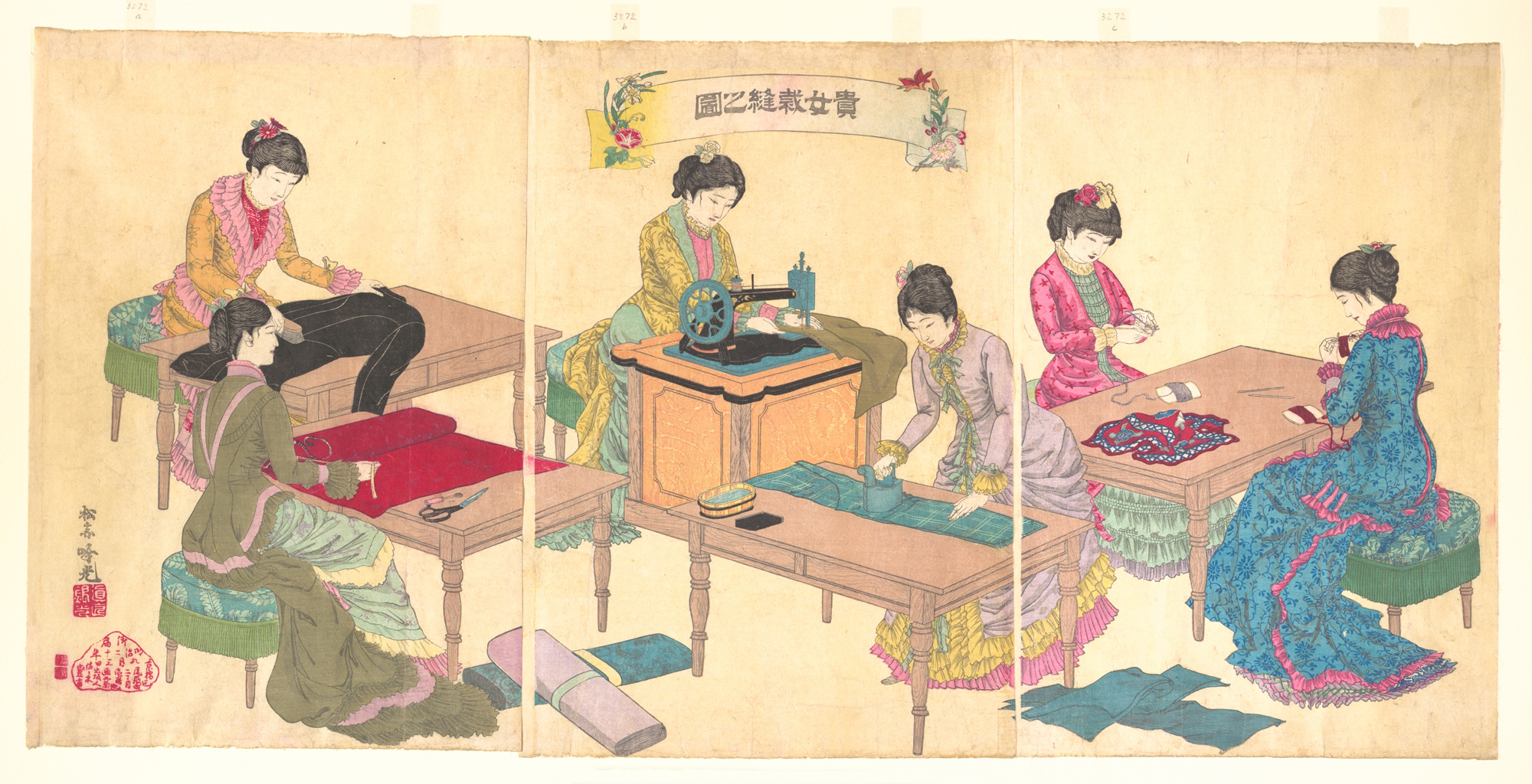
Ladies Sewing (Kijo saihō no zu)
by Adachi Ginkō
- Date:
- September 3rd, 1887
- Medium:
- Triptych of woodblock prints (nishiki-e); ink and color on paper
- Source:
- Metropolitan Museum of Art
Description
This 1887 woodblock triptych, dated September 3rd of that year and held by the Metropolitan Museum of Art, is a bijin-ga (picture of beautiful women) depicting Meiji-era ladies engaged in sewing. The composition places elegantly dressed women in a hybrid interior that combines Japanese architectural elements with Western furnishings, the kind of mixed domestic environment that became typical of upper-middle-class Tokyo households during the 1880s. Adachi Ginkō's print belongs to the bijin-ga tradition reaching back through Utagawa, Kitagawa, and earlier schools, but adapts it to a Meiji-specific subject: women at work on Western-influenced sewing tasks, with materials and tools that signal the modernization of household production. The triptych format allows the artist to unfold a panoramic interior scene, with figures, textiles, and furnishings distributed across three sheets in carefully balanced visual rhythm. The print is a useful primary source for the social history of Meiji domestic life and the visual culture surrounding the modern, educated woman. Held in the Metropolitan Museum of Art's collection of Japanese woodblock prints, it stands as one of Adachi Ginkō's most accomplished bijin-ga.
More Prints by Adachi Ginkō

“Act II, Scene 2: Along Train Tracks in America,” from the series The Strange Tale of the Castaways: A Western Kabuki
1879
Woodblock print (nishiki-e); ink and color on paper; vertical ōban

Memorial portrait of the actor Iwai Hanshiro VIII
1882
Color woodblock print; oban

Kabayama, the Chief of Naval Staff, Attacking Enemy Ships from onboard Saikyomaru (Kabayama gunreibucho Saikyomaru o motte tekikan ni ataru)
1894
Color woodblock print; oban triptych

The Beginning of the Korean Incident (Sono hajime Chosen hottan)
1894
Color woodblock print; oban triptych
Frequently Asked Questions
Ladies Sewing (Kijo saihō no zu) was created by Adachi Ginkō (安達吟光) in September 3rd, 1887.