Biography
Eishōsai Chōki (栄松斎長喜, active circa 1786–1808) was a Japanese ukiyo-e designer whose small but exquisite oeuvre places him among the most refined bijin-ga artists of the late Edo period. Working in the immediate orbit of Kitagawa Utamaro, Chōki produced courtesan portraits and floating-world genre scenes whose elegance of line, sensitivity of expression, and economy of pattern have given his finest prints a quiet, durable reputation. Modern cataloguers have ranked his best designs with those of Utamaro himself.
The biographical record for Chōki is thin even by the standards of an ukiyo-e generation whose private lives are largely lost. His birth and death dates are not recorded, and his given name appears in some sources as Momokawa Chōki (百川長喜). What is reliably known is that he studied with Toriyama Sekien (1712–1788), the Kanō-trained painter best remembered for his illustrated bestiaries of supernatural creatures (the Gazu Hyakki Yagyō); Chōki may even have been Sekien's adopted son. Sekien also trained Kitagawa Utamaro, so Chōki entered the ukiyo-e world as a near-contemporary — and fellow pupil — of the artist who would dominate the bijin-ga genre for the next two decades. Chōki is recorded to have lived in the household of the great publisher Tsutaya Jūzaburō, who issued several of his print series. Where Utamaro emerged as a public figure of national reach, Chōki worked more quietly across roughly two decades from the mid-1780s to the first years of the nineteenth century.
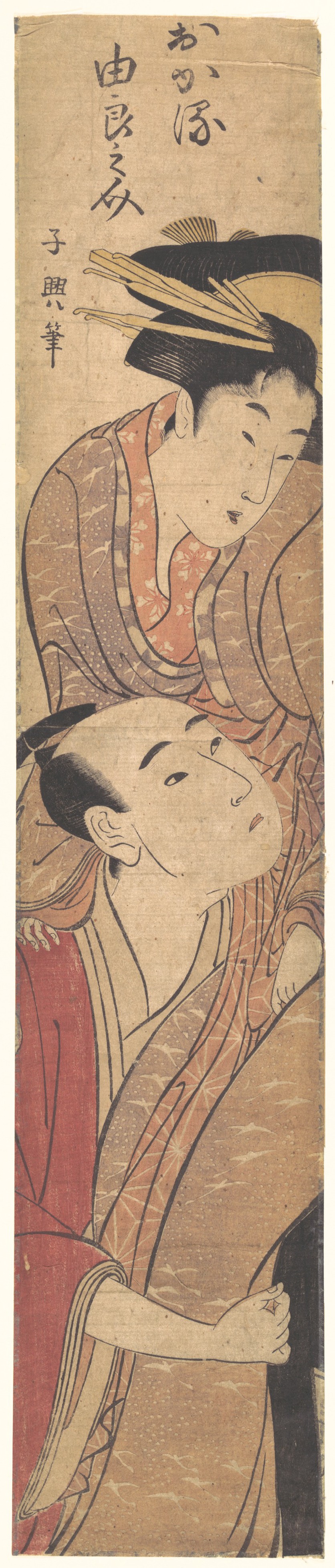
Chōki signed his prints under several names. Eishōsai Chōki (栄松斎長喜) is the form that appears most often on his mature work and is the standard reference; he also signed simply Chōki (長喜), and the variant Shikō (子興) appears on another group of works. The shifting signatures have long caused attribution puzzles, but the Chōki and Shikō marks are generally understood today to be the work of the same hand.
Stylistically, Chōki belongs to the generation that took up the okubi-e — the close-up bust portrait, often set against a plain or mica-dusted ground — that Utamaro brought to commercial prominence in the early 1790s. Chōki's portraits of named Yoshiwara courtesans, with their long oval faces, delicately curving necks, and small precisely painted mouths, follow Utamaro's lead while developing a distinct quietness. Where Utamaro's faces project a sensual warmth and Chōkōsai Eishō's tend toward a linear, almost graphic chill, Chōki's bijin sit between the two: more inward than Utamaro's, more affectionate than Eishō's, often with the suggestion of a half-completed gesture or momentary turn of the head that gives the image a felt sense of interior life. His palette is restrained — soft grey-blues, muted reds, warm greys — and his line is among the most refined in late-Edo printmaking.
Chōki's full-length bijin-ga and multi-figure genre compositions are equally accomplished. His Niwaka Festival prints depict Yoshiwara geisha performing during the festival of the licensed quarter, and his suzumi-bune ('cooling-off boat') scene of women enjoying the evening cool on a boat beneath the Azuma Bridge on the Sumida is among his most expansive designs. Genre scenes such as Catching Fireflies and Moon Viewing — both in the Art Institute of Chicago, with a version of the fireflies subject also at the Metropolitan Museum of Art — place named beauties in seasonal settings that connect the celebrity-portrait mode to the kachō-fūgetsu tradition of seasonal poetic image-making. His Cock Fight, pairing the celebrated Kansei teahouse beauties Naniwaya Okita and Takashimaya Ohisa (Art Institute of Chicago, circa 1791), is one of the iconic celebrity portraits of the era.
Alongside bijin-ga, Chōki worked in the mitate-e (parody) mode that dominated sophisticated print design in the 1790s, and he also treated the great Chūshingura vendetta drama, producing an Eight Views of the Loyal Retainers (Chūshingura hakkei). He continued to take book commissions late in his career; his latest securely known work is a set of illustrations for the 1809 book Nakoso no seki (Nakoso Gate) by Kanwatei Onitake.
Chōki's activity tapers off in the first decade of the nineteenth century. The scarcity of his designs combined with their high quality has kept his prints prized by collectors since the first European wave of ukiyo-e enthusiasm in the 1880s. Today his work is held by every major collection of Japanese prints: the Metropolitan Museum of Art and the Art Institute of Chicago both hold a notable group of his okubi-e and genre scenes, and further examples are in the Library of Congress and other institutions.
Key Facts
- Nationality
- 🇯🇵Japan
- Movement
- Ukiyo-e
- Works Indexed
- 6
Frequently Asked Questions
Eishōsai Chōki (栄松斎長喜, active circa 1786–1808) was a Japanese ukiyo-e designer whose small but exquisite oeuvre places him among the most refined bijin-ga artists of the late Edo period. Working in the immediate orbit of Kitagawa Utamaro, Chōki produced courtesan portraits and floating-world genre scenes whose elegance of line, sensitivity of expression, and economy of pattern have given his finest prints a quiet, durable reputation. Modern cataloguers have ranked his best designs with those of Utamaro himself.
Eishōsai Chōki's work was shaped by the Ukiyo-e tradition in Japanese woodblock printmaking. Ukiyo-e: ## What is ukiyo-e? Ukiyo-e ([浮世絵](/glossary/ukiyo-e)) — literally "pictures of the floating world" — is the Edo-period Japanese print and painting tradition that flourished from roughly 1660 to 1868, depicting the pleasures of urban life in Edo (modern Tokyo): courtesans, kabuki actors, sumo wrestlers, famous landscapes, and seasonal beauties.
Original prints by Eishōsai Chōki can be found in collections including Art Institute of Chicago, Metropolitan Museum of Art.
Woodblock Prints by Eishōsai Chōki (6)

Kan, a waitress of the Izutsuya, and the geisha Fuseya of the Ogiya

The Courtesan Hinazuru of the Chojiya and Her Attendants
early 1790s
Color woodblock print; right sheet of oban triptych
Edo period (1615-1868)
Woodblock print; ink and color on paper

Good and Evil Influences (Zendama akudama)
c. 1795
Color woodblock print; left sheet of oban triptych
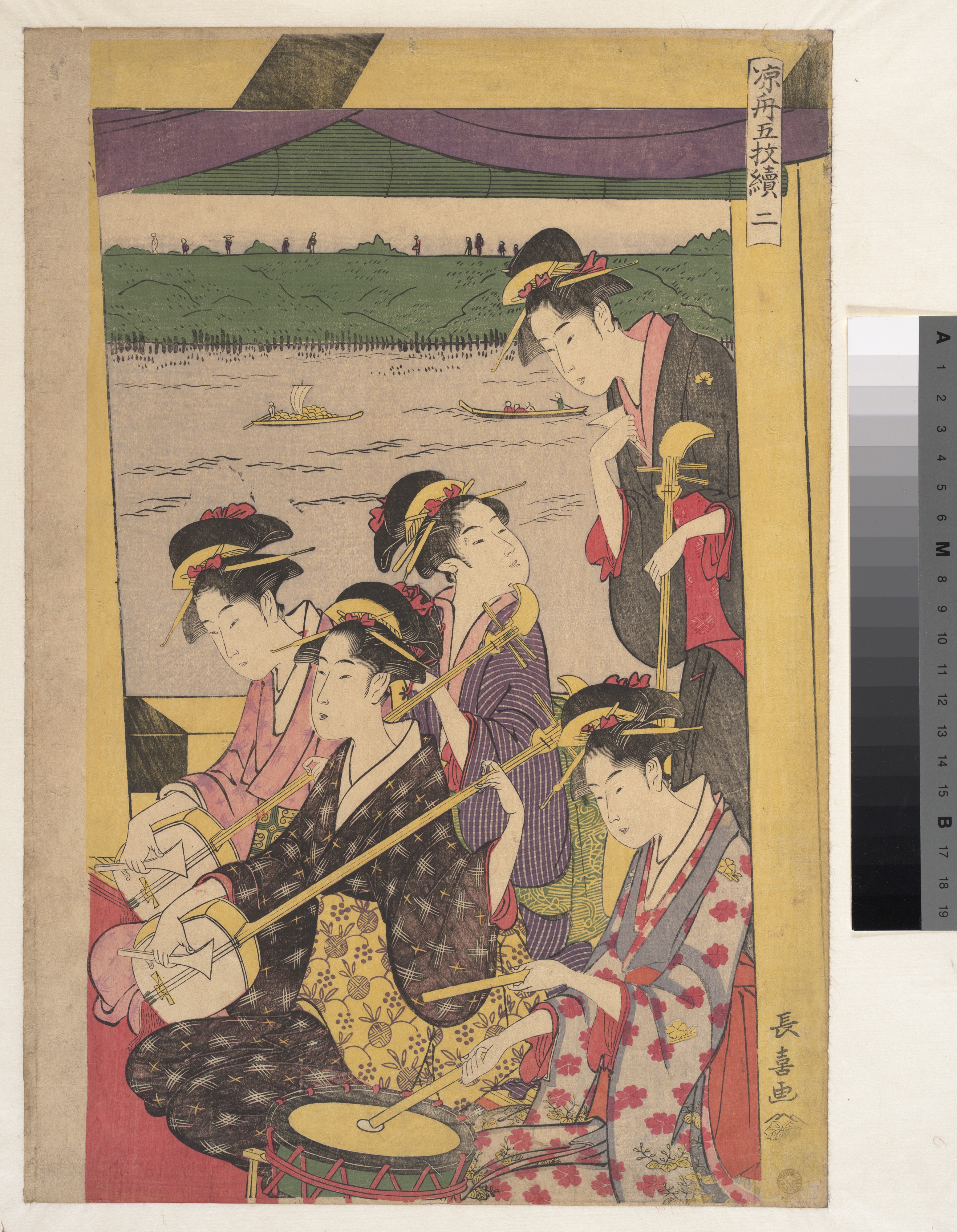
A Party of Geisha in a Suzumi-bune (Second Scene of a Boating Party)
ca. 1796
Second sheet of a pentaptych of woodblock prints; ink and color on paper

The Front Room of the Naniwaya (Naniwaya misesaki)
c. 1800
Color woodblock prints; aiban triptych