Biography
Hasegawa Sadanobu II (二代目長谷川貞信, 1848-1940) was the second-generation head of the Hasegawa workshop of Osaka kamigata-e and one of the longest-lived Japanese print designers of the modern era, a career that opened in the final years of the Tokugawa shogunate and closed on the eve of the Pacific War. The son of the Osaka printmaker Hasegawa Sadanobu I (1809-1879), he produced kabuki actor portraits, kaika-e views of Westernizing Kobe and Osaka, Sino-Japanese War prints, newspaper-supplement nishiki-e shinbun, advertising flyers (hikifuda), and bird-and-flower designs that bridged the late kamigata-e tradition and the early twentieth-century print market.
Born in Osaka in 1848, the future Sadanobu II was given the personal name Tokutarō and studied first with his father in the Hasegawa workshop. He also trained under Ōsai Yoshiume (1819-1879), also known as Utagawa Yoshiume, a pupil of the Edo print master Utagawa Kuniyoshi who had moved west and become an important figure in the Osaka school. Through this lineage he absorbed the Utagawa school's command of figural and theatrical subjects, and he signed his early prints under the gō Konobu (小信).
In 1867, the year before the Meiji Restoration, Konobu moved to the newly opened treaty port of Kobe, where he spent about three years documenting the visual transformation of the western Japanese coast under the impact of Western trade, architecture, and dress. He produced a body of kaika-e ("civilization-and-enlightenment pictures") showing foreign figures, steamships, Western-style buildings, and the mixing of Japanese and foreign life in the new port quarters of Kobe and Osaka — direct counterparts, in the Kansai region, to the better-known Yokohama-e of Hashimoto Sadahide and Utagawa Yoshikazu.
Alongside views of the Westernizing city, Konobu continued his father's actor-portrait practice, producing yakusha-e that documented the leading kamigata kabuki stars of the 1860s and 1870s, and he supplied illustrations — and sometimes the accompanying written narratives — for Osaka newspaper nishiki-e shinbun, including the Osaka Yūbin hōchi shinbun (Postal News) and the Osaka nichinichi shinbunshi (Osaka Daily News). The Sino-Japanese War of 1894-95 later brought him into the production of patriotic war prints (sensō-e).
In 1879, on the death of his father, Konobu adopted the gō Sadanobu, becoming Hasegawa Sadanobu II and head of the workshop; from this point his signature and seals change to reflect the new name. He continued to work across the remaining six decades of his life, and among his later output are bird-and-flower prints (kachō-e) in the late-nineteenth-century kamigata manner, seasonally precise and closely observed.
The Hasegawa workshop continued into the next generation: his son (1881-1963) inherited the name Sadanobu III and was active as a printmaker well into the twentieth century. This multi-generation continuity is unusual in modern Japanese printmaking and reflects the institutional staying power of the Hasegawa name in Osaka. Sadanobu II himself worked into his nineties and died in Osaka in 1940, a generation after the kamigata-e world he had entered had effectively disappeared.
Sadanobu II's prints are held in public collections of Japanese prints, including the Museum of Fine Arts, Boston, and the Pushkin State Museum of Fine Arts in Moscow. His position in the story of modern Japanese prints rests both on his role as the bridge between his father's late-Edo kamigata-e and his son's twentieth-century production, and on the documentary contribution his Kobe and Osaka kaika-e make to the visual record of the early Meiji period.
Key Facts
- Active Period
- 1848–1940
- Nationality
- 🇯🇵Japan
- Movements
- Meiji/Taishō PrintsUkiyo-e
- Subjects
- BridgesCastlesBirds & Flowers
- Works Indexed
- 4
Frequently Asked Questions
Hasegawa Sadanobu II (二代目長谷川貞信, 1848-1940) was the second-generation head of the Hasegawa workshop of Osaka kamigata-e and one of the longest-lived Japanese print designers of the modern era, a career that opened in the final years of the Tokugawa shogunate and closed on the eve of the Pacific War. The son of the Osaka printmaker Hasegawa Sadanobu I (1809-1879), he produced kabuki actor portraits, kaika-e views of Westernizing Kobe and Osaka, Sino-Japanese War prints, newspaper-supplement nishiki-e shinbun, advertising flyers (hikifuda), and bird-and-flower designs that bridged the late kamigata-e tradition and the early twentieth-century print market.
Hasegawa Sadanobu II was active from 1848 to 1940. They were associated with the Meiji/Taishō Prints and Ukiyo-e movements.
Hasegawa Sadanobu II's work was shaped by the Meiji/Taishō Prints and Ukiyo-e traditions in Japanese woodblock printmaking. Meiji/Taishō Prints: Meiji and Taishō era prints (1868–1926) bridge the transition from traditional ukiyo-e to the modern shin-hanga and sosaku-hanga movements. Ukiyo-e: ## What is ukiyo-e? Ukiyo-e ([浮世絵](/glossary/ukiyo-e)) — literally "pictures of the floating world" — is the Edo-period Japanese print and painting tradition that flourished from roughly 1660 to 1868, depicting the pleasures of urban life in Edo (modern Tokyo): courtesans, kabuki actors, sumo wrestlers, famous landscapes, and seasonal beauties.
Hasegawa Sadanobu II's prints frequently feature bridges, castles, birds & flowers.
Original prints by Hasegawa Sadanobu II can be found in collections including RISD Museum (via Wikimedia Commons), Fine Arts Museums of San Francisco (Legion of Honor), Museum of Fine Arts, Boston.
Woodblock Prints by Hasegawa Sadanobu II (4)
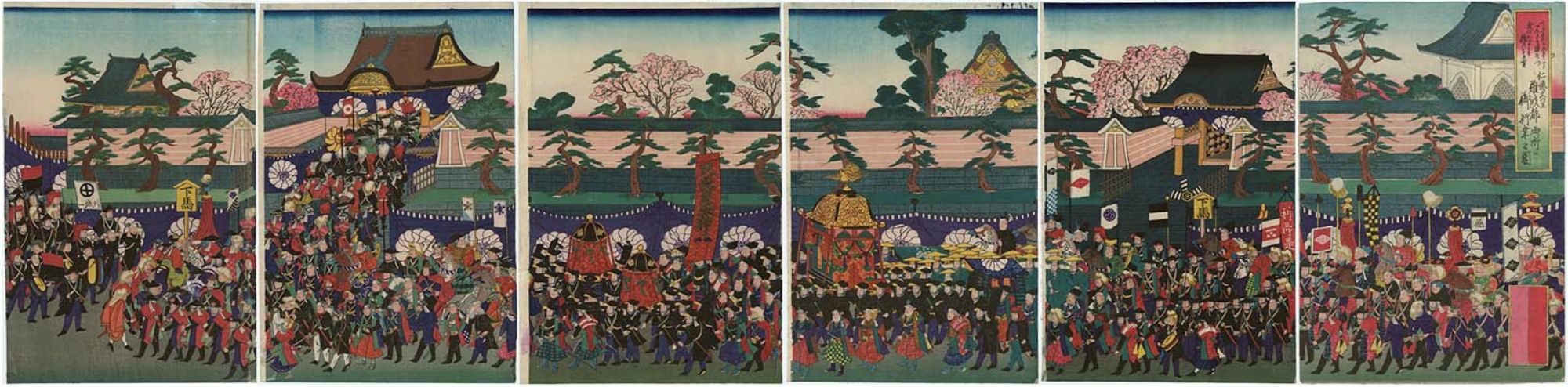
Emperor Nintoku Visits His Palace in the City of Naniwa (Nintoku tennō Naniwa-to gosho e miyuki no zu)
仁徳天皇難波宮へ御幸の図
1868
Color woodblock print; ink and color on paper
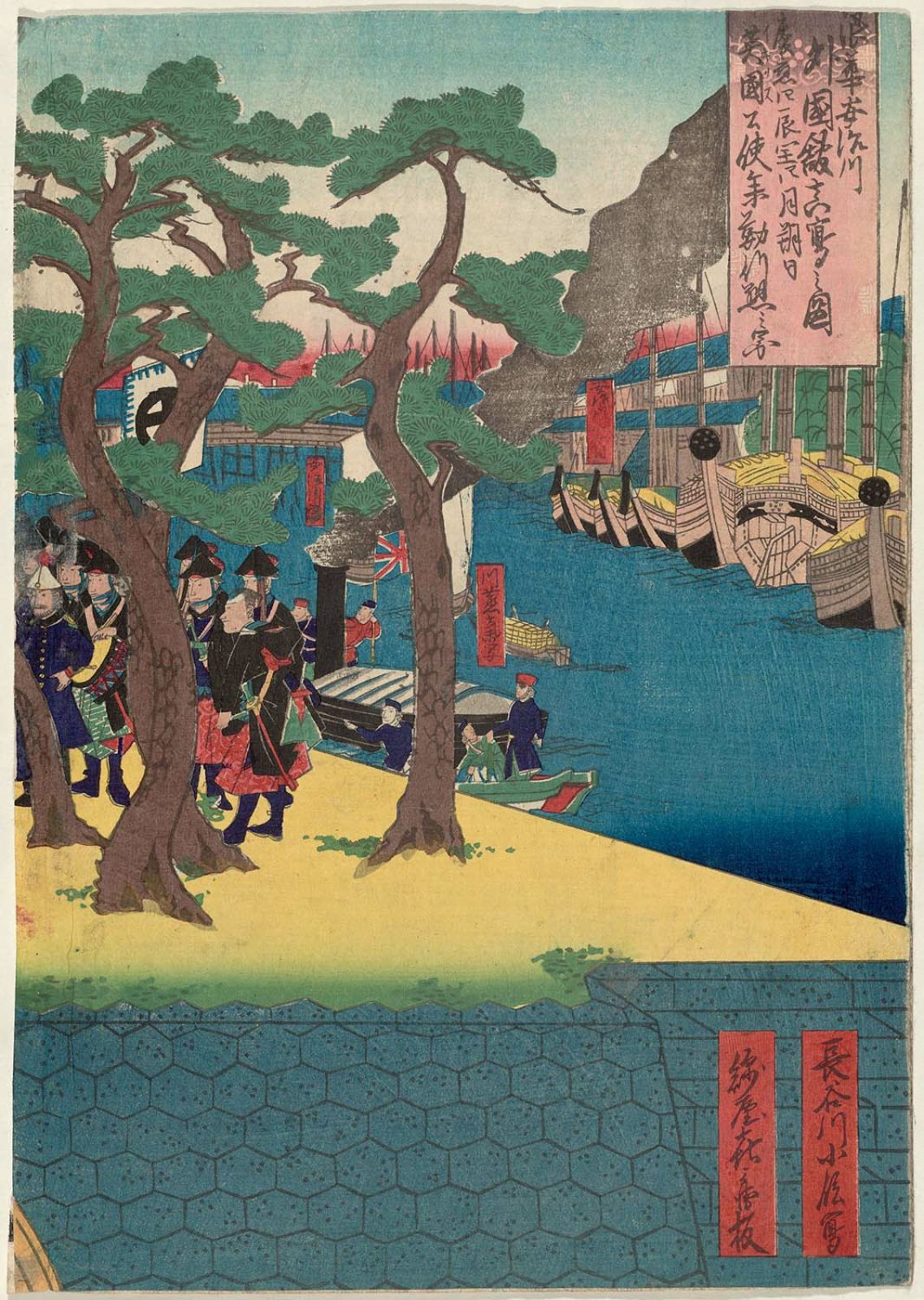
Accurate Depiction of the Foreign Legation on the Aji River in Osaka (Naniwa Ajikawa gaikokukan shinsha no zu)
浪華安治川外国舘真写之図
1868
Color woodblock print; ink and color on paper
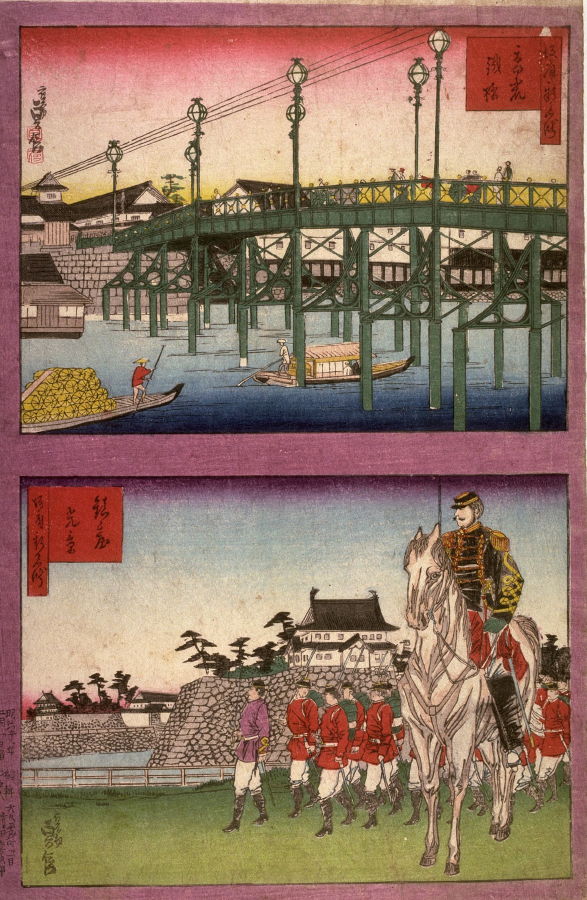
The Iron Bridge and Osaka Castle, from the series Famous New Places in Osaka (Hanfu shinmeisho)
浪華新名所 鉄橋
1870
Color woodblock print with purple borders

Japanese Bush Warbler and Flowering Plum (Ume ni uguisu)
梅に鶯
Before 1941
Color woodblock print; ink and color on paper