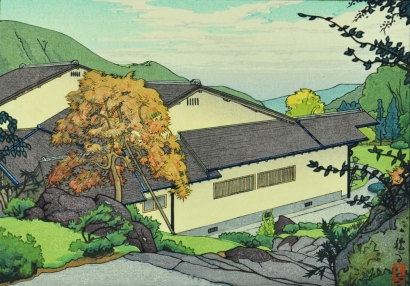
Biography
Hodaka Yoshida (吉田穂高, 1926–1995) was the second son of Hiroshi Yoshida and the artist who pushed the Yoshida family printmaking dynasty furthest from its representational origins, creating abstract and semi-abstract woodblock prints whose bold geometric forms and vibrant color fields aligned him with the international language of postwar modernism while remaining rooted in the craft tradition of the family studio in Tokyo.
Born on September 3, 1926, Hodaka grew up inside a working printmaking workshop. His father Hiroshi was then at the height of his career, producing the landscape prints — the Sailing Boats variations, the Taj Mahal series, the Japan Alps — that would become icons of twentieth-century Japanese printmaking. His elder brother Toshi was already working in the studio. Hodaka absorbed the technical knowledge of woodblock carving, printing, and paper selection as a matter of daily life, acquiring a material fluency that would later enable him to bend the medium toward purposes his father never envisioned.
In 1944 Hodaka entered a science program at Tokyo's Dai-ichi (First) Higher School — his father had urged him toward a stable scientific profession — but his studies were interrupted by the war. Largely self-taught as an artist, he defied his father's plans after 1945 and turned to printmaking, quickly diverging from the representational landscapes that had defined the Yoshida name. The international currents flowing through postwar Japanese art — Abstract Expressionism, Hard-edge painting, Color Field — offered him a vocabulary for the formal explorations he wanted to pursue, as did his admiration for European modernists such as Paul Klee and Joan Miró. By the late 1950s, his prints featured flat planes of saturated color, geometric compositions, and an austerity of means that was the opposite of his father's atmospheric naturalism.
What distinguished Hodaka's abstract prints from those of contemporaries working in lithography or screenprinting was his continued engagement with the woodblock. The grain and resistance of the carved wood, the way water-based sumi ink and mineral pigments interact with the block's surface, the textural imprint of the wood itself — these physical traces gave his abstractions an organic warmth that purely mechanical processes could not replicate. He exploited the wood grain as a compositional element, sometimes printing it prominently, sometimes suppressing it, treating the material's natural patterns as a collaborator rather than an obstacle.
Restlessly experimental, Hodaka did not confine himself to any single method. Alongside the woodblock he explored silkscreen, etching, lithography, monoprinting, and photo-transfer, combining processes to build the multi-layered surfaces that became a hallmark of his work. He joined the Nihon Hanga Kyōkai (Japan Print Association) in 1952, and his practice reflected a craftsman's judgment about what each print needed rather than any fixed allegiance to the shin-hanga or sōsaku-hanga camps.
He exhibited internationally throughout his career, winning prizes at the Lugano International Print Biennial in 1962 and the Seoul International Print Biennial in 1972, and showing at venues across the United States, Europe, and Asia — recognition that established his reputation independent of the family name. His wife Chizuko and daughter Ayomi both became printmakers, continuing the family's printmaking tradition into another generation.
Hodaka died in 1995. His prints are held in the Museum of Modern Art in New York, the British Museum, the Art Institute of Chicago, and the Smithsonian Institution, among numerous other public collections. His body of work demonstrates that the Yoshida family tradition was not a fixed inheritance but a living practice, capable of transformation in each generation.
Key Facts
- Active Period
- 1926–1995
- Nationality
- 🇯🇵Japan
- Works Indexed
- 81
Frequently Asked Questions
Hodaka Yoshida (吉田穂高, 1926–1995) was the second son of Hiroshi Yoshida and the artist who pushed the Yoshida family printmaking dynasty furthest from its representational origins, creating abstract and semi-abstract woodblock prints whose bold geometric forms and vibrant color fields aligned him with the international language of postwar modernism while remaining rooted in the craft tradition of the family studio in Tokyo.
Hodaka Yoshida was active from 1926 to 1995. They were associated with the Contemporary Mokuhanga and Shin-hanga and Sōsaku-hanga movements.
Hodaka Yoshida's work was shaped by the Contemporary Mokuhanga and Shin-hanga and Sōsaku-hanga traditions in Japanese woodblock printmaking. Contemporary Mokuhanga: Contemporary mokuhanga (literally "wood-block print") encompasses artists working from approximately 1970 to the present who continue or reinvent traditional Japanese woodblock printing techniques. Shin-hanga: ## What is Shin-hanga? Shin-hanga (新版画), literally "new prints," is the early twentieth-century revival of the collaborative Japanese woodblock workshop, organized between roughly 1915 and 1960 by the Tokyo publisher Watanabe Shōzaburō (1885–1962) and a handful of competing houses. Sōsaku-hanga: ## What is sōsaku-hanga? Sōsaku-hanga (創作版画, "creative prints") was a twentieth-century Japanese print movement defined by a single commitment: the artist must design, carve, and print every work alone.
Hodaka Yoshida's prints frequently feature abstract, etching, night scenes, nature, landscapes, snow scenes.
Original prints by Hodaka Yoshida can be found in collections including Minneapolis Institute of Art, Art Institute of Chicago, Japanese Art Open Database, ukiyo-e.org.
Woodblock Prints by Hodaka Yoshida (81)
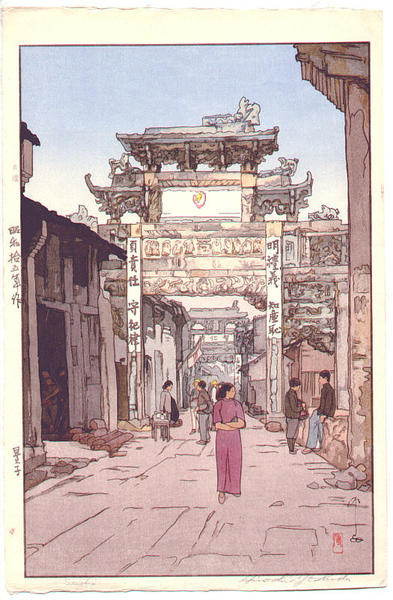
Seishi
Woodblock print

White Two storey house
Mokuhanga (Japanese woodblock)

White House
Mokuhanga (Japanese woodblock)

Landscape Scorpio
Mokuhanga (Japanese woodblock)

Landscape Aries
Mokuhanga (Japanese woodblock)

Autumn Season
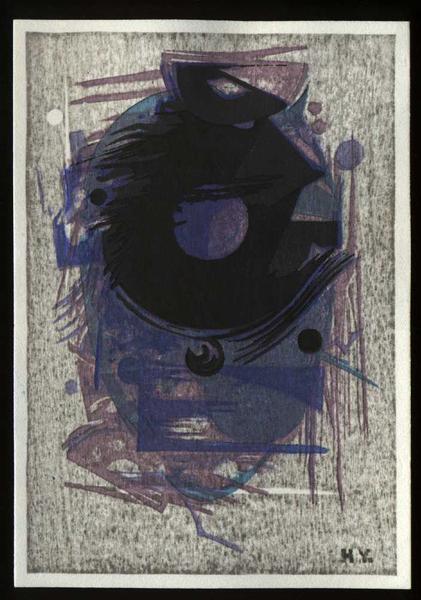
Abstract
Woodblock print
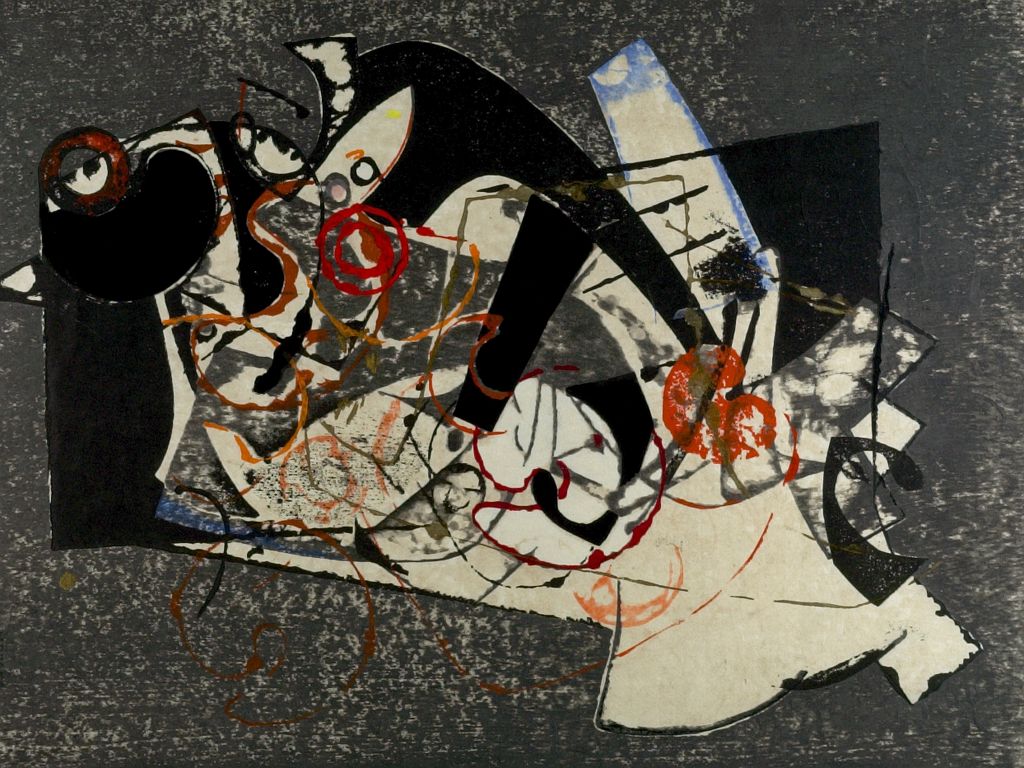
Work 9-1
Woodblock print

May
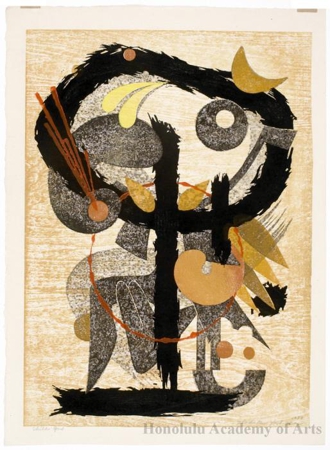
Child God
Woodblock print
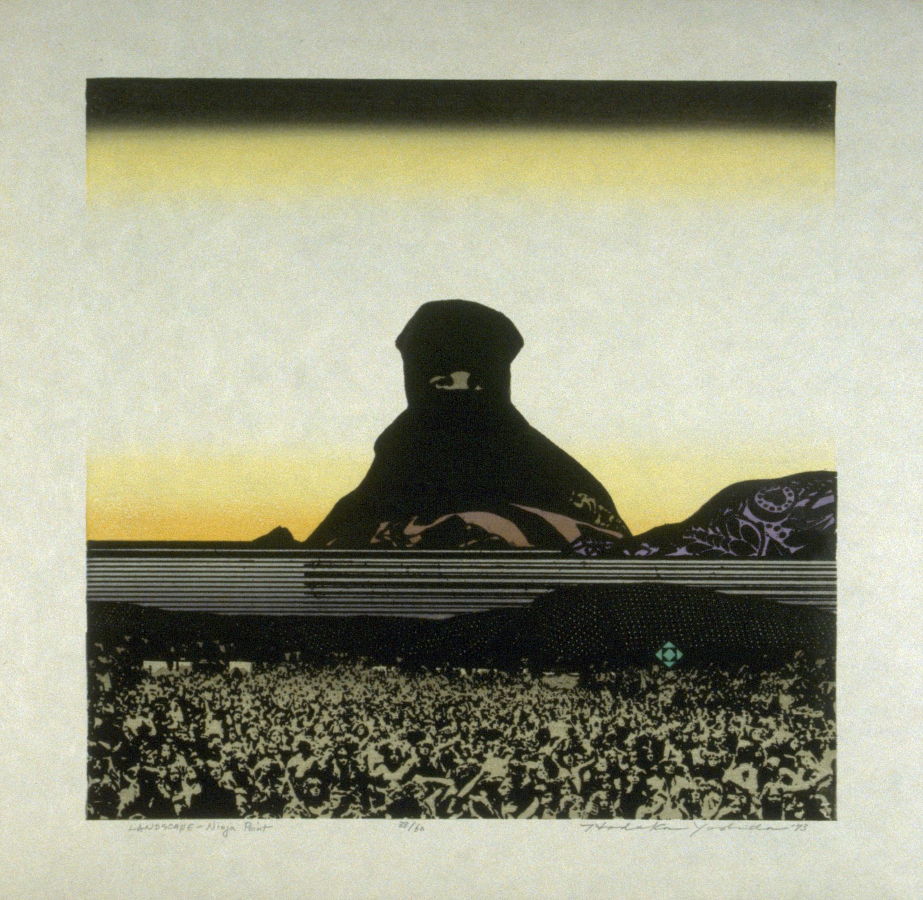
Landscape, Ninja Point - No.20 from the portfolio: Folio Seventy Three
Woodblock print
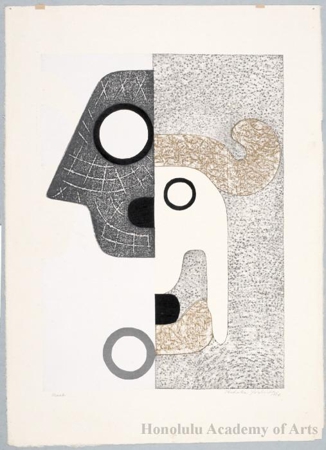
Mask
Woodblock print
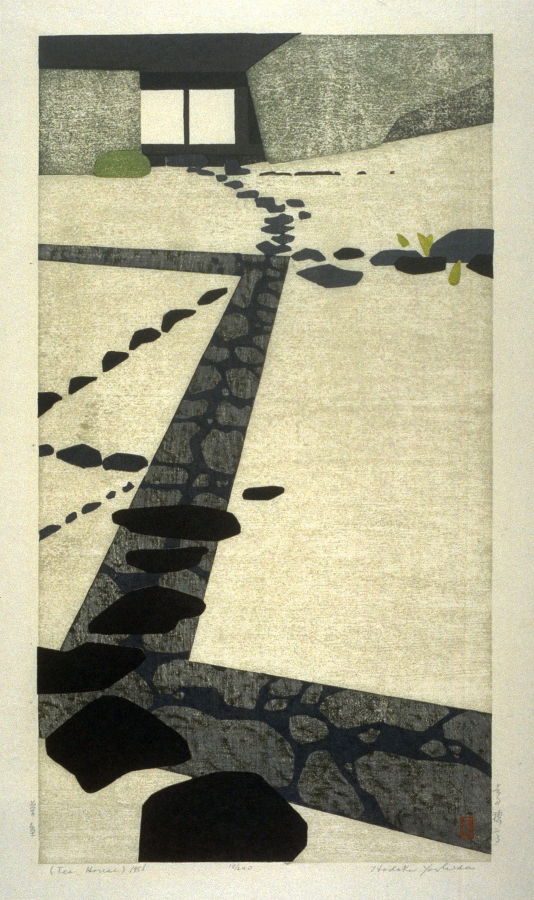
Tea House
Woodblock print

Rainbow in the eastern sky
Mokuhanga (Japanese woodblock)

Work
Mokuhanga (Japanese woodblock)

Landscape With white door
Mokuhanga (Japanese woodblock)

Untitled
Mokuhanga (Japanese woodblock)

People
Mokuhanga (Japanese woodblock)

Landscape Cancer
Mokuhanga (Japanese woodblock)

Stakes, Inokashira
Mokuhanga (Japanese woodblock)

House Of stone with stairs
Mokuhanga (Japanese woodblock)

Rainbow in the eastern sky
Mokuhanga (Japanese woodblock)

Sukiya-bashi Police Box
Mokuhanga (Japanese woodblock)

Sukiya-bashi Police Box
Mokuhanga (Japanese woodblock)