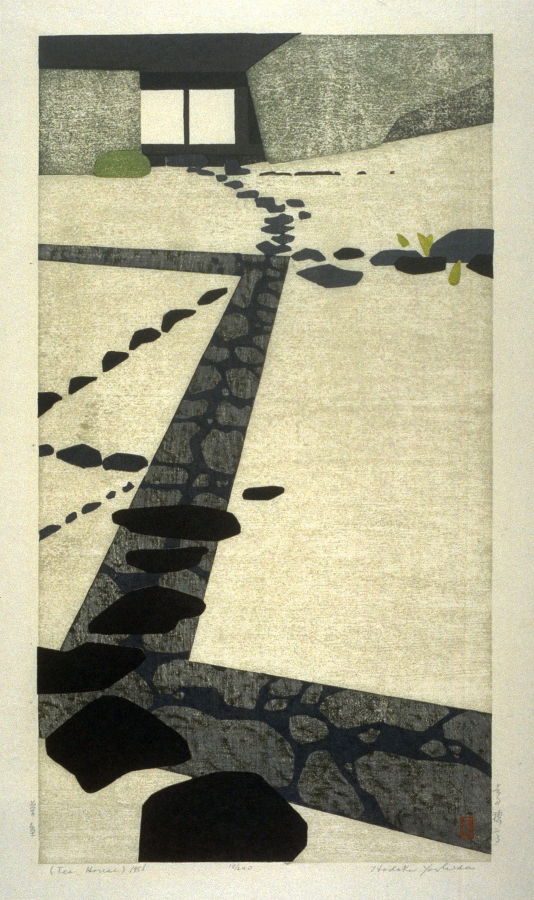
Tea House
- Medium:
- Woodblock print
- Source:
- Fine Arts Museums of San Francisco
- Image courtesy of
- Fine Arts Museums of San Francisco
Description
Tea House depicts a chashitsu — a purpose-built structure for the practice of chado — rendered in Yoshida's planar compositional style. The tea house's characteristic architectural vocabulary of low eaves, shoji screens, a small entry nijiriguchi, and a garden path offered Yoshida a subject built from right angles and overlapping geometric planes that aligned with his formal concerns. The print likely flattens the structure's recession into a near-isometric arrangement of tonal rectangles, the washi-colored paper underlying the composition serving as the lightest value for screen panels or garden gravel. Surrounding vegetation would be indicated through color masses rather than botanical specificity. The subject connects to the Japanese tradition of architectural and interior prints while Yoshida's treatment of it — simplified, graphic, stripped of decorative detail — places it firmly within postwar sōsaku-hanga rather than the meisho-e tradition of site documentation.
More Prints by Hodaka Yoshida

More Architecture Prints


Featured in Collections
Curated cross-cuts that include this print.
Frequently Asked Questions
Tea House was created by Hodaka Yoshida (吉田穂高).
Tea House depicts architecture and food & drink.