
Biography
Ichirakutei Eisui was a Japanese ukiyo-e artist active in Edo from roughly the mid-1790s into the opening years of the nineteenth century, a printmaker whose surviving body of work places him squarely among the most refined practitioners of late-Edo bijin-ga, or pictures of beautiful women. He is among the most distinguished pupils of Chobunsai Eishi, the samurai-turned-print-designer who trained under the ukiyo-e master Torii Bunryusai and went on to establish one of the most influential schools of courtesan portraiture in the closing years of the eighteenth century. Like his fellow Eishi pupils Chokosai Eisho and Rekisentei Eiri, Eisui adopted the first character of his master's name, signaling lineage and aesthetic affiliation in the conventional manner of Edo print studios. The exact dates of his birth and death are not recorded, and his career is reconstructed largely from the dated and datable prints he left behind, the publishers' seals on his sheets, and the small body of contemporary references to the Eishi circle. Despite this biographical thinness, the prints themselves disclose an artist of unusual technical poise, sensitive to surface, gesture, and the iconographic codes of the Yoshiwara, the licensed pleasure quarter that dominated bijin-ga production in his generation.
Eisui's training under Chobunsai Eishi placed him at the center of a distinct aesthetic project. Eishi, born into the Hosoda family of high-ranking shogunal retainers, had brought to ukiyo-e a manner shaped by his early study with the Kano-school painter Eisen'in Michinobu. After leaving official service to devote himself to ukiyo-e in the 1780s, Eishi developed an idiom of attenuated, elongated female figures rendered with restrained color and unusually quiet expressions, a manner that drew on Kano linearity even as it competed directly with the broader, more sensuous beauties of Kitagawa Utamaro. Eisui inherited this elongated canon of proportion, the elegant facial type with thin lips and downcast eyes, and the preference for muted but jewel-like color harmonies that distinguish Eishi-school bijin-ga from the work of Utamaro, Eishosai Choki, and the contemporaneous designers of the Utagawa line. In his most accomplished prints, Eisui carried the master's elegance into a series of large-head bijin-ga, or okubi-e, that rank among the finest produced during the brief period when this format was the central format of the Edo print trade.
The high point of Eisui's documented activity falls in the second half of the 1790s, the years immediately following Utamaro's celebrated okubi-e of the early Kansei era, when publishers competed to issue half-length and bust-format portraits of named Yoshiwara courtesans printed against luxurious mica-dusted grounds. Eisui contributed to this market a series of okubi-e that name specific oiran of the great Yoshiwara houses: courtesans of the Chojiya, the Ogiya, the Matsubaya, and the Hyogoya, the most prestigious establishments of the quarter. His portraits of the courtesans Senzan, Hinazuru, Hanahito, Takigawa, Somenosuke, Tsukioka, and Hanaogi survive in significant museum collections, including the Art Institute of Chicago, the Metropolitan Museum of Art, the British Museum, and the Museum of Fine Arts in Boston. These prints typically present the sitter at half-length or three-quarter length, identified by a cartouche bearing her professional name and that of her brothel, the surface enriched by careful color registration, sparing use of metallic pigment, and pale grey or mica grounds that frame the figure without distracting from her contours.
Alongside the standard portraits of named courtesans, Eisui also designed sets that linked beauties to literary and theatrical themes, in keeping with the late-Edo taste for prints that could be read on more than one level. His series Beauties of the Five Festivals (Bijin gosekku) attaches its courtesans to the five seasonal observances of the Edo calendar, while Beauties in Joruri Roles (Bijin awase joruri kagami) places named oiran in poses associated with celebrated puppet-theater roles, including the lovers Osome and Hisamatsu and the romantic outlaws Shirai Gonpachi and Komurasaki. A separate, more narrative composition takes its subject from the Chushingura cycle, the dramatized history of the forty-seven loyal retainers that recurs throughout late-eighteenth-century print design. In these works, Eisui adapts Eishi's elegant figural type to the demands of named role-play and theatrical reference, producing images that read simultaneously as portraits of glamorous Yoshiwara women and as visual allusions to plays, ballads, and seasonal customs that the original buyers would have recognized without difficulty.
The Chobunsai school to which Eisui belonged was distinguished, in its own time and afterward, by its refusal to push into the heightened emotionalism and erotic explicitness of certain contemporaries. Where Utamaro's late okubi-e seek the visible flush of a particular feeling, Eisui's beauties remain composed, their interior life suggested rather than declared, the surface of skin and silk preserving a slight reserve that critics have long associated with the school's samurai origins. This restraint did not preclude inventiveness in design: Eisui's compositions make sophisticated use of the oban sheet, balancing the weight of the figure against negative space, employing tilted-head poses that animate the contour without violating the calm of the face, and selecting kimono patterns and obi designs with a graphic intelligence that places his sheets among the more decoratively coherent of their generation.
Eisui's career as a print designer appears to have wound down in the first years of the nineteenth century, in part because of the broader contraction of the Eishi school after the master himself turned increasingly to painting. Like his fellow students Eisho and Eiri, Eisui was a designer for the publishers of his particular moment, and the rise of the Utagawa school under Toyokuni and his pupils reshaped the Edo print market in ways that left less room for the elongated Eishi manner. Nonetheless, his okubi-e of named Yoshiwara courtesans remain influential documents of late-Kansei taste, and his surviving sheets at major museums make clear that he was a primary contributor to one of the most sophisticated decades in the history of Japanese print design. For collectors and students of ukiyo-e, Ichirakutei Eisui stands today as the closest of Chobunsai Eishi's students, an artist whose tightly focused body of bijin-ga preserves the cool elegance of his master's school in some of its most accomplished impressions.
Key Facts
- Nationality
- 🇯🇵Japan
- Movement
- Ukiyo-e
- Works Indexed
- 11
Frequently Asked Questions
Ichirakutei Eisui was a Japanese ukiyo-e artist active in Edo from roughly the mid-1790s into the opening years of the nineteenth century, a printmaker whose surviving body of work places him squarely among the most refined practitioners of late-Edo bijin-ga, or pictures of beautiful women. He is among the most distinguished pupils of Chobunsai Eishi, the samurai-turned-print-designer who trained under the ukiyo-e master Torii Bunryusai and went on to establish one of the most influential schools of courtesan portraiture in the closing years of the eighteenth century. Like his fellow Eishi pupils Chokosai Eisho and Rekisentei Eiri, Eisui adopted the first character of his master's name, signaling lineage and aesthetic affiliation in the conventional manner of Edo print studios. The exact dates of his birth and death are not recorded, and his career is reconstructed largely from the dated and datable prints he left behind, the publishers' seals on his sheets, and the small body of contemporary references to the Eishi circle. Despite this biographical thinness, the prints themselves disclose an artist of unusual technical poise, sensitive to surface, gesture, and the iconographic codes of the Yoshiwara, the licensed pleasure quarter that dominated bijin-ga production in his generation.
Ichirakutei Eisui's work was shaped by the Ukiyo-e tradition in Japanese woodblock printmaking. Ukiyo-e: ## What is ukiyo-e? Ukiyo-e ([浮世絵](/glossary/ukiyo-e)) — literally "pictures of the floating world" — is the Edo-period Japanese print and painting tradition that flourished from roughly 1660 to 1868, depicting the pleasures of urban life in Edo (modern Tokyo): courtesans, kabuki actors, sumo wrestlers, famous landscapes, and seasonal beauties.
Original prints by Ichirakutei Eisui can be found in collections including Art Institute of Chicago, Metropolitan Museum of Art.
Woodblock Prints by Ichirakutei Eisui (11)
The Courtesan Senzan of the Chojiya, from the series "Beauties of the Five Festivals (Bijin gosekku)"
c. 1795/1800
Color woodblock print; oban
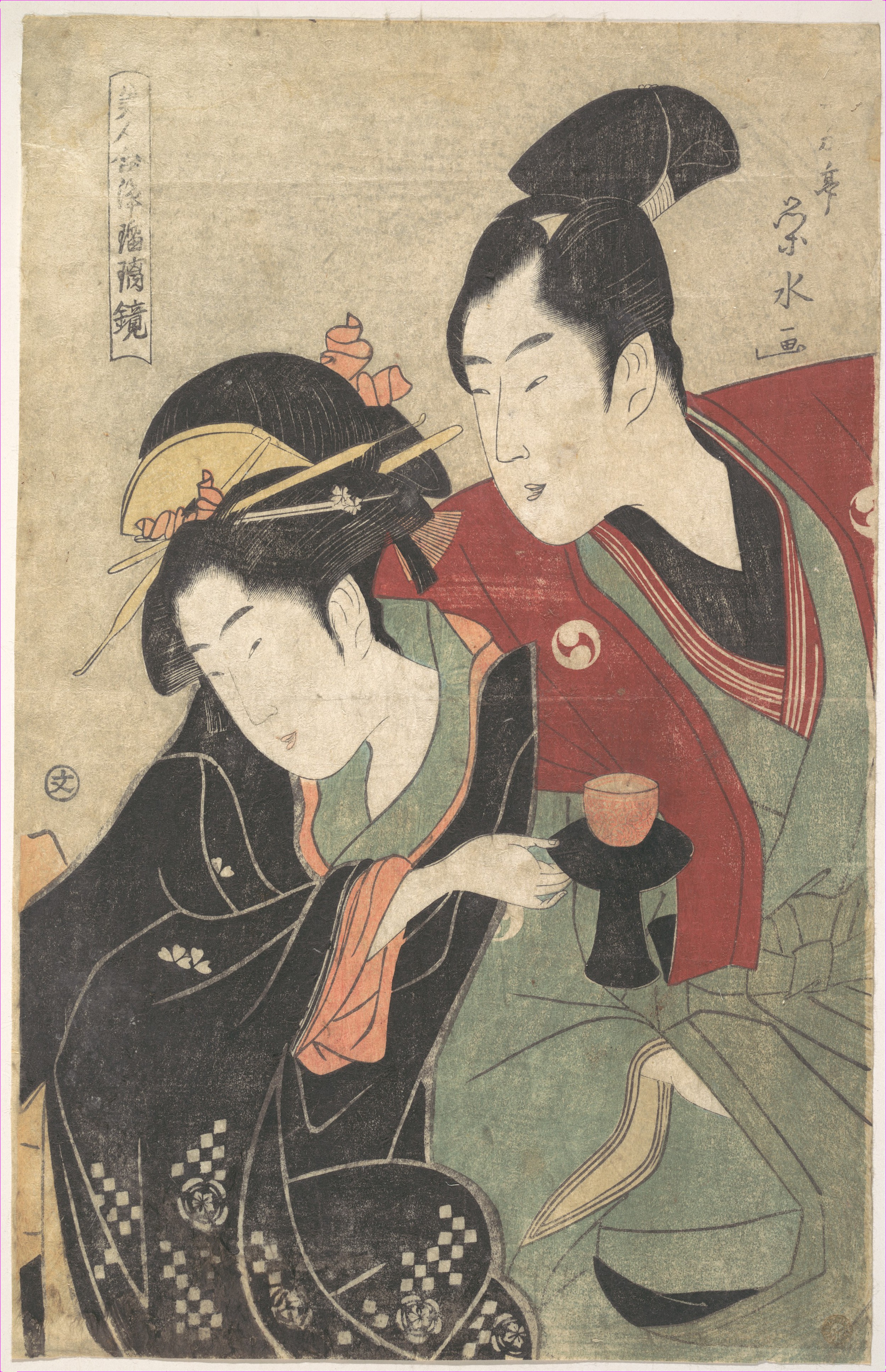
Scene from the "Chushingura" Drama
ca. 1797
Woodblock print; ink and color on paper

Shirai Gonpachi and Komurasaki, from the series "Beauties in Joruri Roles (Bijin awase joruri kagami)"
c. 1795
Color woodblock print; oban

The Courtesan Takigawa of the Ogiya, from the series "Beauties of the Five Festivals (Bijin gosekku)"
c. 1795/1800
Color woodblock print; oban

The courtesan Hinazuru of the Chojiya
1790/1823
Color woodblock print; oban

The Courtesan Hanahito of the Ogiya and attendants Sakura and Momiji, from the series "Beauties of the Five Festivals (Bijin gosekku)"
c. 1795/1800
Color woodblock print; oban

Osome and Hisamatsu, from the series "Beauties in Joruri Roles (Bijin awase joruri kagami)"
c. 1795
Color woodblock print; oban

The Courtesan Somenosuke of the Matsubaya
c. 1797
Color woodblock print; oban
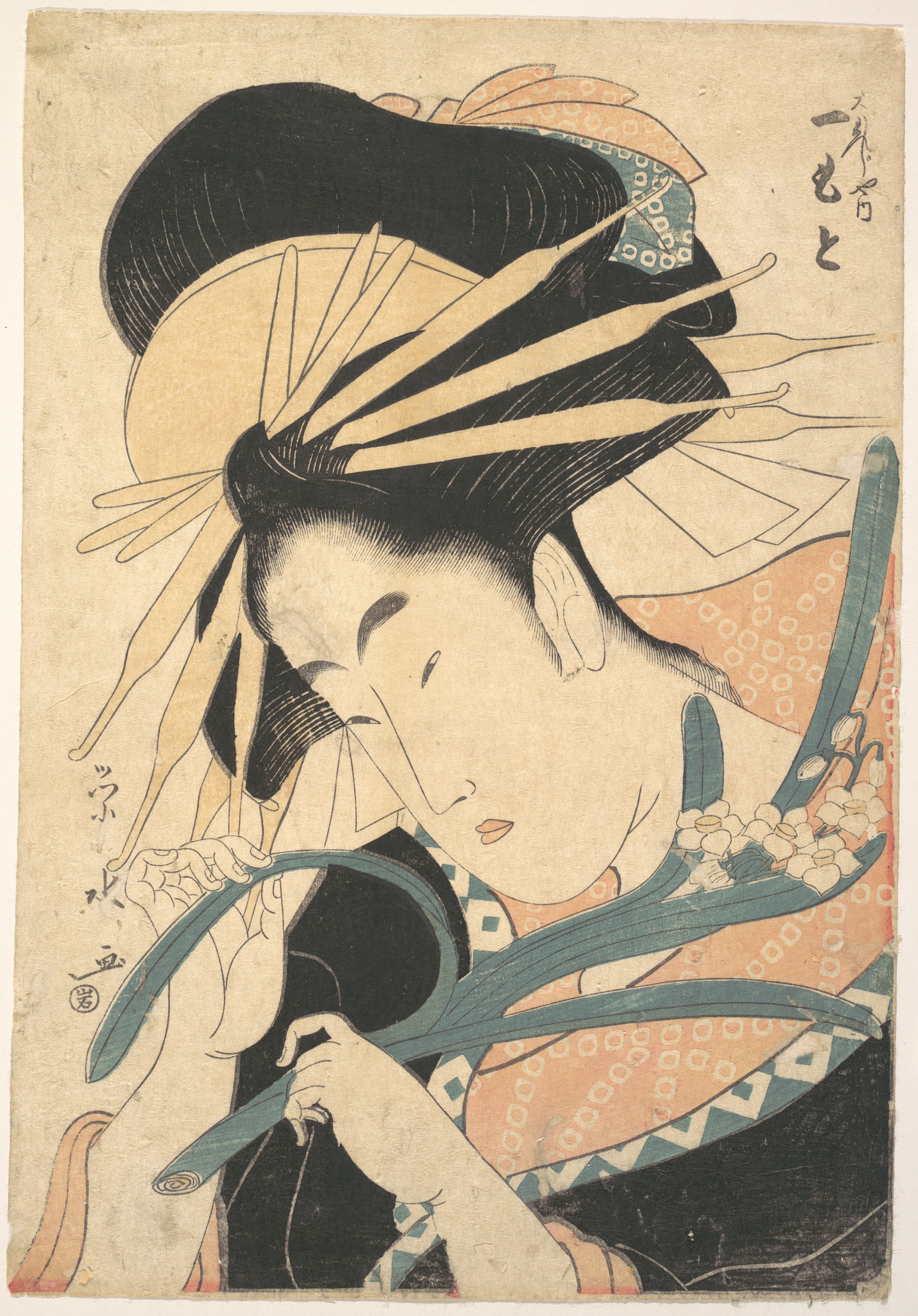
A Beauty
Woodblock print; ink and color on paper

The Courtesan Tsukioka of Hyōgoya
c. 1797
Woodblock print; ink and color on paper

The Courtesan Hanaogi of the Ogiya
c. 1798
Color woodblock print; oban