Biography
Ishii Hakutei (石井柏亭, 1882–1958) was a Japanese painter, printmaker, and art critic who occupied a distinctive position in the history of modern Japanese printmaking as a figure whose career touched both the shin-hanga and the creative-print (sōsaku-hanga) worlds. An early advocate of the creative-print spirit who nonetheless produced most of his own prints through the collaborative workshop model, Hakutei embodied the creative tensions and ideological debates that shaped twentieth-century Japanese printmaking.
Born in 1882 in the Taitō district of Tokyo, Hakutei — whose given name was Mankichi — came from an artistic family: his father, Ishii Teiko, was a Japanese-style (nihonga) painter. Hakutei first studied traditional painting with his father before turning to Western-style painting (yōga), which he pursued under Asai Chū and Nakamura Fusetsu and then, briefly, under Kuroda Seiki and Fujishima Takeji at the Tokyo School of Fine Arts, though he left in his first year. This grounding in both Japanese and Western art gave him an unusually broad perspective and positioned him to move between the two artistic worlds with ease.
Hakutei's involvement with the creative-print movement began early and through publishing rather than institutions. In 1907 he co-founded, with the artist Yamamoto Kanae, the influential art magazine Hōsun (方寸), which ran until 1911 and became an important vehicle for promoting the ideal of the artist as sole creator — designing, carving, and printing without the assistance of professional craftsmen. This philosophy stood in contrast to the collaborative model later associated with shin-hanga, in which the artist provided the design while specialized carvers and printers executed the physical print. Through Hōsun and his participation in artistic circles such as the Pan no Kai, Hakutei helped lay the intellectual groundwork for what would become the sōsaku-hanga movement.
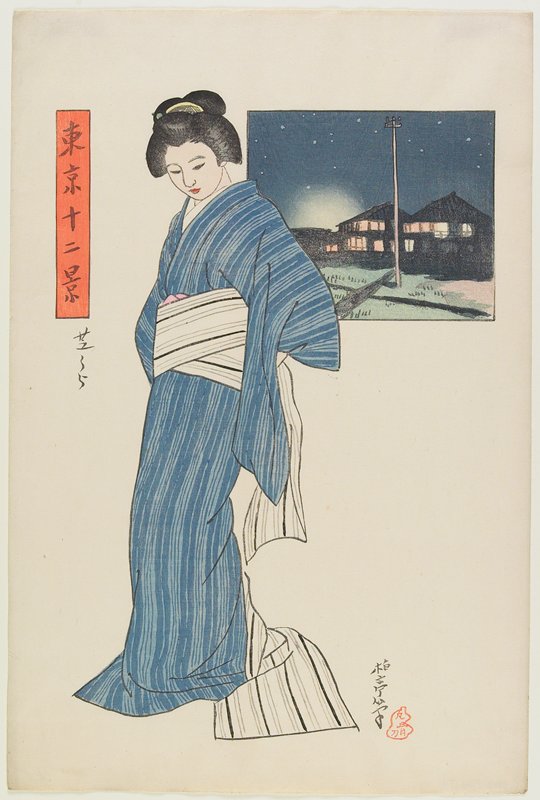
Yet Hakutei's own printmaking did not follow creative-print orthodoxy. Apart from a single small woodcut he cut and printed himself in 1914, his prints were produced in the collaborative manner, with professional artisans carving and printing his designs. His best-known prints belong to the series Twelve Views of Tokyo, begun in 1910, in which each sheet pairs a woman in everyday kimono with an inset view (koma-e) of a modern Tokyo district; the designs were realized with the carver Igami Bonkotsu and the printer Nishimura Kumakichi. This pragmatic approach reflected a belief that the quality of the finished work mattered more than the ideological purity of the production process.
As a painter, Hakutei worked primarily in watercolor and oil, producing landscapes and genre scenes that reflected his Western training. In 1914 he was among the founders of the Nika-kai (Second Section Society), a progressive art association, and he exhibited widely; he later helped establish the Bunka Gakuin art school (1921) and co-founded the Issuikai (1936). From 1911 he traveled in Europe, spending time in Paris and reporting back on the Fauvist, Futurist, Cubist, and other avant-garde work he encountered. His art criticism was influential, helping to shape public understanding of both Japanese and Western modern art.
Hakutei's woodblock prints encompass landscapes, cityscapes, and genre scenes rendered in a style that combines Western observation with a Japanese compositional sensibility. He died in 1958, having lived through the entire arc of both the shin-hanga and sōsaku-hanga movements. His legacy is that of a thoughtful, versatile artist who moved freely across the boundaries that divided the Japanese print world, and whose paintings and prints are held in museum collections in Japan and abroad.
Key Facts
- Active Period
- 1882–1958
- Nationality
- 🇯🇵Japan
- Movements
- Shin-hangaSōsaku-hanga
- Works Indexed
- 55
Frequently Asked Questions
Ishii Hakutei (石井柏亭, 1882–1958) was a Japanese painter, printmaker, and art critic who occupied a distinctive position in the history of modern Japanese printmaking as a figure whose career touched both the shin-hanga and the creative-print (sōsaku-hanga) worlds. An early advocate of the creative-print spirit who nonetheless produced most of his own prints through the collaborative workshop model, Hakutei embodied the creative tensions and ideological debates that shaped twentieth-century Japanese printmaking.
Ishii Hakutei was active from 1882 to 1958. They were associated with the Shin-hanga and Sōsaku-hanga movements.
Ishii Hakutei's work was shaped by the Shin-hanga and Sōsaku-hanga traditions in Japanese woodblock printmaking. Shin-hanga: ## What is Shin-hanga? Shin-hanga (新版画), literally "new prints," is the early twentieth-century revival of the collaborative Japanese woodblock workshop, organized between roughly 1915 and 1960 by the Tokyo publisher Watanabe Shōzaburō (1885–1962) and a handful of competing houses. Sōsaku-hanga: ## What is sōsaku-hanga? Sōsaku-hanga (創作版画, "creative prints") was a twentieth-century Japanese print movement defined by a single commitment: the artist must design, carve, and print every work alone.
Ishii Hakutei's prints frequently feature urban scenes, landscapes, famous places (meisho-e), edo & tokyo, bridges, rivers & lakes.
Original prints by Ishii Hakutei can be found in collections including Museum of Fine Arts Boston, Scholten Japanese Art, British Museum, Minneapolis Institute of Art.