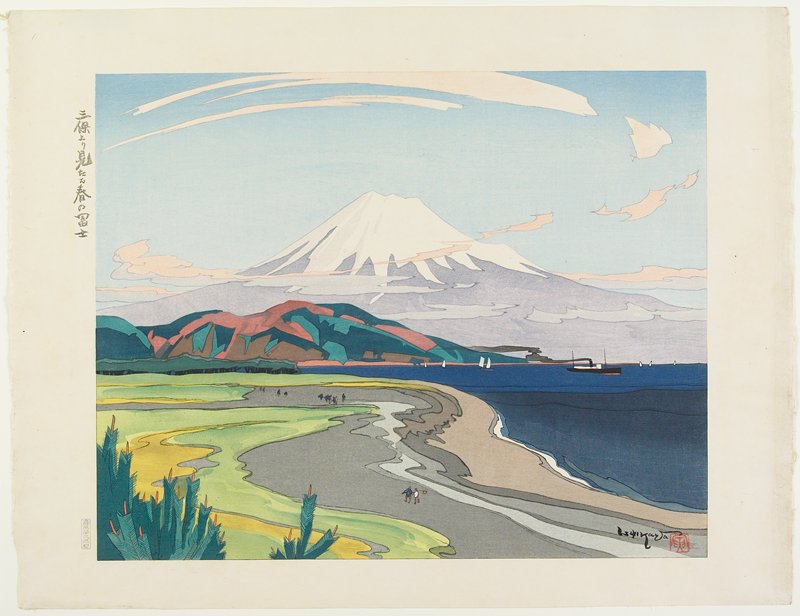
Biography
Ishikawa Toraji (石川寅治, 1875–1964) was a Japanese painter and printmaker whose woodblock prints of female nudes and figure studies occupy a distinctive position in early-twentieth-century Japanese printmaking. At a time when most figure printmakers of the period worked within the bijin-ga tradition of clothed beauties, Ishikawa's prints of unclothed women represented a bold synthesis of Western oil-painting conventions with the Japanese woodblock medium, creating works that were unusual, technically accomplished, and artistically daring.
Born in 1875 in Kōchi, on the Pacific coast of the island of Shikoku, Ishikawa trained as a Western-style (yōga) painter under Koyama Shōtarō, studying at Koyama's Fudōsha school rather than in the nihonga tradition. This grounding in Western painting gave him a command of anatomical drawing, chiaroscuro modeling, and perspective that distinguished his approach throughout his career. In 1902 he became a founding member of the Taiheiyō Gakai (Pacific Painting Society), a leading association of Western-style painters, and around the same time he undertook an extended sketching journey of roughly two years through the United States and Europe. He built a substantial reputation as an oil painter, exhibiting in major Japanese exhibitions, and in 1953 he was honored with the Imperial Prize of the Japan Art Academy.
Ishikawa's best-known contribution to printmaking is his series "Ten Types of Female Nudes" (Rajo Jisshu), which he produced in 1934. Rather than issuing the prints through an established commercial publisher, he brought the series out himself, designing the images and having them realized with the help of professional carvers and printers. The prints treat the female body with a naturalism and three-dimensional modeling that departs markedly from the flat, decorative approach characteristic of traditional Japanese figure art, and their frank modernity made the series controversial when it first appeared.
The prints typically depict single female figures in everyday moments — bathing, reading, grooming, or reclining — rendered with careful attention to the play of light across skin and the subtle modeling of form. The flesh tones are built up through multiple layers of bokashi (graduated color) printing, creating a warmth and luminosity that demonstrates the woodblock medium's capacity for effects normally associated with oil painting. The backgrounds are generally minimal, focusing attention on the figure itself.
Beyond his nude studies, Ishikawa began his career as a landscape painter and continued to work in oils throughout his life, remaining active in Japanese art circles as both a practitioner and an advocate for Western-style art. In 1943 he was appointed head of the Pacific Art School, and after the war he taught at the Tokyo University of Education. His long life — he lived to eighty-nine — spanned the entire arc of the shin-hanga era from its origins to its decline.
Ishikawa's prints are held in various museum collections, and his work appeals to collectors who appreciate the cross-cultural synthesis of Western figure painting and Japanese woodblock technique that his prints embody.
Key Facts
- Active Period
- 1875–1964
- Nationality
- 🇯🇵Japan
- Movement
- Shin-hanga
- Works Indexed
- 75
Frequently Asked Questions
Ishikawa Toraji (石川寅治, 1875–1964) was a Japanese painter and printmaker whose woodblock prints of female nudes and figure studies occupy a distinctive position in early-twentieth-century Japanese printmaking. At a time when most figure printmakers of the period worked within the bijin-ga tradition of clothed beauties, Ishikawa's prints of unclothed women represented a bold synthesis of Western oil-painting conventions with the Japanese woodblock medium, creating works that were unusual, technically accomplished, and artistically daring.
Ishikawa Toraji was active from 1875 to 1964. They were associated with the Shin-hanga movement.
Ishikawa Toraji's work was shaped by the Shin-hanga tradition in Japanese woodblock printmaking. Shin-hanga: ## What is Shin-hanga? Shin-hanga (新版画), literally "new prints," is the early twentieth-century revival of the collaborative Japanese woodblock workshop, organized between roughly 1915 and 1960 by the Tokyo publisher Watanabe Shōzaburō (1885–1962) and a handful of competing houses.
Ishikawa Toraji's prints frequently feature bijin-ga, figures, nude, cats, seascapes, spring.
Original prints by Ishikawa Toraji can be found in collections including Honolulu Museum of Art, Fine Arts Museums of San Francisco, Art of Japan, Japanese Art Open Database.
Series by Ishikawa Toraji
Woodblock Prints by Ishikawa Toraji (75)

Ten Types of Female Nudes: Reading (Rajo jusshu: Dokusho)
Woodblock print

Nude on a beach (keyblock for an unpublished print)
Woodblock print
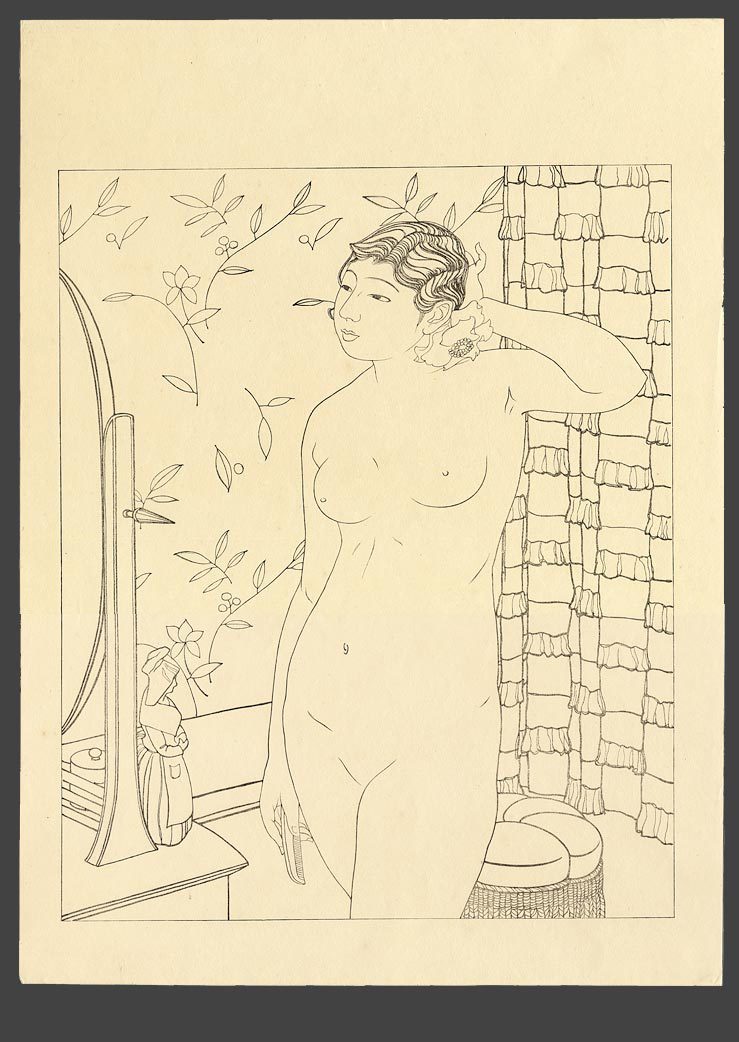
Spring time of life
Woodblock print

Nude at Her Bath
Woodblock print
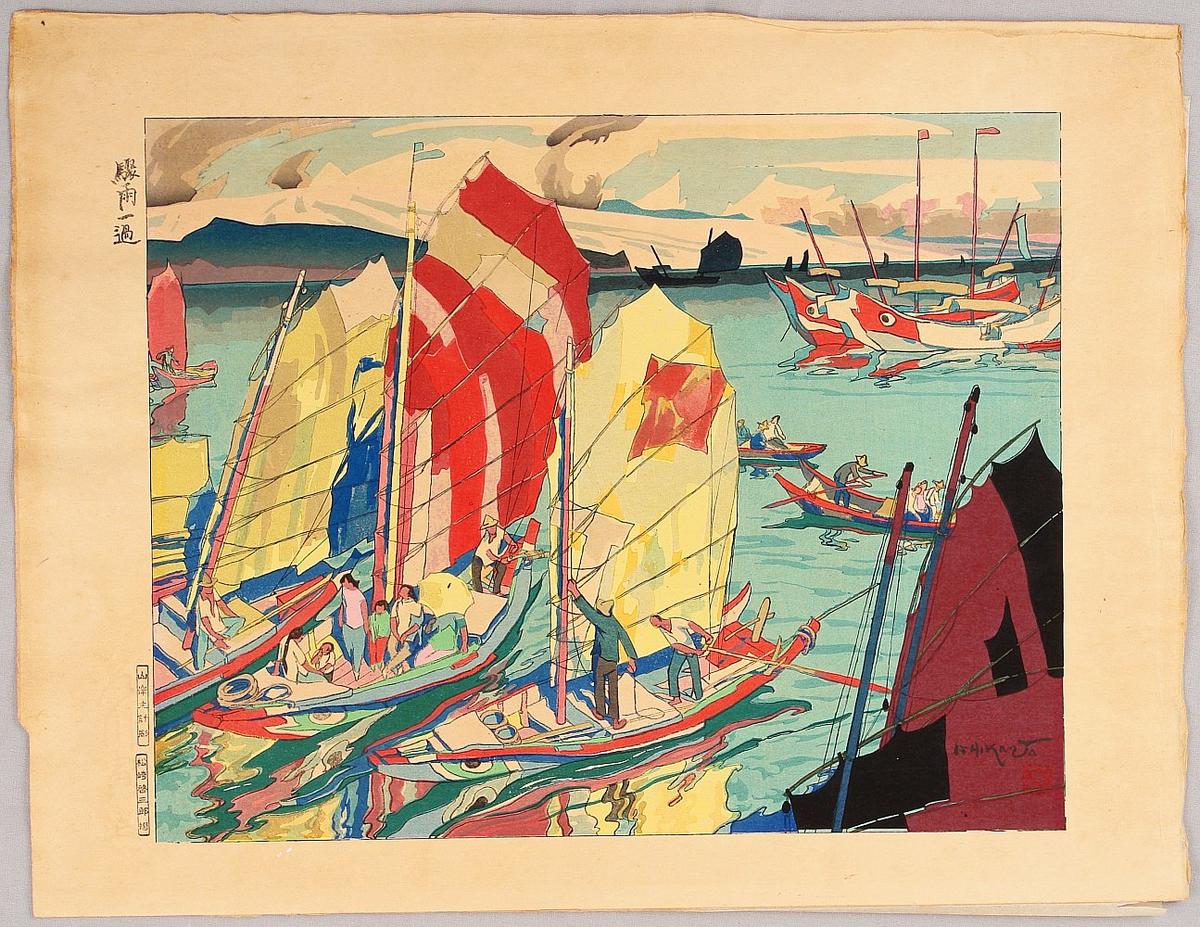
After a Shower
Woodblock print
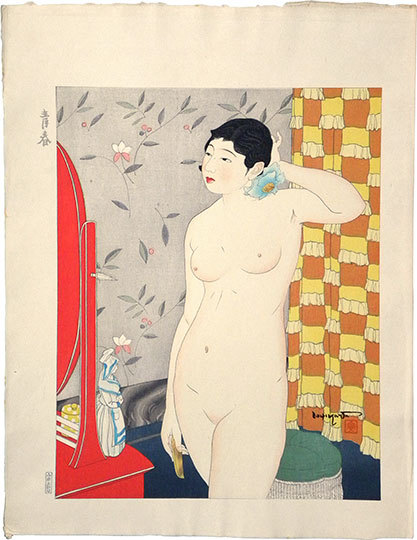
Ten Types of Female Nudes: Springtime of Life (Youth) (Rajo jusshu: Seishun)
Woodblock print
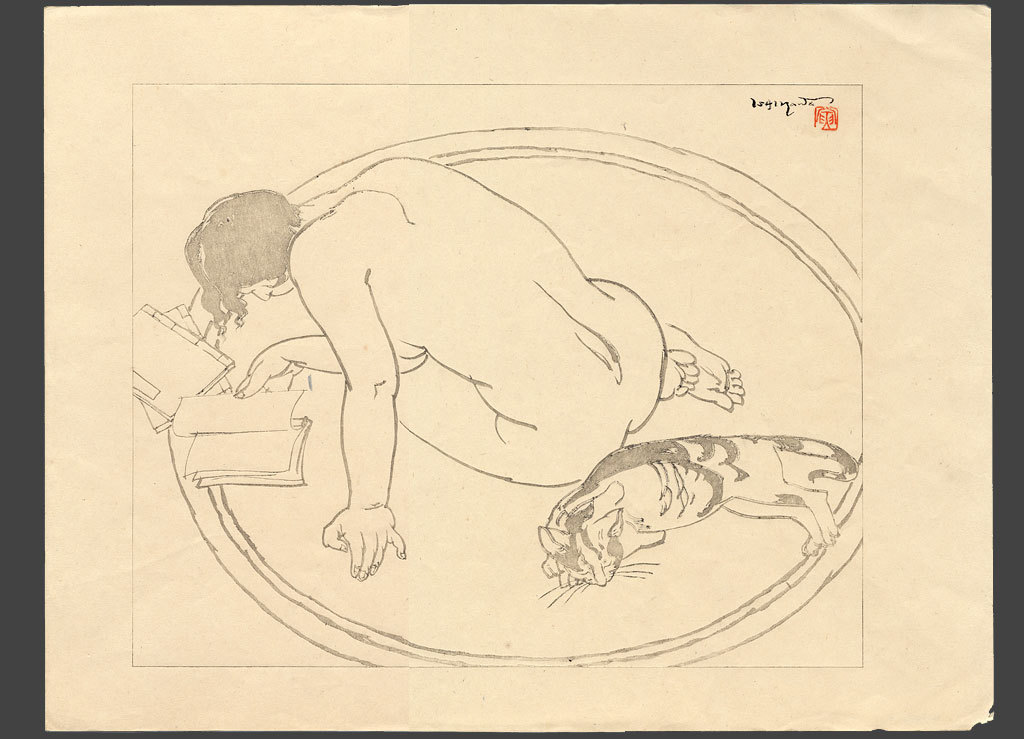
Bored
Woodblock print

Springtime of Life
Woodblock print
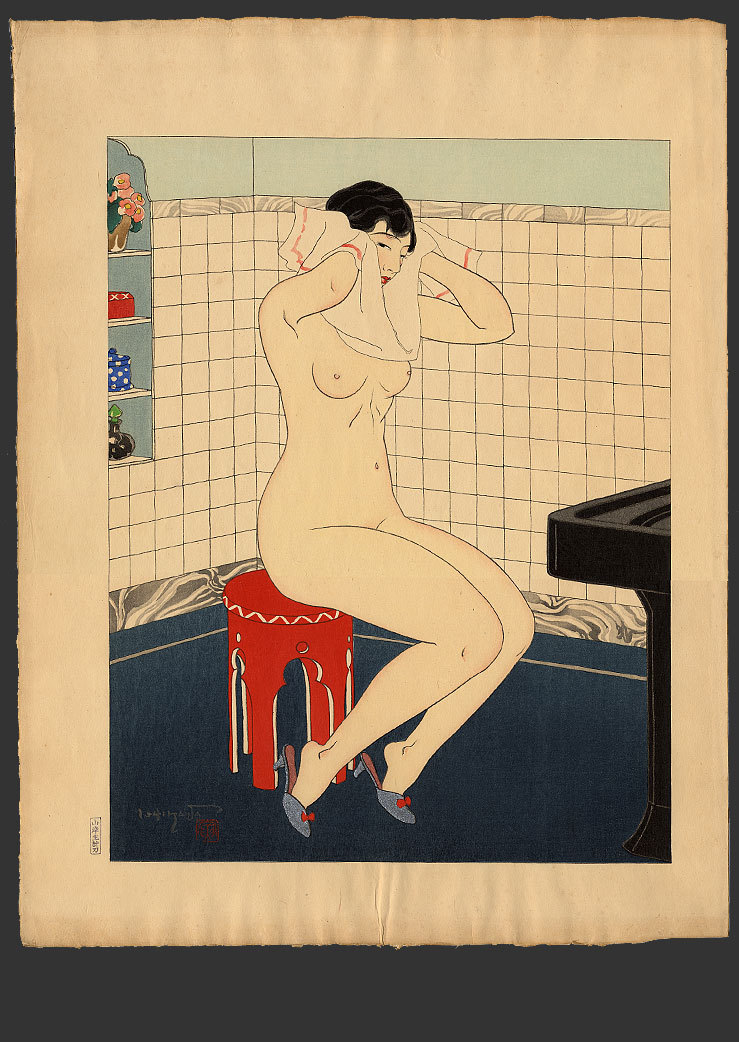
Morning
Woodblock print

In the bathroom
Mokuhanga (Japanese woodblock)

New Territory Souvenirs
Mokuhanga (Japanese woodblock)

Small woodblock print, page 69 from Shin Nihon kenbutsu
Mokuhanga (Japanese woodblock)

Small woodblock print, page 38 from Shin Nihon kenbutsu
Mokuhanga (Japanese woodblock)

Small woodblock print, page 20 from Shin Nihon kenbutsu
Mokuhanga (Japanese woodblock)

Inland sea
Mokuhanga (Japanese woodblock)

Mt Fuji in spring seen from Miho
Mokuhanga (Japanese woodblock)

Breakwater
Mokuhanga (Japanese woodblock)

Reading
Mokuhanga (Japanese woodblock)

After a sudden shower
Mokuhanga (Japanese woodblock)

Black cat
Mokuhanga (Japanese woodblock)

Black cat
Mokuhanga (Japanese woodblock)

Reading
Mokuhanga (Japanese woodblock)

Bored
Mokuhanga (Japanese woodblock)

Blue Parrot
Mokuhanga (Japanese woodblock)