Biography
Iwasa Matabei (岩佐又兵衛, 1578-1650) is one of the most consequential and disputed figures in the genealogy of ukiyo-e, an early Edo-period painter whose hanging scrolls and screens of common-life subjects are frequently cited as the genre's prehistory and, in some scholarly traditions, as the moment when ukiyo-e first crystallized as a coherent pictorial mode. Working a half-century before Hishikawa Moronobu's foundational woodblock single sheets of the 1670s, Matabei produced his floating-world imagery as painted scrolls and screens rather than as prints, but the subjects he addressed — dancers and entertainers of Kyoto, genre scenes of the new urban classes, literary heroines of medieval narrative reimagined in contemporary dress — anticipated by decades the visual world that later print masters would inherit and codify.
Matabei was born in 1578 into one of the spectacular tragedies of the late Sengoku period. He was the son of Araki Murashige, a daimyo and former retainer of Oda Nobunaga who had famously rebelled against his lord that same year and held the besieged Arioka Castle for over a year before fleeing. When the castle finally fell, Nobunaga's forces executed virtually the entire Araki household in a notorious bloodbath; Matabei survived only because a wet nurse spirited the infant away to the Hongan-ji temple in Kyoto, where he was raised under the family name Iwasa, his mother's surname. This childhood escape from annihilation seems to have left a lasting mark on his sensibility; scholars have noted the strain of psychological intensity and unsettling violence that runs through his most ambitious paintings.
After coming of age, Matabei studied painting in both the Tosa school's classical yamato-e tradition, with its delicate line, narrative subjects, and bright mineral colors, and the more austere ink idiom of the Kano school, which dominated official commissions under the Tokugawa regime. His mature work synthesizes these inheritances with the popular subject matter of Kyoto's flourishing entertainment culture, producing a distinctive style marked by full-bodied figures with broad cheeks, elongated jaws, and slightly downcast eyes. This full-cheeked figural manner became the visible signature of his hand and the basis for centuries of attributions and misattributions.
Matabei began his career in Kyoto, then still the cultural center of Japan, but around the age of forty he left the capital for Echizen province (present-day Fukui) to serve its Matsudaira lords. It was during this roughly two-decade Echizen period that he is thought to have produced many of the ambitious narrative handscrolls for which he is now known, including the great emaki treating the medieval romances of Yamanaka Tokiwa and Joruri Monogatari, with their lengthy serial illustrations of legendary love and loss rendered in his unmistakable figural style; both survive today at the MOA Museum of Art. He also painted hanging scrolls of classical literary subjects — the heroines of the Tales of Ise, the famous female poets of the Heian period, the courtier-poets of the imperial anthologies — all reimagined in his characteristic manner, as well as the dispersed album leaves of the Thirty-Six Poetic Immortals known as the Dōon Version, sheets of which now reside in collections including the Metropolitan Museum of Art.
In 1637, at the invitation of the shogun Tokugawa Iemitsu, Matabei moved to Edo, where he spent the final thirteen years of his life producing commissions for the Tokugawa house and other warrior patrons; in 1640 he painted a set of the Thirty-Six Poets for the Tōshōgū shrine at Kawagoe. Matabei died in Edo in 1650, leaving behind a body of work whose attribution and dating have occupied generations of scholars and a cluster of follower-paintings that significantly outnumber the firmly attributed core.
The historiographic claim that Matabei founded ukiyo-e originates from later Edo-period writings by critics and ukiyo-e practitioners who looked back to his genre subjects as the origin point of their own tradition; in Japan it long remained common to regard him as the originator of ukiyo-e. The claim is contested in modern scholarship: some attribute the foundational role more squarely to Hishikawa Moronobu and the woodblock print, while others hold that the early tradition linking Matabei to ukiyo-e reflects a genuine genealogical connection. What is uncontested is that his genre scrolls and screens are among the most accomplished early treatments of what would become the central ukiyo-e subjects. A related Iwasa or Matabei school descended from him and continued producing genre and literary subjects in his manner through the seventeenth century. His work survives today in major Japanese collections, including the MOA Museum of Art, and in American holdings such as the Metropolitan Museum of Art and the Cleveland Museum of Art.
Key Facts
- Active Period
- 1578–1650
- Nationality
- 🇯🇵Japan
- Movement
- Ukiyo-e
- Works Indexed
- 5
Frequently Asked Questions
Iwasa Matabei (岩佐又兵衛, 1578-1650) is one of the most consequential and disputed figures in the genealogy of ukiyo-e, an early Edo-period painter whose hanging scrolls and screens of common-life subjects are frequently cited as the genre's prehistory and, in some scholarly traditions, as the moment when ukiyo-e first crystallized as a coherent pictorial mode. Working a half-century before Hishikawa Moronobu's foundational woodblock single sheets of the 1670s, Matabei produced his floating-world imagery as painted scrolls and screens rather than as prints, but the subjects he addressed — dancers and entertainers of Kyoto, genre scenes of the new urban classes, literary heroines of medieval narrative reimagined in contemporary dress — anticipated by decades the visual world that later print masters would inherit and codify.
Iwasa Matabei was active from 1578 to 1650. They were associated with the Ukiyo-e movement.
Iwasa Matabei's work was shaped by the Ukiyo-e tradition in Japanese woodblock printmaking. Ukiyo-e: ## What is ukiyo-e? Ukiyo-e ([浮世絵](/glossary/ukiyo-e)) — literally "pictures of the floating world" — is the Edo-period Japanese print and painting tradition that flourished from roughly 1660 to 1868, depicting the pleasures of urban life in Edo (modern Tokyo): courtesans, kabuki actors, sumo wrestlers, famous landscapes, and seasonal beauties.
Original prints by Iwasa Matabei can be found in collections including Art Institute of Chicago, The Metropolitan Museum of Art, Cleveland Museum of Art.
Woodblock Prints by Iwasa Matabei (5)

Portrait of Chunagon Asatada
Edo period (1610-1868); about 1600
Hanging scroll; ink and color on paper
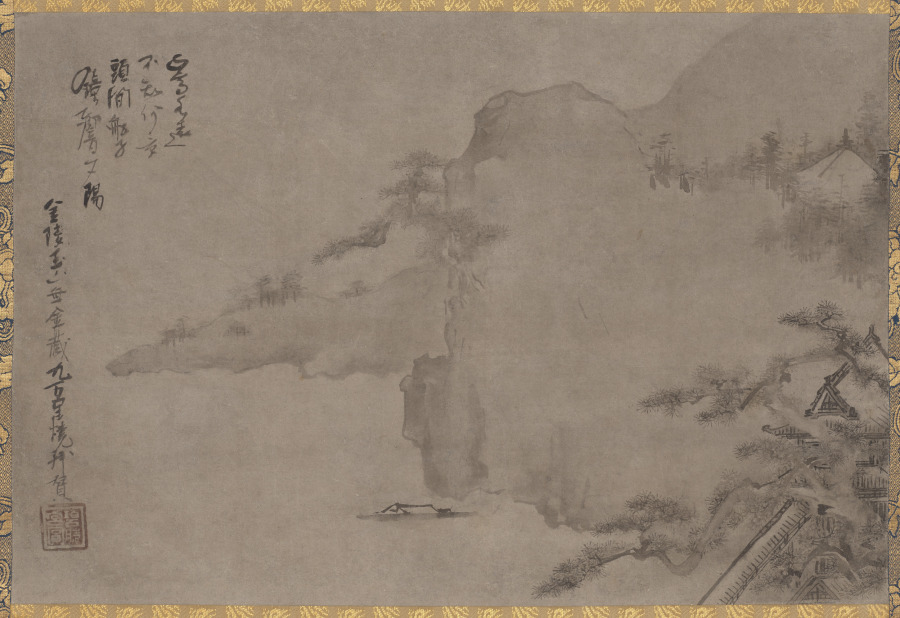
Coastal Landscape
1573-1615
Hanging scroll; ink on paper

Samurai
17th century
Hanging scroll; ink and color on paper

The Poetess Kotaigogu no Daibu
Edo period (1610-1898)
Hanging scroll; ink and colors on gold-flecked paper

Archbishop Henjō (Sōjō Henjō zu), from the Dōon Version of the Thirty-Six Poetic Immortals
僧正遍昭図
1620s-1630s
Hanging scroll: ink, color, gold and silver on paper