
The Poetess Kotaigogu no Daibu
- Date:
- Edo period (1610-1898)
- Medium:
- Hanging scroll; ink and colors on gold-flecked paper
- Source:
- Art Institute of Chicago
Description
Attributed to Iwasa Matabei and held in the Art Institute of Chicago, this hanging scroll painted in ink and colors on gold-flecked paper depicts Kenreimon'in Ukyo no Daibu, the celebrated late twelfth-century court lady-in-waiting and waka poet whose diary, the Kenreimon'in Ukyo no Daibu Shu, is one of the masterpieces of medieval Japanese literature. Known by her courtly title Kotaigogu no Daibu, she served Empress Kenreimon'in (Taira no Tokuko) and witnessed the catastrophic fall of the Taira clan, an experience that shaped the elegiac character of her surviving poetry. Matabei's depiction places her within the iconographic tradition of the female poetic immortals, a parallel canon to the male Thirty-Six Immortals, and renders her with his signature figural treatment, the broad face and downcast eyes, set against a richly decorative ground enhanced by scattered gold leaf, kirikane and noge, that catches the light in characteristic Momoyama fashion. The gold-flecked paper and the literary subject together demonstrate Matabei's command of the classical yamato-e tradition that he inherited from the Tosa school and his adaptation of it to the slightly looser, more pictorial sensibility of the early Edo period, when classical female literary figures were being reimagined for new patrons.
More Prints by Iwasa Matabei

Portrait of Chunagon Asatada
Edo period (1610-1868); about 1600
Hanging scroll; ink and color on paper

Archbishop Henjō (Sōjō Henjō zu), from the Dōon Version of the Thirty-Six Poetic Immortals
僧正遍昭図
1620s-1630s
Hanging scroll: ink, color, gold and silver on paper
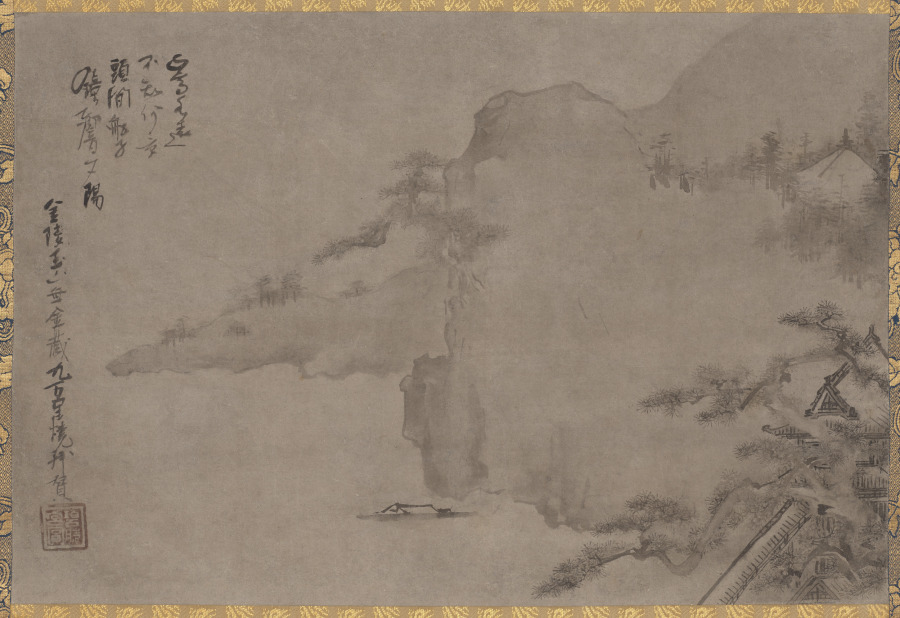
Coastal Landscape
1573-1615
Hanging scroll; ink on paper

Samurai
17th century
Hanging scroll; ink and color on paper
Frequently Asked Questions
The Poetess Kotaigogu no Daibu was created by Iwasa Matabei (岩佐又兵衛) in Edo period (1610-1898).