
Biography
Joel Stewart is an American artist who has lived and worked in Kyoto, Japan, since 1986, creating etchings, lithographs, watercolors, and mixed-media works that capture the quiet beauty of Japanese landscapes, still lifes, and architectural details with a sensitivity to light and shadow that reveals his deep immersion in Japanese visual culture.
Born in 1959 in Danville, California, Stewart grew up in the San Francisco Bay Area. He studied at Pitzer College in Claremont, California, earning a Bachelor of Arts degree in Art and Anthropology in 1982. The dual focus of his studies, combining studio practice with the study of human cultures, anticipated the cross-cultural artistic life he would later build.
After graduating, Stewart exhibited paintings in California and Washington before making the move that would define his career. In 1986 he relocated to Kyoto, initially to teach English, and made the city his permanent home. There he developed his practice in original color etchings, building the technical skills that would become the foundation of his print work.
Stewart's prints and watercolors emphasize the effects of light and shadow, creating a sense of depth and movement that draws viewers into his compositions. His subjects range from landscapes and architectural views to fish kites, ceramic still lifes, and close-up studies of flowers. There is a contemplative quality to his work that reflects both his years of living in Japan and his sensitivity to the subtle changes of light that mark the passage of seasons.
As a visiting artist at the American Academy in Rome, Stewart further developed his skills in watercolor. The experience added another layer to his artistic vocabulary without diluting his fundamental connection to Japan.
Stewart's work is held in collections including the Portland Art Museum, the Cleveland Museum of Art, the Los Angeles County Museum of Art, and the Allen Memorial Art Museum at Oberlin College, as well as the Morgan Stanley collection in Japan. His prints and paintings have been exhibited widely in both Japan and the United States.
He is represented by The Verne Collection in Cleveland, the Ren Brown Collection Gallery in California, and Hanga Ten gallery. Stewart continues to live and work in Kyoto, where he has spent nearly four decades finding new ways to render the beauty of the world around him.
Key Facts
- Active Period
- 1959
- Nationality
- 🇺🇸United States
- Movement
- Contemporary Mokuhanga
- Works Indexed
- 24
Frequently Asked Questions
Joel Stewart is an American artist who has lived and worked in Kyoto, Japan, since 1986, creating etchings, lithographs, watercolors, and mixed-media works that capture the quiet beauty of Japanese landscapes, still lifes, and architectural details with a sensitivity to light and shadow that reveals his deep immersion in Japanese visual culture.
Joel Stewart was active born in 1959. They were associated with the Contemporary Mokuhanga movement.
Joel Stewart's work was shaped by the Contemporary Mokuhanga tradition in Japanese woodblock printmaking. Contemporary Mokuhanga: Contemporary mokuhanga (literally "wood-block print") encompasses artists working from approximately 1970 to the present who continue or reinvent traditional Japanese woodblock printing techniques.
Joel Stewart's prints frequently feature etching, still life, lithograph, night scenes, moonlight, summer.
Woodblock Prints by Joel Stewart (24)
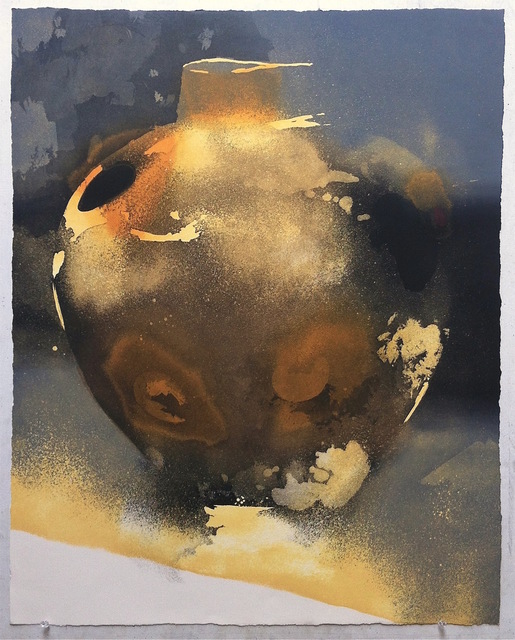
Harlequin
2000
Aquatint
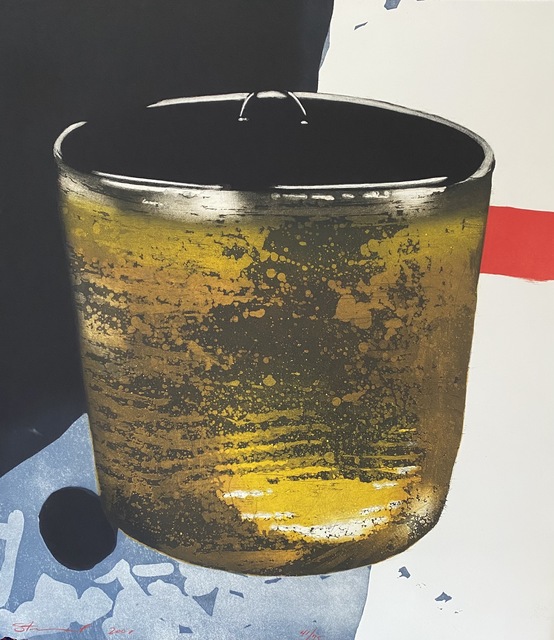
Lucky Strike
2001
Etching with aquatint

Edo
Etching

Homage
Etching

Chawan
Etching

Dawn
Etching

Edo II
Etching

Tanabota
Etching
Chabana
Etching

Moonlight
Etching

Nara Sansai
Etching

Red Flowers
Mokuhanga (Japanese woodblock)

Summer Tearoom
Mokuhanga (Japanese woodblock)

lucky strike
Mokuhanga (Japanese woodblock)

Winter Light
Mokuhanga (Japanese woodblock)

Chabana Series -Spring
Mokuhanga (Japanese woodblock)

History
Mokuhanga (Japanese woodblock)

Yesternow
Mokuhanga (Japanese woodblock)

Here and Now
Mokuhanga (Japanese woodblock)
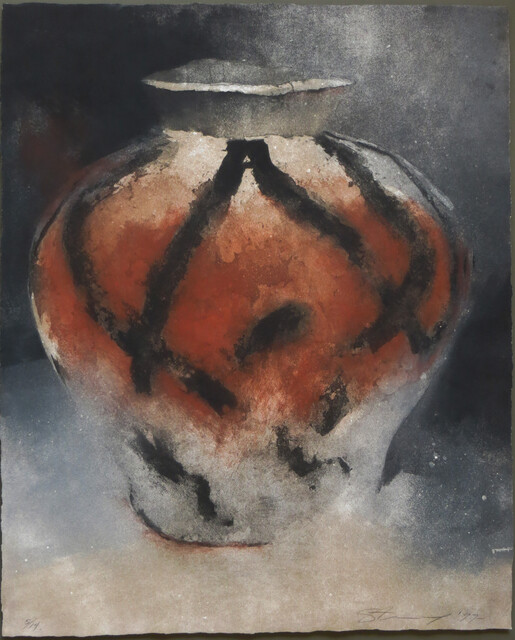
Eclipse
Aquatint on heavy paper

Summer Tearoom
Mokuhanga (Japanese woodblock)

Sunrise
Mokuhanga (Japanese woodblock)

Moonlight
Mokuhanga (Japanese woodblock)

Dawn
Mokuhanga (Japanese woodblock)