Biography
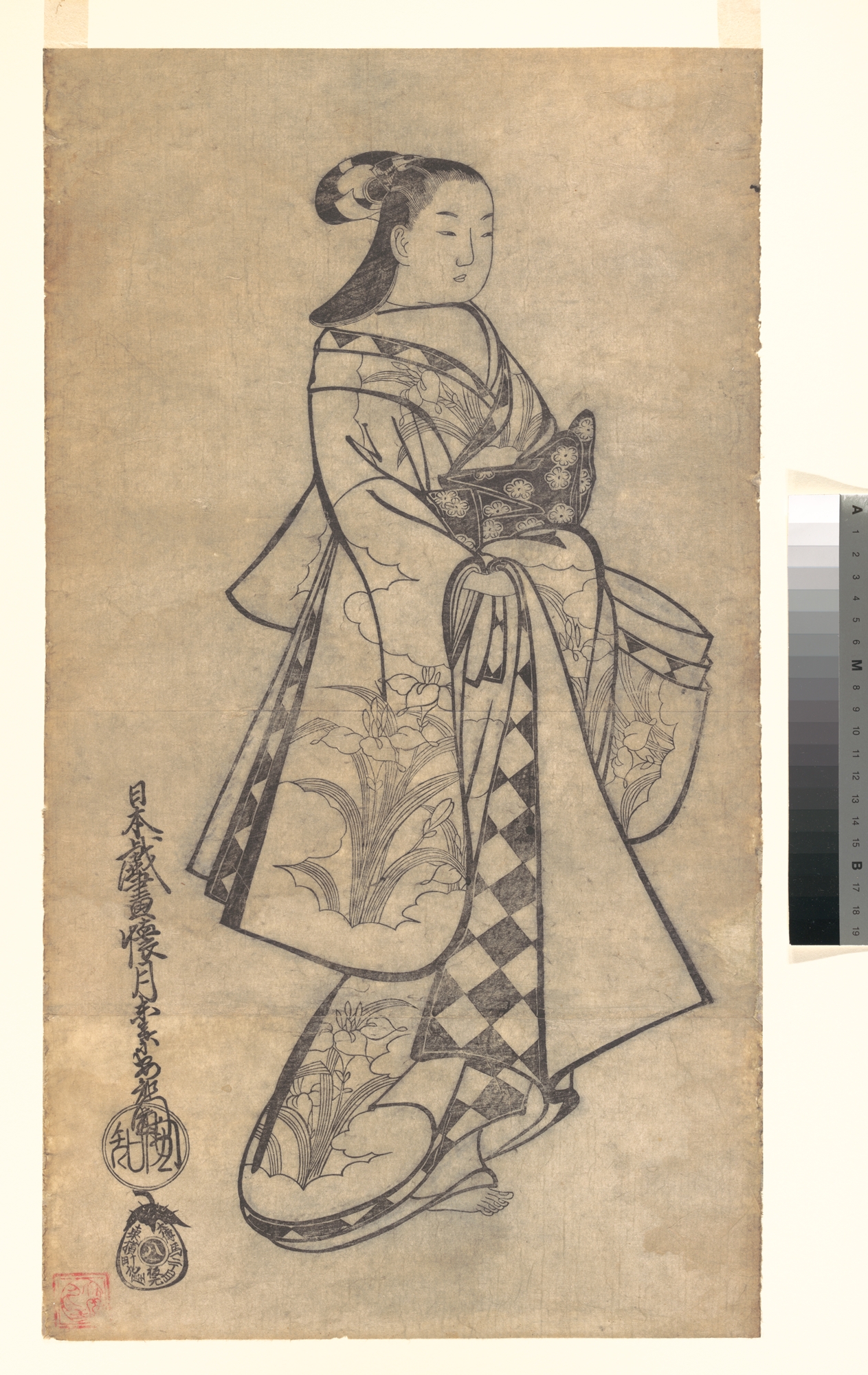
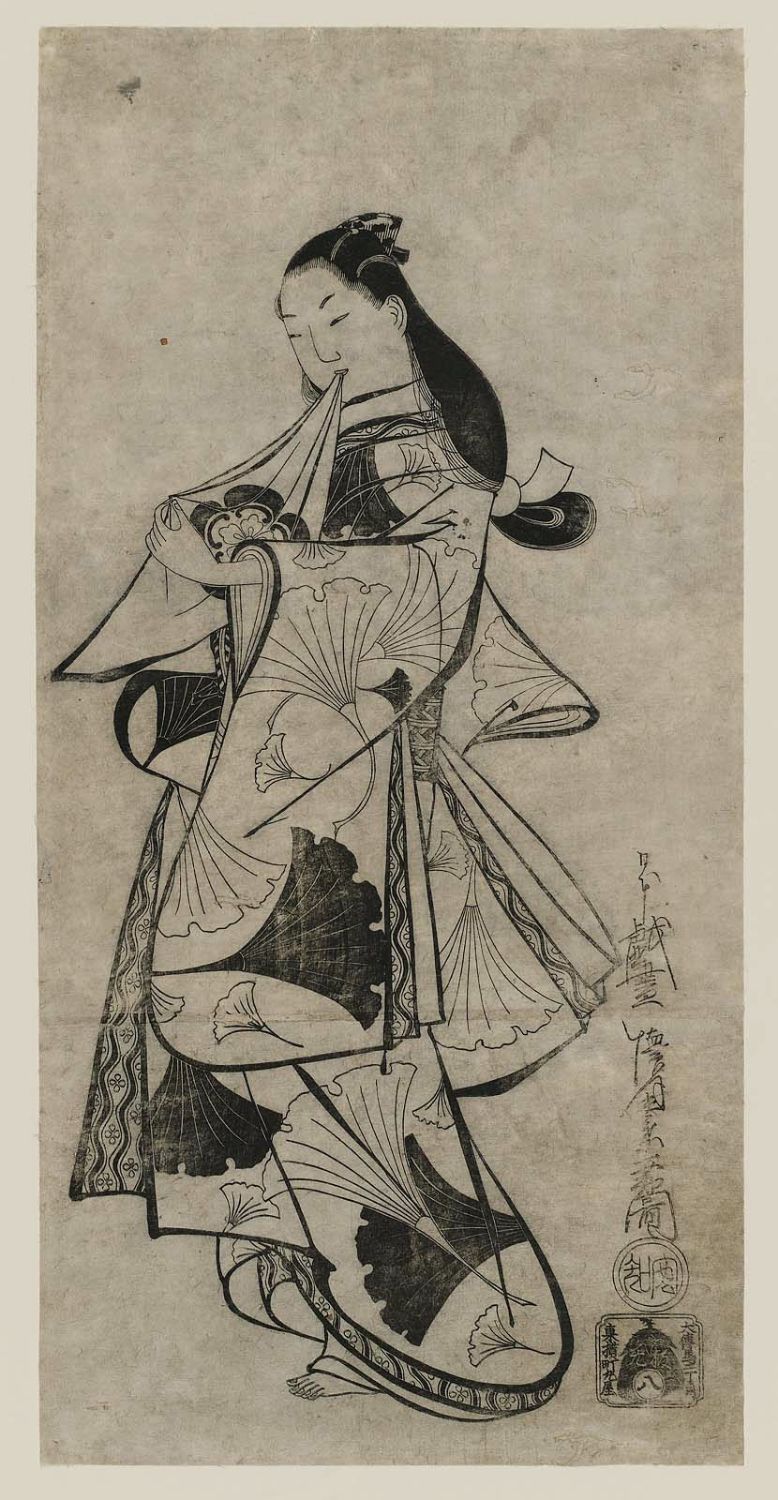
Kaigetsudō Anchi (懐月堂安知, active c. 1700–1716) was one of the principal pupils of Kaigetsudō Ando (c. 1671–1743), the founder of the short-lived but stylistically distinctive Kaigetsudō school of early-eighteenth-century ukiyo-e. Working in the opening years of the eighteenth century, Anchi belonged to a workshop of perhaps six artists — Ando himself, Anchi, Doshin, Doshu, Dohan, and a small handful of others — who together produced an instantly recognizable body of large-format paintings and a very small number of woodblock prints, almost all of them depicting single standing courtesans of the Yoshiwara pleasure quarter rendered as massive, sculpturally posed figures in voluminous, boldly patterned kimono. The Kaigetsudō style is so internally consistent that the workshop's individual members are distinguished principally by their signatures and seals; Anchi may have been Ando's principal student, since he is the only one of the group to inherit the 'An' character of his teacher's name in his own art-name.
The school's iconic image — a single bijin viewed at near-life-size, set against a blank ground, her body defined by strong sweeping calligraphic outlines that describe the architectural mass and patterning of an elaborate uchikake outer robe — was the Kaigetsudō contribution to a broader early-eighteenth-century turn toward monumental courtesan imagery. Where earlier ukiyo-e printmakers in the Hishikawa Moronobu lineage had favored multi-figure narrative compositions in horizontal handscroll-derived formats, the Kaigetsudō school distilled the courtesan portrait to its essential single-figure form, treating each bijin as a kind of secular icon. The compositional formula was so successful that it survived the workshop's dissolution to influence subsequent generations: Okumura Masanobu, Nishikawa Sukenobu, and eventually the Torii lineage all drew on Kaigetsudō formal vocabulary even as they updated it for changing chromatic and stylistic conventions.
Anchi's known oeuvre is, like that of every Kaigetsudō artist, dominated by paintings on silk or paper, with only a small number of prints attributable to his hand. The surviving prints are early sumizuri-e (ink-only woodblock prints) and hand-colored tan-e (orange-pigment prints) from approximately 1710–1716, the very last years before urushi-e and beni-e expanded the chromatic vocabulary of ukiyo-e printing. Only eight print designs by Anchi are currently known to scholarship, and several of these survive in unique impressions: for example, the British Museum's circa 1711–1714 courtesan in an outer garment of ivy leaves, cherry blossoms, fans, and braided tassels is the only known impression of that particular design. The scholar Richard Lane observed of Anchi's bijin that they convey a distinctive emotional register, noting that 'Anchi's girls are manifestly courtesans, lovely but at the same time somehow predatory.' Despite the small surviving corpus, Anchi's prints are held in major public collections, including the British Museum, where they document a foundational moment in the development of the single-figure bijin portrait.
The Kaigetsudō workshop dissolved abruptly in 1714 when Ando was exiled to the Pacific island of Ōshima for his involvement in the Ejima-Ikushima scandal, a shogunal-court affair in which a senior lady-in-waiting to the shogun's mother was found to have illicitly attended a kabuki performance in the company of the actor Ikushima Shingorō. Ando was implicated and banished, and his pupils — including Anchi — appear to have largely ceased active production in the immediate aftermath, though Anchi's exact later career is not securely documented. The brevity and concentration of the Kaigetsudō moment, combined with the workshop's distinctive house style and the extreme rarity of its prints, has made Anchi and his fellow pupils some of the most studied of all early ukiyo-e printmakers despite the scarcity of biographical information about any of them.
Key Facts
- Nationality
- 🇯🇵Japan
- Movement
- Ukiyo-e
- Works Indexed
- 2
Frequently Asked Questions
Kaigetsudō Anchi (懐月堂安知, active c. 1700–1716) was one of the principal pupils of Kaigetsudō Ando (c. 1671–1743), the founder of the short-lived but stylistically distinctive Kaigetsudō school of early-eighteenth-century ukiyo-e. Working in the opening years of the eighteenth century, Anchi belonged to a workshop of perhaps six artists — Ando himself, Anchi, Doshin, Doshu, Dohan, and a small handful of others — who together produced an instantly recognizable body of large-format paintings and a very small number of woodblock prints, almost all of them depicting single standing courtesans of the Yoshiwara pleasure quarter rendered as massive, sculpturally posed figures in voluminous, boldly patterned kimono. The Kaigetsudō style is so internally consistent that the workshop's individual members are distinguished principally by their signatures and seals; Anchi may have been Ando's principal student, since he is the only one of the group to inherit the 'An' character of his teacher's name in his own art-name.
Kaigetsudō Anchi's work was shaped by the Ukiyo-e tradition in Japanese woodblock printmaking. Ukiyo-e: ## What is ukiyo-e? Ukiyo-e ([浮世絵](/glossary/ukiyo-e)) — literally "pictures of the floating world" — is the Edo-period Japanese print and painting tradition that flourished from roughly 1660 to 1868, depicting the pleasures of urban life in Edo (modern Tokyo): courtesans, kabuki actors, sumo wrestlers, famous landscapes, and seasonal beauties.
Original prints by Kaigetsudō Anchi can be found in collections including Art Institute of Chicago, Metropolitan Museum of Art.