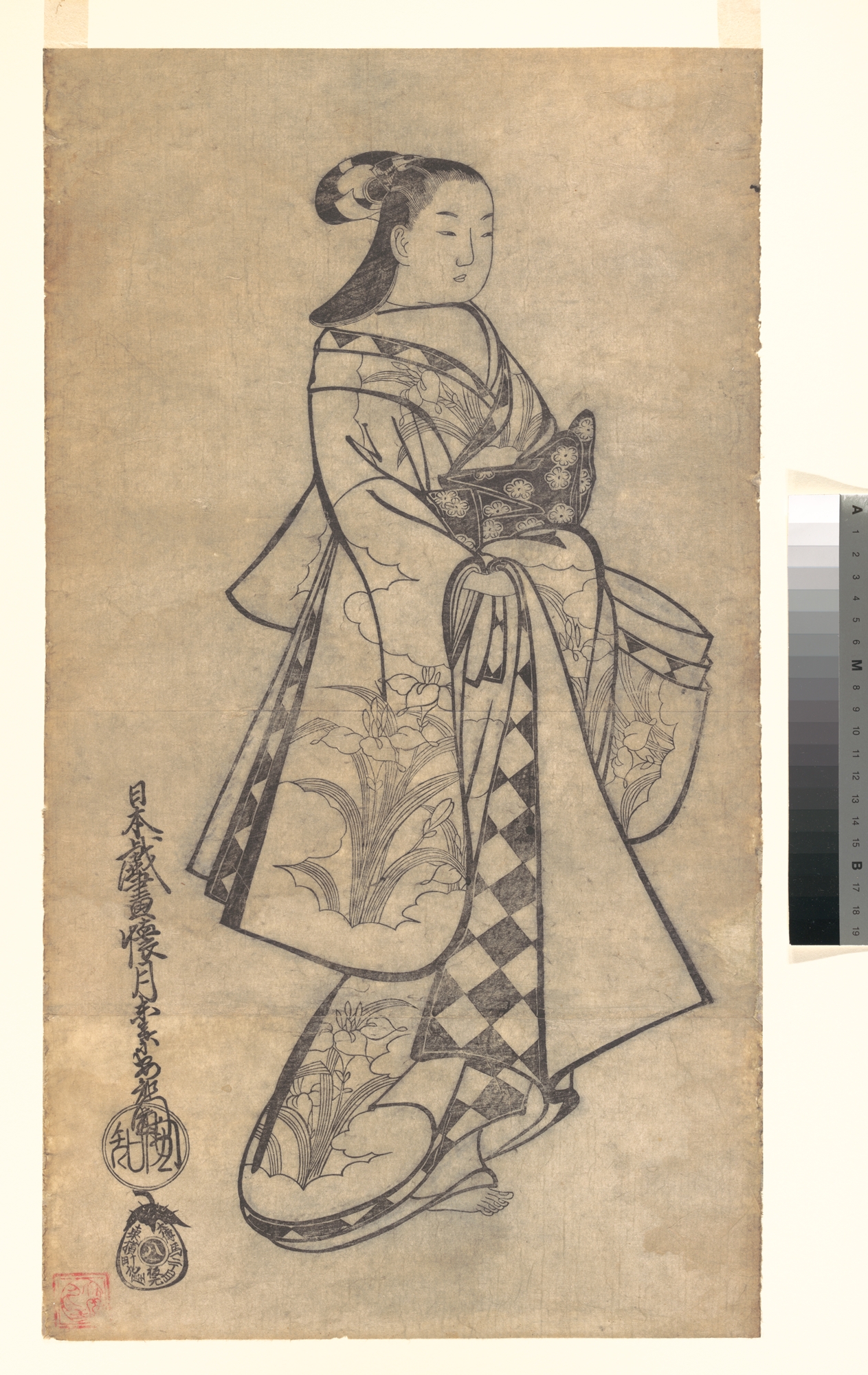
Courtesan
- Date:
- ca. 1714
- Medium:
- Monochrome woodblock print (sumizuri-e); ink on paper
- Source:
- Metropolitan Museum of Art
Description
Held in the Metropolitan Museum of Art and dated to circa 1714, Courtesan is a monochrome sumizuri-e woodblock print measuring approximately 58 by 32 centimeters that exemplifies the Kaigetsudō school's signature single-figure bijin formula in its purest black-ink form. The composition presents a courtesan standing in three-quarter view against a completely blank ground, her body's monumental presence established entirely through the calligraphic confidence of the sweeping outlines that describe the architecture of her elaborate uchikake outer robe. The Kaigetsudō house style, in which the figure is treated as a kind of secular icon to be contemplated for the elegance of pose and the intricacy of patterning, finds in this print one of its most distilled expressions. The sumizuri-e technique — single-block printing in black ink alone, with no applied coloring — was the foundational ukiyo-e printing mode that preceded the early-eighteenth-century turn toward hand-colored beni-e and urushi-e, and the Kaigetsudō workshop's commitment to it reflects the school's identification of outline drawing as the principal carrier of pictorial meaning. The Met's example, one of only eight known print designs attributable to Anchi, documents the rarity and the importance of his surviving printed output: where the school's primary production was paintings on silk and paper, the small number of prints that the workshop produced has become disproportionately influential precisely because of the medium's reproducible accessibility to subsequent generations of ukiyo-e artists who absorbed the Kaigetsudō formal vocabulary.
More Prints by Kaigetsudō Anchi

Frequently Asked Questions
Courtesan was created by Kaigetsudō Anchi (懐月堂安知) in ca. 1714.