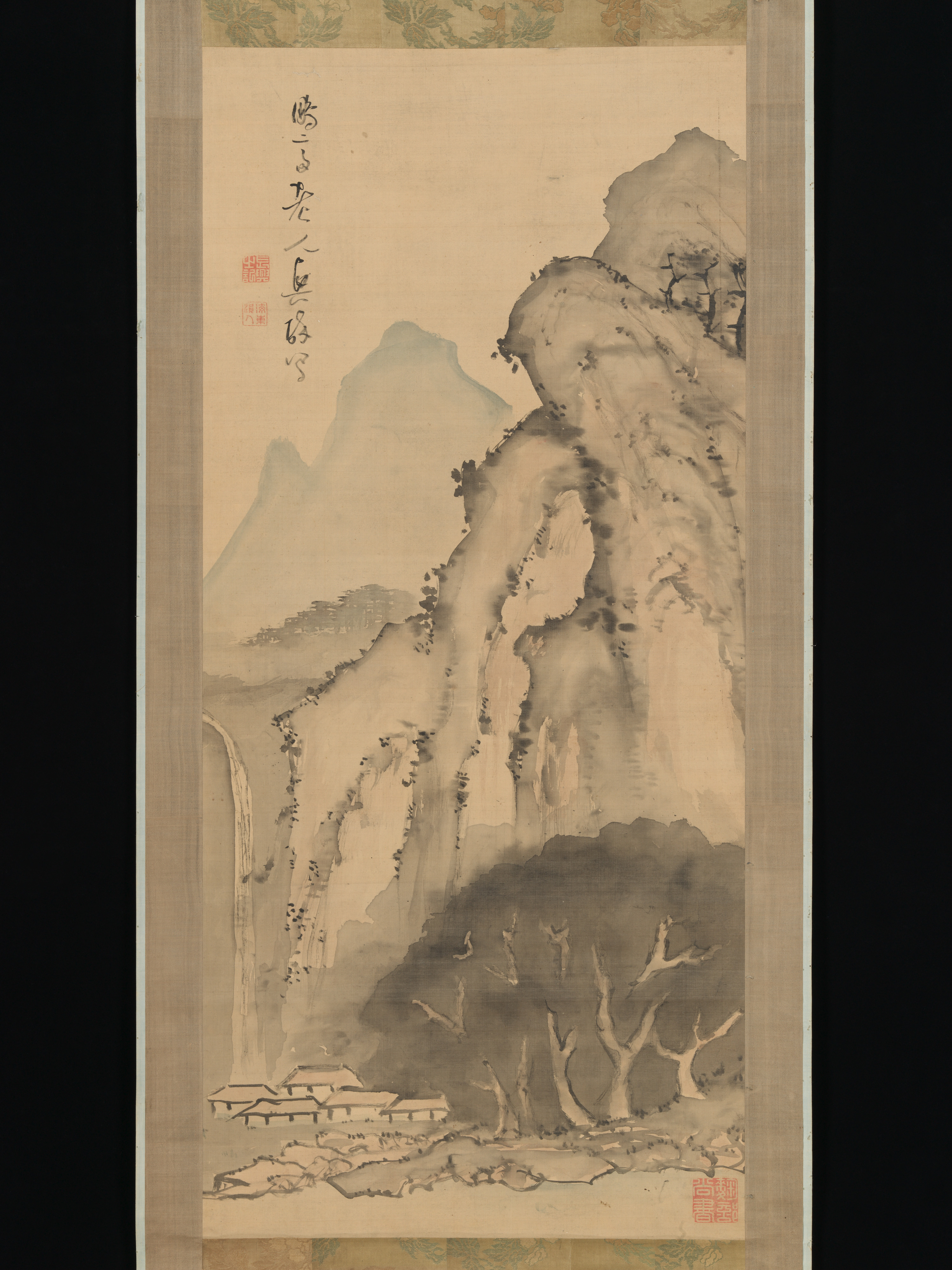
Kameda Bōsai
亀田鵬斎
1752–1826
Japan
Biography
Kameda Bōsai (亀田鵬斎, 1752-1826) was an Edo Confucian scholar, calligrapher, and bunjinga (literati) painter whose career sits at the meeting point of late Tokugawa intellectual reform, classical Chinese learning, and the Edo cultural circles that produced the great nanga landscape tradition. Born in Edo in 1752 to a merchant family, he was given a thorough classical Chinese education — unusual for a merchant's son — and showed early aptitude for the Confucian canon. By his twenties he had established himself as a Confucian teacher in the capital, running a private academy that at its height drew hundreds of students and earned him a reputation as one of the most independent-minded scholars of his generation.
That independence proved professionally costly. Bōsai aligned himself with the eclectic school (setchūgaku), a non-orthodox current that synthesized several Confucian traditions, rather than the Zhu Xi orthodoxy favored by the shogunate. In 1790, the senior councilor Matsudaira Sadanobu issued the Kansei Edict (Kansei Igaku no Kin), which banned the teaching of heterodox interpretations at the shogunal academy and effectively blacklisted scholars whose lectures fell outside Zhu Xi orthodoxy. Bōsai became one of five prominent scholars who resisted the prohibition — a group later nicknamed the 'Five Demons of the Kansei era' (Kansei no gokijin), alongside Yamamoto Hokuzan, Tsukada Taihō, Toshima Hōshū, and Ichikawa Kakumei. As his students fell away and his livelihood as a teacher was undermined, he turned increasingly to calligraphy, painting, and the broader bunjin literary culture of late Edo as both vocation and livelihood.
The decades after the edict are when Bōsai produced the work for which he is best remembered. His calligraphy — a fluid cursive famous for its idiosyncratic, wriggling 'earthworm' line — became enormously sought after, and he sold sheets, screens, and inscriptions to support himself and his family. He developed a literati landscape manner indebted to Chinese Yuan and Ming painting and to Japanese nanga predecessors like Ike Taiga and Yosa Buson, characterized by loose, wet ink, soft contours, and a meditative atmosphere drawn from his deep engagement with Chinese poetic landscape. His most famous publication, Kyōchūzan (Mountains of the Heart, 1816), is a woodblock-printed book of imaginary landscapes accompanied by his own inscriptions — a defining example of late Edo bunjinga in printed form. Among his notable friendships was one with the Zen poet-calligrapher Ryōkan, whom he visited in Echigo; the two shared a love of poetry and unconventional cursive calligraphy, and Ryōkan is said to have composed a verse in his honor.
Bōsai remained based in Edo for the rest of his life, supported by sales of his calligraphy and painting and by a wide network of literati admirers. He died in 1826. His work survives in major museum collections in Japan and abroad, including the Metropolitan Museum of Art, and his Kyōchūzan remains one of the most studied examples of the late Edo literati picture book.
Key Facts
- Active Period
- 1752–1826
- Nationality
- 🇯🇵Japan
- Works Indexed
- 4
Frequently Asked Questions
Kameda Bōsai (亀田鵬斎, 1752-1826) was an Edo Confucian scholar, calligrapher, and bunjinga (literati) painter whose career sits at the meeting point of late Tokugawa intellectual reform, classical Chinese learning, and the Edo cultural circles that produced the great nanga landscape tradition. Born in Edo in 1752 to a merchant family, he was given a thorough classical Chinese education — unusual for a merchant's son — and showed early aptitude for the Confucian canon. By his twenties he had established himself as a Confucian teacher in the capital, running a private academy that at its height drew hundreds of students and earned him a reputation as one of the most independent-minded scholars of his generation.
Kameda Bōsai was active from 1752 to 1826.
Kameda Bōsai's prints frequently feature moonlight, fish, autumn foliage, waterfalls.
Original prints by Kameda Bōsai can be found in collections including Minneapolis Institute of Art, Metropolitan Museum of Art.
Woodblock Prints by Kameda Bōsai (4)
Landscape with Waterfall
ca. 1817
Hanging scroll; ink and color on silk

Bat Flying Over the Moon
ca. 1824
Hanging scroll; ink on paper

Landscape with Qin
early 19th century
Hanging scroll; ink on paper
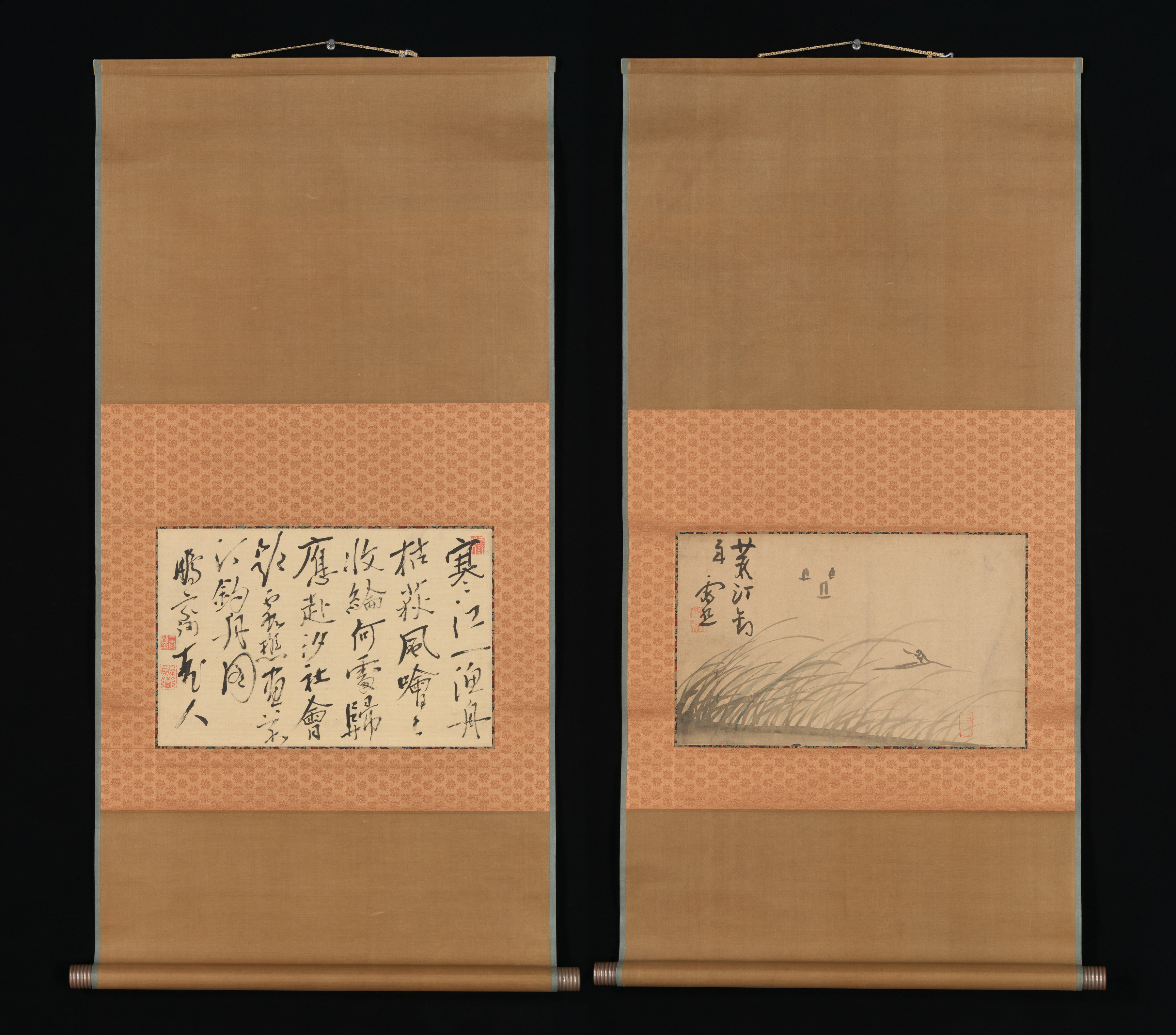
Fishing Boat on Reed Covered Bank and Calligraphy
18th to 19th century
Album leaves mounted as hanging scrolls; ink on paper