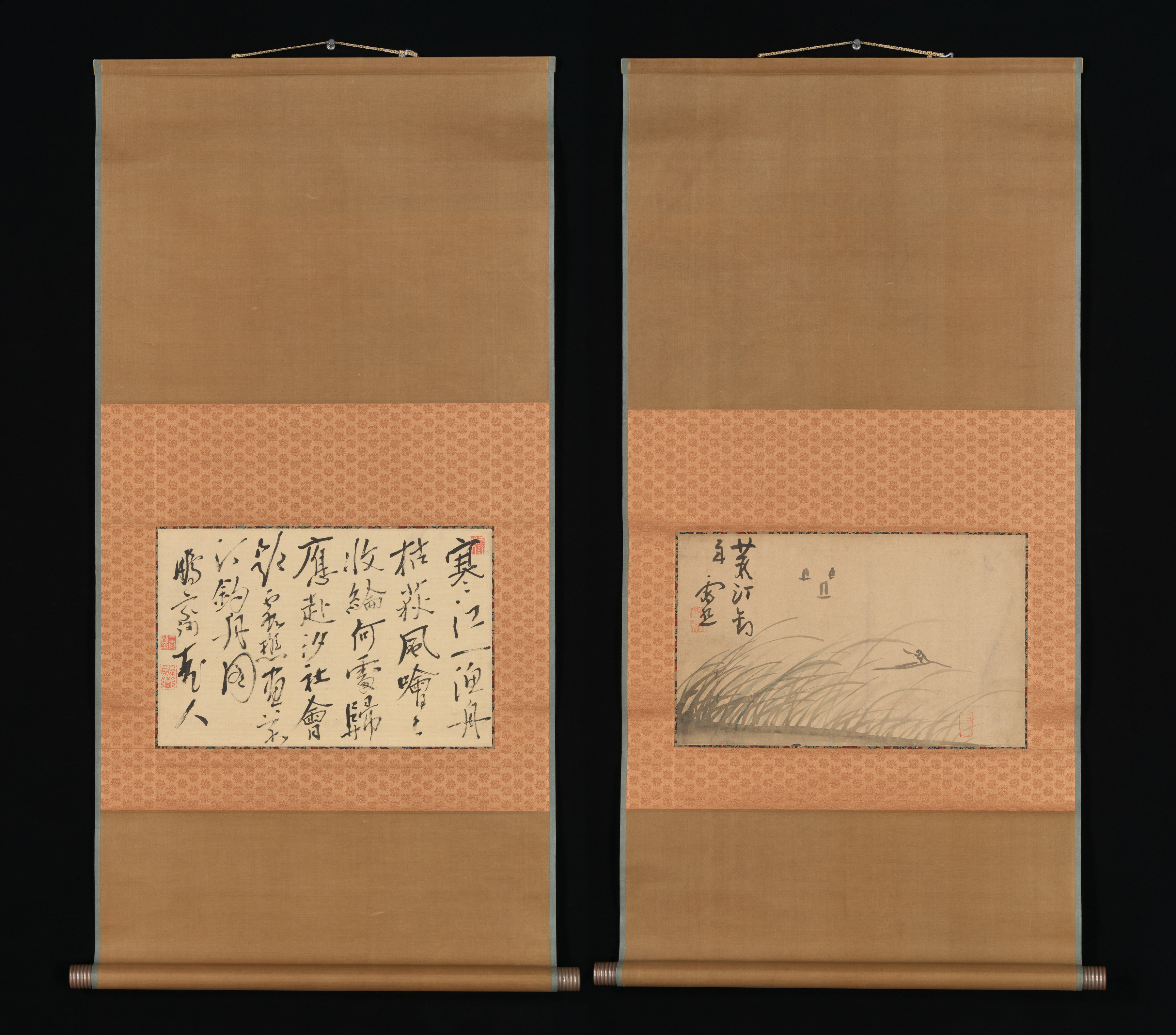
Fishing Boat on Reed Covered Bank and Calligraphy
by Kameda Bōsai
- Date:
- 18th to 19th century
- Medium:
- Album leaves mounted as hanging scrolls; ink on paper
- Source:
- Metropolitan Museum of Art
Description
Fishing Boat on Reed Covered Bank and Calligraphy is a painting by Kameda Bōsai (亀田鵬斎, 1752-1826), held by the Metropolitan Museum of Art (accession recorded at https://www.metmuseum.org/art/collection/search/670541). The pairing of painting and calligraphy in a single composition — the inscribed text and the rendered image occupying the same sheet in a deliberate complementary relation — was a core practice of Chinese and Japanese literati art, the visible expression of the conviction that brushwork in writing and brushwork in painting were ultimately the same exercise of a cultivated hand. For Bōsai the conviction was unusually direct: he was a serious Confucian scholar and a celebrated calligrapher whose writing is considered among the most accomplished of late-Edo bunjin production, and his paintings frequently bear inscriptions of comparable importance to the imagery they accompany. The subject of a small fishing boat among reeds carries the long Chinese literati associations of the recluse-fisherman, a figure that descends from the legendary recluse-fisherman of the Han period (the Yuyin tradition) and is elaborated in Tang and Song poetry and Yuan landscape painting (the great fisherman scrolls of Wu Zhen, for instance), where it stands for the cultivated withdrawal from worldly affairs into a contemplative life on the water. A Bōsai composition on this theme would foreground the literati conviction that economy of means — a single small boat, a few stalks of reed, an expanse of water, an inscribed text — bears more cultivated weight than topographic abundance. The Metropolitan source provides the firm attribution.
More Prints by Kameda Bōsai


More Fish Prints


Frequently Asked Questions
Fishing Boat on Reed Covered Bank and Calligraphy was created by Kameda Bōsai (亀田鵬斎) in 18th to 19th century.
Fishing Boat on Reed Covered Bank and Calligraphy depicts fish.