
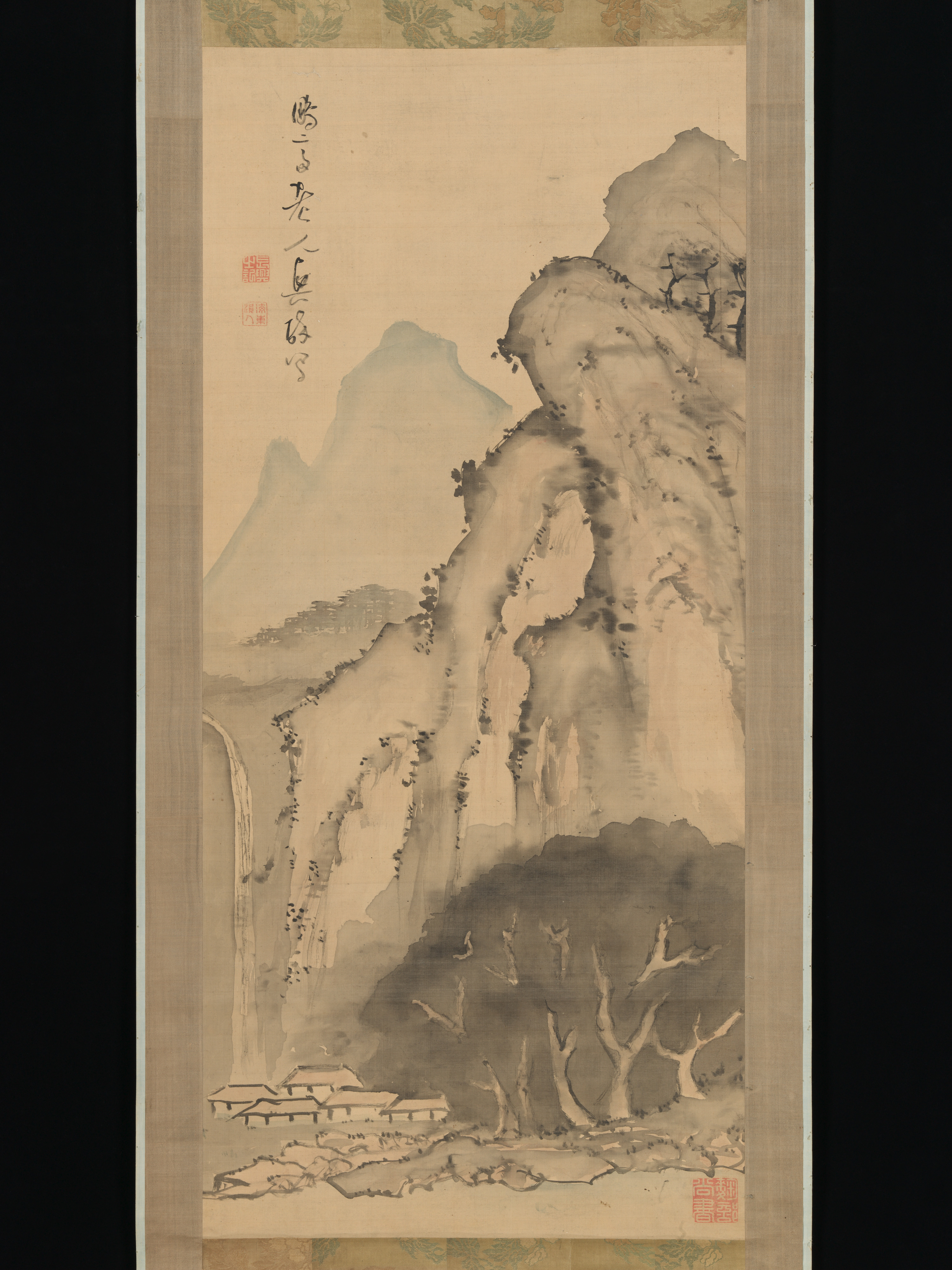
Landscape with Qin
by Kameda Bōsai
- Date:
- early 19th century
- Medium:
- Hanging scroll; ink on paper
- Source:
- Minneapolis Institute of Art
Description
Landscape with Qin is a hanging-scroll painting by the Edo nanga painter and Confucian scholar Kameda Bōsai (亀田鵬斎, 1752-1826), held by the Minneapolis Institute of Art (accession recorded at https://collections.artsmia.org/art/121292). The motif of a scholar with a qin — the seven-stringed Chinese zither (Japanese kin) that occupies a unique place in literati culture as the instrument of cultivated philosophical introspection — places the painting at the heart of the Chinese scholar-painter repertoire that Edo bunjin absorbed and reworked. The qin had been canonized in Chinese tradition as one of the Four Arts of the cultivated gentleman, alongside chess (qi), calligraphy (shu), and painting (hua); its appearance in a landscape signals the scholar's withdrawal from worldly concerns into the rarified company of music, mountains, and friends. The motif descends from the Tang and Song traditions of scholar-recluse iconography and was elaborated by Ming and Qing literati painters whose model albums reached Edo Japan through Nagasaki. Bōsai is one of the most distinctive figures of late-Edo literati culture: trained as a Confucian scholar and the head of his own academy in Edo, he was caught up in the Kansei Reforms' suppression of unorthodox teaching (the Kansei igaku no kin of 1790), an episode that turned him decisively toward bunjinga and toward the life of the painter-poet. His friendships with the literati painters and poets of his generation, including the Kyoto and Edo nanga circles, gave him direct access to the imported Chinese sources on which Edo bunjin painting depended, and his self-taught brush is celebrated for its eccentric, calligraphically inflected freedom — a manner closer in spirit to the most personal of the Chinese scholar-amateur traditions than to academic landscape practice. The Minneapolis source provides the firm attribution.
More Prints by Kameda Bōsai

Frequently Asked Questions
Landscape with Qin was created by Kameda Bōsai (亀田鵬斎) in early 19th century.