Katsushika Hokusai
葛飾北斎
Also known as: Hokusai, Shunro, Sori, Kako, Taito, Iitsu, Gakyo Rojin Manji
1760–1849
Biography
Katsushika Hokusai (葛飾北斎, 1760–1849) stands as one of the most prolific, inventive, and internationally influential artists in the history of Japanese art. Over a career spanning more than seven decades, he produced an estimated thirty thousand paintings, sketches, woodblock prints, and illustrated books, reinventing himself and his art with a restlessness that became legendary. His most iconic image, "The Great Wave off Kanagawa," is arguably the single most recognized work of Japanese art in the world, a composition so powerful that it transcended its origins to reshape the visual imagination of artists across Europe and beyond.
Hokusai was born in 1760 — his birth is traditionally dated to the last day of October — in the Katsushika district of Edo, the sprawling capital that would later become Tokyo. The details of his earliest years remain somewhat obscure. He was likely born into an artisan family; by some accounts his father was Nakajima Ise, a mirror-maker for the shogun, though Hokusai may have been adopted into the household at the age of three. What is certain is that from a young age he displayed an insatiable curiosity about the visual world. He later recalled that by the age of six he had developed an obsession with drawing the forms of things. His father's work polishing and painting designs on mirrors may have provided the child's earliest exposure to visual craftsmanship, and by his early teens he was already working in a bookshop and lending library, immersing himself in the illustrated literature that was a staple of Edo popular culture.
At around fourteen, Hokusai was apprenticed to a wood-block engraver, where he spent several years learning the technical craft of carving the cherry-wood blocks used to produce printed images. This hands-on knowledge of the printing process would inform his work for the rest of his life, giving him an unusual command over the relationship between design and reproduction. Unlike most ukiyo-e designers who simply drew images for others to carve and print, Hokusai understood the medium from the inside — the grain of the wood, the pressure of the baren, the behavior of pigments on dampened paper. In 1778, at the age of eighteen, he entered the studio of Katsukawa Shunsho, one of the leading ukiyo-e masters of the day, renowned for his portraits of kabuki actors. Under Shunsho's guidance, the young artist adopted the name Shunro and began producing actor prints and illustrations in the house style. His earliest published works, appearing around 1779, were competent contributions to the genre, but they already hinted at a restless ambition that would not be contained by any single school or tradition.
The death of Shunsho in 1793 marked a turning point. Hokusai was expelled from the Katsukawa school — or left of his own accord, depending on the source — and entered a period of intense experimentation. He immersed himself in the study of Chinese painting, classical Japanese Yamato-e and Rinpa traditions, and, remarkably, Western copper-engraving techniques that had filtered into Japan through the Dutch trading post at Nagasaki. He is said to have studied the work of Shiba Kokan, a Japanese painter who had absorbed Dutch approaches to linear perspective, and this encounter with European spatial conventions would profoundly shape his later landscape compositions.
This eclectic absorption of styles was reflected in the bewildering succession of art names he adopted throughout his life. Over the course of his career, Hokusai changed his artistic name more than thirty times — an extraordinary number even by the standards of ukiyo-e, where artists routinely adopted new names to mark fresh phases of work. The most significant of these names chart his artistic evolution: Shunro (1779–1794) during his Katsukawa years; Sori (1795–1798) when he associated with the Tawaraya school and designed privately commissioned surimono; Hokusai (from 1798), the name he made famous; Taito (1811–1820), under which he began the Manga; Iitsu (1820–1834), the name that graces the Thirty-six Views of Mount Fuji; and finally Gakyo Rojin Manji (1834–1849), meaning "the old man mad about painting," a self-description that captured both his consuming dedication and his wry self-awareness.
During the 1790s and early 1800s, Hokusai turned his attention to surimono — privately commissioned prints of exceptional refinement, produced in small editions for poetry clubs and wealthy patrons. These exquisite works, often combining witty kyoka verse with images of still lifes, birds, landscapes, and seasonal motifs, allowed him to experiment with lavish metallic pigments, embossing, and other techniques that were prohibitively expensive for commercial editions. Simultaneously, he became one of the most sought-after book illustrators in Edo, contributing designs to novels, poetry anthologies, and instructional manuals.
It was during this middle period that Hokusai began to develop the landscape sensibility that would define his greatest achievements. While ukiyo-e had traditionally focused on the "floating world" of courtesans, actors, and urban pleasures, Hokusai increasingly turned his eye toward the natural world — mountains, rivers, waterfalls, and the ocean — as well as the daily lives of ordinary working people. He was not the first ukiyo-e artist to depict landscapes, but he brought to the genre a compositional boldness, a sense of cosmic scale, and a feeling for the dynamic forces of nature that had no precedent in the tradition.
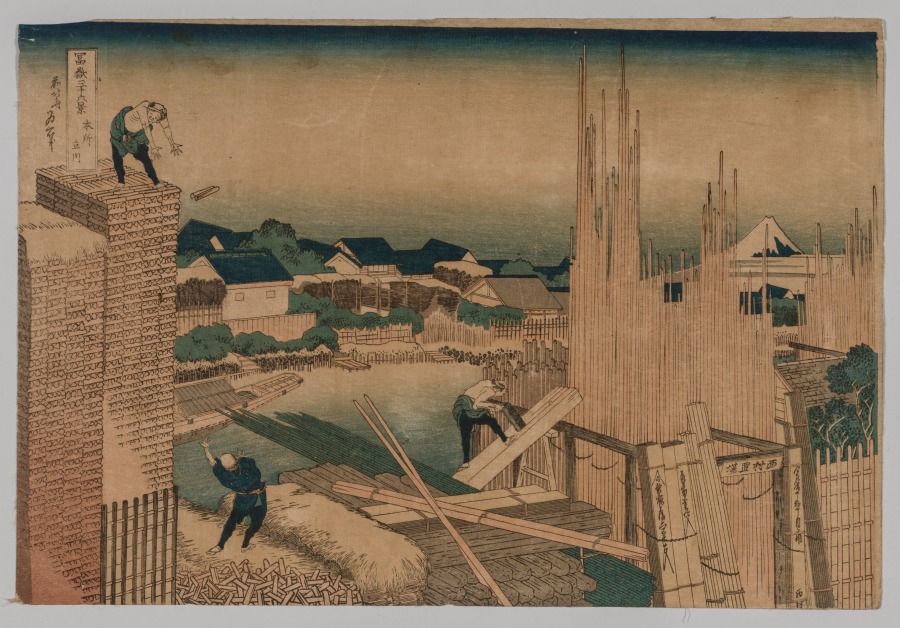
Hokusai's greatest series were produced when he was already in his seventies, a period of astonishing late-career creativity that has few parallels in art history. Between approximately 1830 and 1832, he designed "Thirty-six Views of Mount Fuji" (Fugaku Sanjurokkei), the series that would secure his immortality. Originally planned as thirty-six prints, the set proved so popular that ten additional compositions were added, bringing the total to forty-six. The series presented Japan's sacred mountain from every conceivable angle and distance — glimpsed through barrel-makers' hoops, looming behind fishing boats in a storm, framed by cherry blossoms, or dominating the horizon as travelers crossed vast plains. The most famous print in the series, "The Great Wave off Kanagawa," depicted a towering, claw-like wave threatening to engulf small fishing boats while Mount Fuji sat serene and diminutive in the background. Its composition — the dramatic diagonal of the wave, the contrast between human vulnerability and natural force, the startling use of imported Prussian blue pigment — was unlike anything seen before in Japanese or Western art.
The success of the Thirty-six Views launched a sustained period of landscape production. Between roughly 1832 and 1835, Hokusai produced a series of additional landscape masterpieces that are sometimes overshadowed by the Fuji series but are equally remarkable in their ambition and execution. "A Tour of Waterfalls in Various Provinces" (Shokoku Taki Meguri, c. 1833) comprises eight prints depicting waterfalls across Japan, each rendered with a dramatically different compositional approach that captures the unique character of falling water. "Remarkable Views of Bridges in Various Provinces" (Shokoku Meikyo Kiran, c. 1834) presents eleven prints exploring the structural elegance and landscape settings of famous bridges. "One Thousand Pictures of the Ocean" (Chie no Umi, c. 1832–33) includes ten prints of fishing scenes along the Japanese coastline, remarkable for their observation of marine life and working fishermen. "Snow, Moon and Flowers" (Setsugekka, c. 1833) is a trio of prints that elevate these traditional poetic themes to monumental scale. "Eight Views of the Ryukyu Islands" (Ryukyu Hakkei, c. 1832) imagines landscapes of the distant Ryukyu kingdom that Hokusai had never visited, based on published accounts. "A True Mirror of Chinese and Japanese Poetry" (Shiika Shashin Kyo, c. 1833) pairs famous poems with evocative landscape settings, and "One Hundred Poems Explained by the Nurse" (Hyakunin Isshu Uba ga Etoki, c. 1835) was an ambitious but unfinished project to illustrate all one hundred poems of the classical anthology.
Another monumental work was the "Hokusai Manga," a fifteen-volume collection of sketches that Hokusai began publishing in 1814 and which continued to appear, several volumes posthumously, until 1878. The volumes contain approximately four thousand images depicting everything from human figures in every posture and occupation to animals, plants, landscapes, architectural studies, supernatural beings, and pure abstractions of natural forces like wind and water. The Manga was conceived partly as a drawing manual for students, but it transcended that purpose to become a vast visual encyclopedia of the observable world, animated by Hokusai's inexhaustible curiosity and impish wit.
Hokusai's technical innovations were numerous and far-reaching. He was among the first Japanese artists to make extensive use of Prussian blue (bero-ai), a synthetic pigment imported from Europe that offered a more vivid and lightfast blue than the traditional indigo and dayflower dyes. The striking blue palette of the Thirty-six Views owes much to this imported pigment. He pioneered the use of Western-influenced linear perspective within the ukiyo-e tradition, creating compositions that suggested spatial depth through converging lines and graduated scale — a departure from the flattened picture planes traditional to Japanese art. He also experimented with the aizuri-e technique of printing primarily in shades of blue, and with innovative uses of the bokashi gradation method to create atmospheric effects in skies and water. His approach to depicting water — whether the spiraling eddies of whirlpools, the explosive spray of waves, or the glassy stillness of a mountain pond — was informed by years of dedicated study and became one of the defining achievements of his art. He developed a vocabulary of curving, claw-like forms for waves and circular, fractal-like patterns for foam that remain instantly recognizable and have influenced artistic depictions of water across cultures.
Hokusai's contemporaries and rivalries shaped the landscape of late Edo printmaking. His relationship with the younger Utagawa Hiroshige, who emerged as a major landscape artist in the early 1830s, was one of productive competition rather than open antagonism. The success of Hokusai's Thirty-six Views inspired Hiroshige's own landscape masterwork, "The Fifty-three Stations of the Tokaido," and the two artists represented contrasting approaches to the genre — Hokusai's landscapes were bold, geometric, and almost architecturally constructed, while Hiroshige's were atmospheric, intimate, and emotionally nuanced. Within the Katsukawa school, Hokusai's departure created tensions that persisted throughout his career. He also maintained a complex relationship with the world of Edo publishing, working with numerous publishers including Nishimuraya Yohachi, who issued many of his most famous series, and Tsutaya Juzaburo, the ambitious publisher who also championed Utamaro. Unlike some artists who were loyal to a single publishing house, Hokusai worked with dozens of publishers over his career, leveraging his fame to maintain artistic independence.
When Japan ended its long period of isolation in the 1850s, Japanese woodblock prints began to flood into Europe, where they ignited the phenomenon of "Japonisme" that swept through the French art world in the 1860s and 1870s. Hokusai was at its center. Claude Monet hung Japanese prints in his dining room at Giverny and painted his cathedral and haystack series in multiple variations of light — an approach that consciously echoed Hokusai's serial depictions of Mount Fuji. Edgar Degas studied their asymmetric compositions and flattened perspectives, and reportedly declared that "Hokusai is not just one artist among others in the Floating World. He is an island, a continent, a whole world in himself." James McNeill Whistler drew on their tonal subtlety and atmospheric qualities for his Nocturne paintings. Paul Gauguin, Gustav Klimt, Franz Marc, and August Macke all collected Hokusai's prints. The Art Nouveau movement absorbed their flowing organic lines. Hokusai's prints helped European artists break free from the conventions of academic perspective, contributing directly to the development of Impressionism, Post-Impressionism, and early modernism. The composer Claude Debussy was so inspired by "The Great Wave" that he placed an adaptation of the image on the cover of his orchestral work "La Mer" (1905).
Hokusai's personal life was marked by the same restlessness as his art. He moved house an estimated ninety-three times, often leaving dwellings so cluttered with work and debris that it was easier to relocate than to clean. He was married twice and had several children, including his daughter Katsushika Oi (also known as Oei), who became a talented artist in her own right and collaborated closely with her father in his later years, to the point where scholars still debate which late works should be attributed to Hokusai and which to Oi. Despite his enormous output and commercial success, Hokusai was frequently impoverished, in part because he had little interest in managing money and in part because he supported a dissolute grandson whose debts were a constant drain.
In his later years, Hokusai continued to produce work of extraordinary quality despite declining health and repeated personal misfortunes. A devastating fire in 1839 destroyed his studio and many of his sketches, preparatory drawings, and unpublished works — an incalculable loss. In his eighties he traveled repeatedly to the town of Obuse in Shinano Province (present-day Nagano Prefecture), at the invitation of the wealthy patron Takai Kozan. At Obuse, Hokusai produced festival float ceiling paintings, including spectacular depictions of a phoenix and crashing waves, that demonstrate his undiminished power as a painter even in his mid-eighties. He also continued to produce extraordinary brush paintings during this period, including a series of studies of tigers, dragons, and other mythological creatures that show a looseness and spontaneity of brushwork that departed from the precision required by woodblock printing.
Hokusai's philosophical approach to art was articulated in a famous passage from the postscript to the first volume of "One Hundred Views of Mount Fuji" (Fugaku Hyakkei, 1834), in which he wrote: "From the age of six I had a passion for copying the form of things and since the age of fifty I have published many drawings, yet of all I drew by my seventieth year there is nothing worth taking into account. At seventy-three years I partly understood the structure of animals, birds, insects and fishes, and the life of grasses and plants. And so, at eighty-six I shall progress further; at ninety I shall even further penetrate their secret meaning, and by one hundred I shall perhaps truly have reached the level of the marvelous and divine. When I am one hundred and ten, each dot, each line shall surely possess a life of its own." This statement, remarkable for its humility, its ambition, and its vision of art as a lifelong path of deepening understanding, has become one of the most quoted passages in the literature of art.
Hokusai died on May 10, 1849, in Edo, at the age of eighty-eight. According to a widely reported account, his last words were: "If only Heaven will give me just another ten years... just another five more years, then I could become a real painter." In his final self-portrait, drawn in ink at the end of his life, he depicted himself as a wizened figure gazing intently at the horizon, still searching, still unsatisfied.
Today, Hokusai is recognized not only as the supreme master of the Japanese woodblock print but as one of the most important artists in world history. His "Great Wave" was selected as the design for Japan's new 1,000-yen banknote, which entered circulation in July 2024 — a recognition of its status as the nation's most universally known artistic image. Mount Fuji, the subject that inspired his greatest series, was designated a UNESCO World Heritage Site in 2013, with the cultural significance of Hokusai's depictions cited as part of its heritage value. His works are held in virtually every major museum with an Asian art collection, including the British Museum (which holds the largest collection outside Japan), the Metropolitan Museum of Art, the Art Institute of Chicago, the Museum of Fine Arts Boston, the Bibliothèque nationale de France, the Rijksmuseum in Amsterdam, the National Museum of Tokyo, and the dedicated Sumida Hokusai Museum in Tokyo, which opened in 2016 near the site of his birth. The Great Wave has appeared on postage stamps in multiple countries, on the walls of buildings from Moscow to Melbourne, and has been referenced, parodied, and reimagined in countless works of contemporary art, design, and popular culture — a testament to the enduring power of an image created by an old man mad about painting nearly two centuries ago.
Key Facts
- Active Period
- 1760–1849
- Movement
- Ukiyo-e
- Works Indexed
- 511
Frequently Asked Questions
Katsushika Hokusai (葛飾北斎, 1760–1849) stands as one of the most prolific, inventive, and internationally influential artists in the history of Japanese art. Over a career spanning more than seven decades, he produced an estimated thirty thousand paintings, sketches, woodblock prints, and illustrated books, reinventing himself and his art with a restlessness that became legendary. His most iconic image, "The Great Wave off Kanagawa," is arguably the single most recognized work of Japanese art in the world, a composition so powerful that it transcended its origins to reshape the visual imagination of artists across Europe and beyond.
Katsushika Hokusai was active from 1760 to 1849. They were associated with the Ukiyo-e movement.
Katsushika Hokusai's work was shaped by the Ukiyo-e tradition in Japanese woodblock printmaking. Ukiyo-e: ## What is ukiyo-e? Ukiyo-e ([浮世絵](/glossary/ukiyo-e)) — literally "pictures of the floating world" — is the Edo-period Japanese print and painting tradition that flourished from roughly 1660 to 1868, depicting the pleasures of urban life in Edo (modern Tokyo): courtesans, kabuki actors, sumo wrestlers, famous landscapes, and seasonal beauties.
Katsushika Hokusai's prints frequently feature landscapes, mount fuji, bridges, travel scenes, tōkaidō, figures.
Original prints by Katsushika Hokusai can be found in collections including Harvard Art Museums, Art Institute of Chicago, Victoria and Albert Museum, ukiyo-e.org.
External Resources
Series by Katsushika Hokusai
Fifty-three Stations of the Tokaido
1804–1806 · 55 prints
Thirty-Six Views of Mount Fuji
1830–1832 · 46 prints
One Hundred Poems as Explained by the Wet Nurse (Hyakunin isshu uba ga etoki)
1 print
Eight Views of Omi in Etching Style
7 prints
Eight Views of Elegant Gallants (Furyu otokodate hakkei)
1 print
Tour of the Waterfalls in Various Provinces
2 prints
Dutch-style Pictures: Eight Views of Edo
2 prints
Eight views of Traveling Lovers from Joruri Plays
1 print
Three Evening Poems (Sanseki no uchi)
1 print
Woodblock Prints by Katsushika Hokusai (511)
Signature Techniques
Mokuhanga techniques most associated with Katsushika Hokusai.
Compare With
Hokusai and Hiroshige are ukiyo-e's two great landscape masters; their Mount Fuji series invite direct comparison.