Biography
Kawamata Tsunemasa (川又常正) was an eighteenth-century Edo painter who specialized in delicate, refined depictions of beautiful women (bijinga). Working almost exclusively in painted formats — hanging scrolls and handscrolls in ink and color on silk and paper (nikuhitsu-ga) — rather than in the woodblock medium, Tsunemasa belongs to the small but consequential group of ukiyo-e painters whose work bridged the courtly painted bijin tradition descending from Kaigetsudō Ando and the eighteenth-century commercial print culture of Edo. His painted bijinga are relatively scarce today — something more than fifty paintings are identified as his — but they are represented in major collections including the Metropolitan Museum of Art and the Art Institute of Chicago, where they document an artist of distinct elegance and a confident command of the painted bijin idiom.
Biographical details for Tsunemasa are sparse, and his death date is unknown. He is generally considered to have been a disciple of Kawamata Tsuneyuki (川又常行), the founder of the small Kawamata line of ukiyo-e painters, though the exact nature of their relationship — whether Tsunemasa was Tsuneyuki's son, adopted son, or an unrelated studio pupil who inherited the family name — is not firmly established. The Kawamata atelier appears to have been a modest Edo studio operating in parallel with the more famous Hishikawa, Kaigetsudō, and Miyagawa workshops, and its production was almost entirely confined to painted hanging scrolls and handscrolls aimed at a private collector market rather than the commercial woodblock-print trade.
Tsunemasa is recorded as active from around the Genbun era (1736–41), and his career appears to have extended for some decades, perhaps as late as the Meiwa era (1764–72). Rather than working entirely before the polychrome nishiki-e revolution, his later paintings show the influence of Suzuki Harunobu in the way he depicts women, placing him at the transition into the full-color print era rather than wholly before it. He worked in the refined, intimate idiom of the mid-eighteenth-century painted bijinga tradition, and his surviving paintings document a painter capable of the highly disciplined linework and atmospheric color application that the genre demanded.
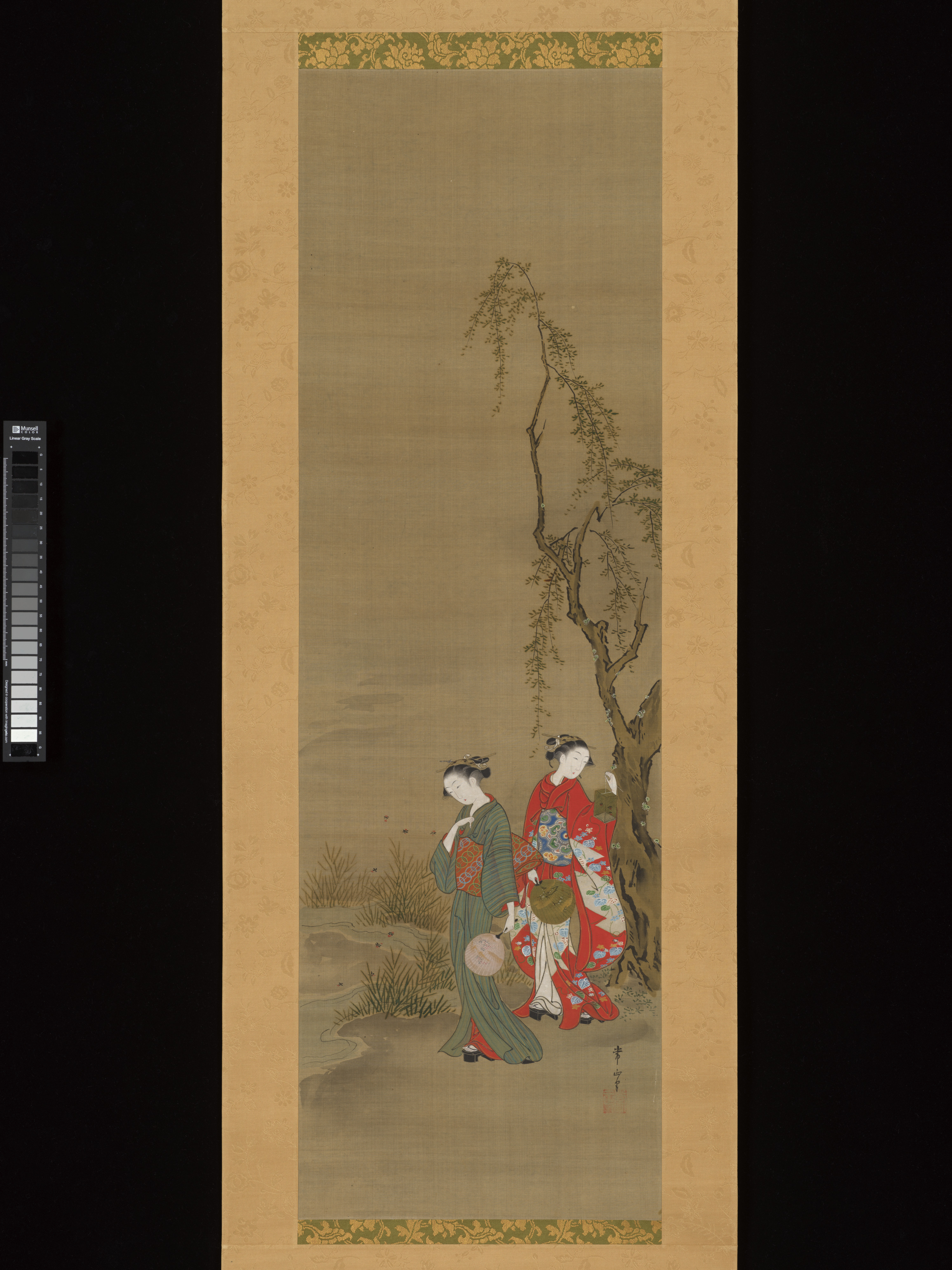
In subject matter, Tsunemasa stayed close to the foundational themes of painted ukiyo-e: depictions of beautiful women drawn from the licensed pleasure quarters and from the literary tradition, as well as mitate-e that alluded to classical themes. His courtesan portraits, such as the Art Institute of Chicago's Courtesan and Two Attendants, document the Yoshiwara hierarchy of the high-ranking oiran and her attendants in the elaborate kimono and seasonal accessories that defined the genre. His genre scenes, such as the Metropolitan Museum's Two Girls Catching Fireflies, capture the more intimate seasonal pastimes of Edo women. His literary subjects, exemplified by the Met's painting of the Yūgao or "Evening Faces" chapter from Murasaki Shikibu's Tale of Genji — in which he dressed his figures in Edo-period rather than Heian-period dress — demonstrate his engagement with the prestigious classical tradition that gave painted bijinga its cultural legitimacy.
Tsunemasa is recognized today as a substantial but lesser-known figure in the eighteenth-century painted ukiyo-e tradition, an artist whose surviving works, scattered across major museum collections, help reconstruct the development of the Edo painted bijinga. Within the small Kawamata line, he is the most thoroughly documented painter, and the surviving examples of his work establish him as one of the strongest practitioners of his generation in the painted mode.
Key Facts
Frequently Asked Questions
Kawamata Tsunemasa (川又常正) was an eighteenth-century Edo painter who specialized in delicate, refined depictions of beautiful women (bijinga). Working almost exclusively in painted formats — hanging scrolls and handscrolls in ink and color on silk and paper (nikuhitsu-ga) — rather than in the woodblock medium, Tsunemasa belongs to the small but consequential group of ukiyo-e painters whose work bridged the courtly painted bijin tradition descending from Kaigetsudō Ando and the eighteenth-century commercial print culture of Edo. His painted bijinga are relatively scarce today — something more than fifty paintings are identified as his — but they are represented in major collections including the Metropolitan Museum of Art and the Art Institute of Chicago, where they document an artist of distinct elegance and a confident command of the painted bijin idiom.
Kawamata Tsunemasa's work was shaped by the Ukiyo-e tradition in Japanese woodblock printmaking. Ukiyo-e: ## What is ukiyo-e? Ukiyo-e ([浮世絵](/glossary/ukiyo-e)) — literally "pictures of the floating world" — is the Edo-period Japanese print and painting tradition that flourished from roughly 1660 to 1868, depicting the pleasures of urban life in Edo (modern Tokyo): courtesans, kabuki actors, sumo wrestlers, famous landscapes, and seasonal beauties.
Kawamata Tsunemasa's prints frequently feature children.
Original prints by Kawamata Tsunemasa can be found in collections including Art Institute of Chicago, Metropolitan Museum of Art.