
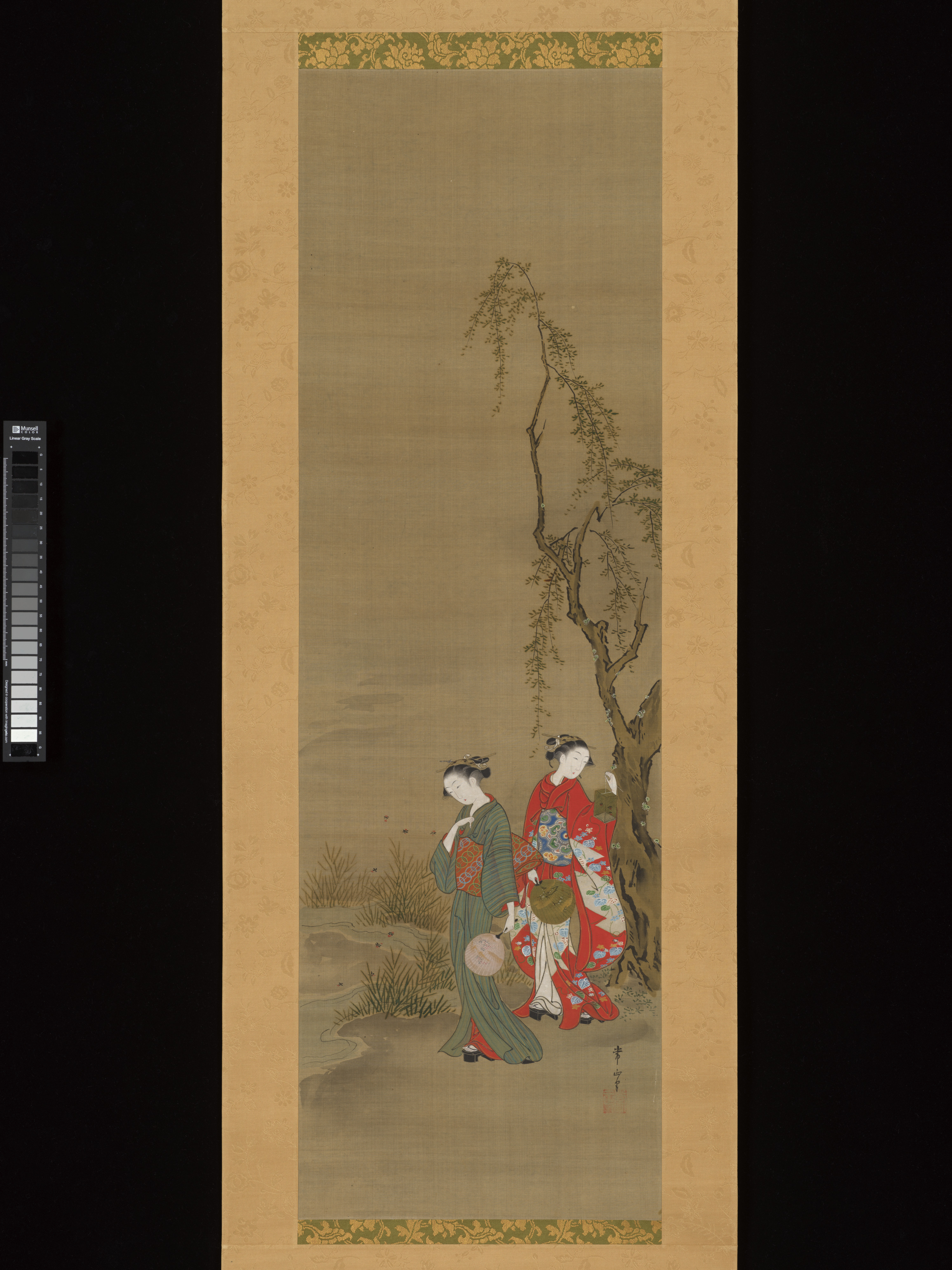
Courtesan and Two Attendants
- Date:
- c. 1723
- Medium:
- Hanging scroll; ink and color on paper
- Source:
- Art Institute of Chicago
Description
Held in the Art Institute of Chicago and dated to circa 1723, Courtesan and Two Attendants is a hanging scroll in ink and color on paper that captures the elaborate processional pageantry of the high-ranking Yoshiwara courtesan (oiran) and her attendant kamuro, the young girl apprentices who accompanied her on her formal walks through the licensed pleasure quarter. The painting belongs to the Kyōhō-era moment when the painted bijinga tradition descending from Kaigetsudō Ando had matured into the more refined, atmospheric idiom that Kawamata Tsunemasa, Miyagawa Chōshun, and Hanekawa Chinchō were jointly developing in the 1720s. Tsunemasa's composition arranges the central oiran and her two attendants in the kind of vertically stacked grouping that the painted hanging-scroll format favored, with the courtesan's elaborately patterned outer kimono and exposed obi sash dominating the visual field while the smaller kamuro figures flank her in supporting roles. The figural proportions follow the painted-bijinga conventions of attenuated elegance — long bodies, small heads, exaggerated grace of pose — that the Kaigetsudō school had codified and that Tsunemasa inherited and refined. The painting's restrained palette, focused on the patterned textiles and the figures' fair skin against the neutral paper ground, exemplifies the disciplined approach to color that the painted bijinga genre demanded. As one of Tsunemasa's documented works in a Western collection, the painting helps anchor his oeuvre and demonstrates his command of the courtesan portrait format that was the painted-bijinga school's defining subject in the early eighteenth century.
More Prints by Kawamata Tsunemasa
Frequently Asked Questions
Courtesan and Two Attendants was created by Kawamata Tsunemasa (川又常正) in c. 1723.