Biography
Kitagawa Tsukimaro (喜多川月麿, active c. 1794-1836) was one of the most accomplished pupils of Kitagawa Utamaro and a significant figure in the second generation of late-Edo bijin-ga. His birth and death dates are not securely documented — a circumstance not unusual for ukiyo-e designers of merchant or chōnin background — but his print career can be reconstructed in some detail from signed work, publisher colophons, and book illustrations spanning roughly four decades. The Met catalogues him under the name he used in the first decade of his career, Kitagawa Kikumaro, while later collections file the same artist under his more famous later signature Tsukimaro. The shift from one name to the other, around 1804, marks an important inflection in the way he positioned himself within and ultimately beyond the Utamaro school.
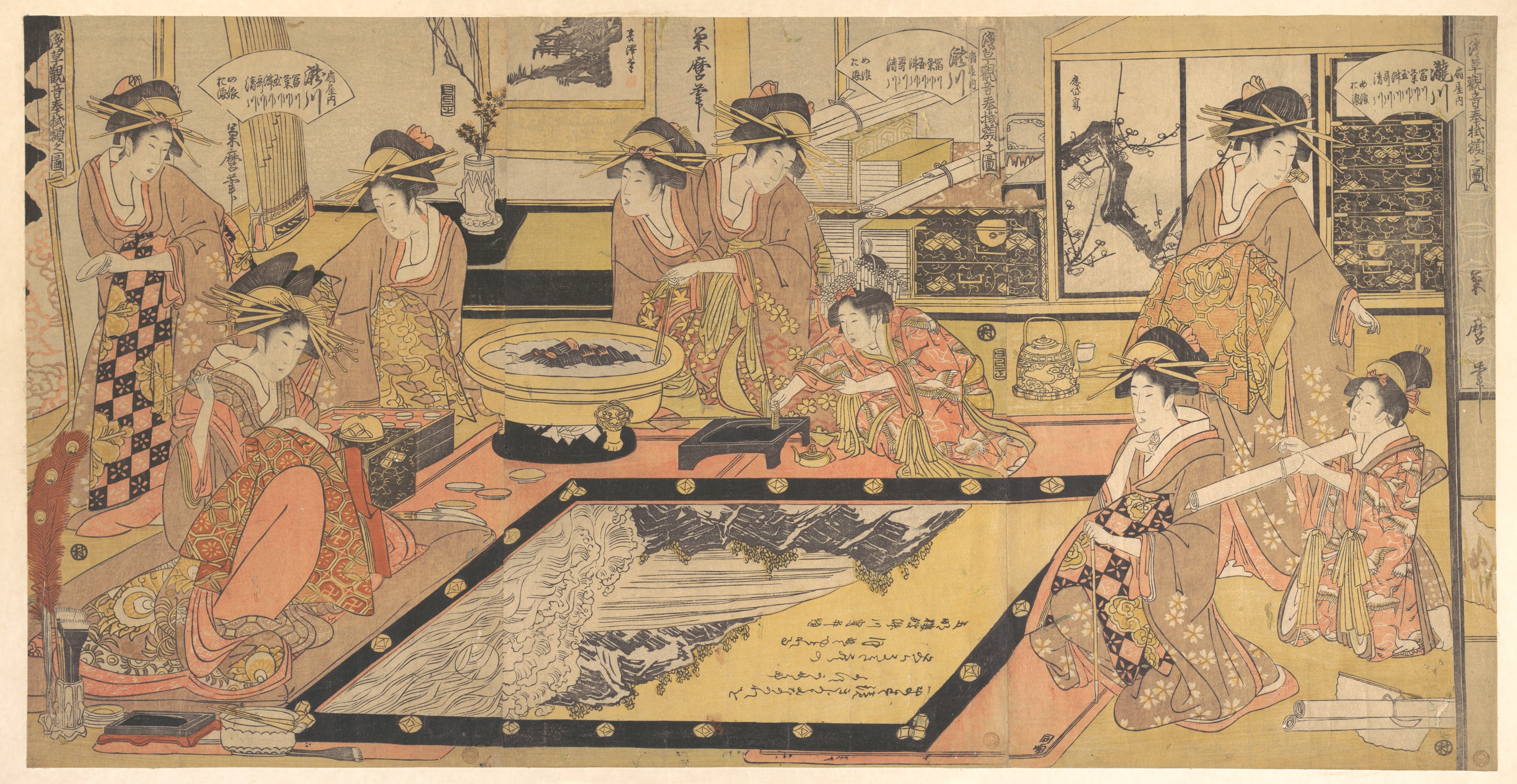
Nothing is known with certainty about Tsukimaro's early life, but the convention of the Kitagawa atelier — by which advanced pupils received a portion of the master's name (the 'maro' suffix) — places him firmly within Utamaro's workshop by the mid-1790s. His earliest dated prints appear around 1794-95, designed under the name Kikumaro ('Chrysanthemum Maro'). These designs are stylistically close to Utamaro's own bijin-ga of the same years: tall standing courtesans rendered in three-quarter view, the elongated proportions and small oval faces that defined the Kansei-era Yoshiwara portrait. Like the other Kitagawa pupils — Hidemaro, Takemaro, Shikimaro, and the later Utamaro II — Kikumaro worked primarily for the Yoshiwara-oriented publishers who had made his master's reputation. His most ambitious projects of the late 1790s and early 1800s, including the triptych A Votive Picture to Be Donated to the Kannon of Asakusa (ca. 1800), display a confident grasp of the Utamaro idiom and an interest in depicting the named celebrities of the Edo pleasure quarters by name, in the manner of his master's Seirō Nenjū Gyōji and other Yoshiwara-life series.
In 1804, the same year that Utamaro was arrested and briefly detained by the shogunate for a print depicting the sixteenth-century warlord Toyotomi Hideyoshi — a politically charged image that ran afoul of the censorship restrictions descended from the Kansei Reforms on the depiction of political and military subjects — Kikumaro changed his signature to Tsukimaro ('Moon Maro'). Tsukimaro was himself among the artists punished in the same episode. The reasons for the change of name are not fully clear; some scholars have suggested it reflected a desire to distinguish himself from the troubled master, others that the lunar-themed name simply represented an artistic maturation. Whatever the cause, the change of signature coincided with a noticeable broadening of his subject matter and a slow drift away from the Utamaro half-length okubi-e in favor of full-length standing figures, intimate genre scenes, and night settings. Utamaro himself died in 1806, two years after the punishment, and the master's leading pupils — Tsukimaro among them — emerged in the latter half of the first decade of the nineteenth century as the inheritors of the Kitagawa manner.
Tsukimaro's mature work of the 1810s is among the most refined bijin-ga of the period after Utamaro. He developed a distinctive interest in atmospheric night scenes — beauties walking after dark accompanied by lantern-bearing servants, courtesans seen by candlelight, the kind of intimate after-hours imagery that gives his oeuvre a quieter, more domestic register than the full-dress public bijin-ga of the 1790s. He continued to design Yoshiwara portraits, often of named courtesans of the Matsubaya, Ōgiya, and other major brothels, but increasingly he produced single-sheet prints of women engaged in everyday activities: playing the shamisen, attending to children, exchanging letters, preparing for an evening's entertainment. His surimono — privately commissioned, deluxe prints produced for kyōka poetry circles — became a particularly important strand of his output in the 1810s. The Met's Two Court Ladies (probably 1815) belongs to this category, with its delicate surimono refinements and elongated court-style figures that betray the format's traditional association with classical poetic culture rather than the popular bijin-ga of the commercial print sheets.
Tsukimaro was also a prolific book illustrator, producing designs for kibyōshi (yellow-cover comic books), kyōkabon (illustrated poetry anthologies), and ehon throughout his career. The Art Institute of Chicago holds two of his published books: Hō ōzome gosan no kiriyama (1804), signed Kikumaro, and Muda shugyō kane no waraji (1813), signed Tsukimaro — works that bracket his career across the name change and document his continuous engagement with the literary print culture of late-Edo Edo. He worked frequently in the surimono format for the kyōka poetry circles of the era, an association that placed him near the center of the literary half of the floating world even as his commercial prints continued to circulate among the broader Yoshiwara public.
Around 1820, Tsukimaro largely withdrew from commercial single-sheet print design, though he continued to produce surimono and book illustrations for a number of years afterward. In his later career he increasingly worked in painting on silk and paper, adopting the name Kansetsu (観雪), in a style influenced by the Maruyama-Shijō school of Kyoto-based naturalist painting. These late paintings of beauties retain Tsukimaro's distinctive elongated figural canon while moving away from the bright printed palette toward the more subdued ink-and-light-color manner characteristic of Maruyama-Shijō. He remained active into the 1830s; his last dated work is an illustration for a kyōka anthology of 1836, and his death is conventionally placed around that time.
Tsukimaro's reputation has fluctuated. In the immediate aftermath of Utamaro's death he was widely recognized as one of the master's most able successors, alongside Utamaro II; in the twentieth-century Western scholarly literature on ukiyo-e he was frequently treated as a minor figure overshadowed by his teacher. More recent scholarship has restored him as one of the most accomplished bijin-ga designers of the 1810s — an artist whose night scenes, surimono, and book illustrations document the gradual transformation of the Utamaro idiom into something more intimate, atmospheric, and literary. His prints are held in the major Western ukiyo-e collections, including the Metropolitan Museum of Art, the Museum of Fine Arts Boston, the Cleveland Museum of Art, the Art Institute of Chicago, the British Museum, and the Honolulu Museum of Art. He remains the connecting figure between Utamaro's late-Kansei Yoshiwara and the bijin-ga of Kikukawa Eizan and Keisai Eisen that would dominate the genre in the 1820s and 1830s.
Key Facts
Frequently Asked Questions
Kitagawa Tsukimaro (喜多川月麿, active c. 1794-1836) was one of the most accomplished pupils of Kitagawa Utamaro and a significant figure in the second generation of late-Edo bijin-ga. His birth and death dates are not securely documented — a circumstance not unusual for ukiyo-e designers of merchant or chōnin background — but his print career can be reconstructed in some detail from signed work, publisher colophons, and book illustrations spanning roughly four decades. The Met catalogues him under the name he used in the first decade of his career, Kitagawa Kikumaro, while later collections file the same artist under his more famous later signature Tsukimaro. The shift from one name to the other, around 1804, marks an important inflection in the way he positioned himself within and ultimately beyond the Utamaro school.
Kitagawa Tsukimaro's work was shaped by the Ukiyo-e tradition in Japanese woodblock printmaking. Ukiyo-e: ## What is ukiyo-e? Ukiyo-e ([浮世絵](/glossary/ukiyo-e)) — literally "pictures of the floating world" — is the Edo-period Japanese print and painting tradition that flourished from roughly 1660 to 1868, depicting the pleasures of urban life in Edo (modern Tokyo): courtesans, kabuki actors, sumo wrestlers, famous landscapes, and seasonal beauties.
Kitagawa Tsukimaro's prints frequently feature children.
Original prints by Kitagawa Tsukimaro can be found in collections including Cleveland Museum of Art, Metropolitan Museum of Art.
Woodblock Prints by Kitagawa Tsukimaro (5)
A Votive Picture to Be Donated to the Kannon of Asakusa (Asakusa Kannon hō kakegaku no zu), by Takigawa of the Ōgiya, Kamuro Menami and Onami, with Tomikawa, Kumegawa, Tamagawa, Tsugawa, Utagawa, and Kiyokawa
ca. 1800
Triptych of woodblock prints; ink and color on paper
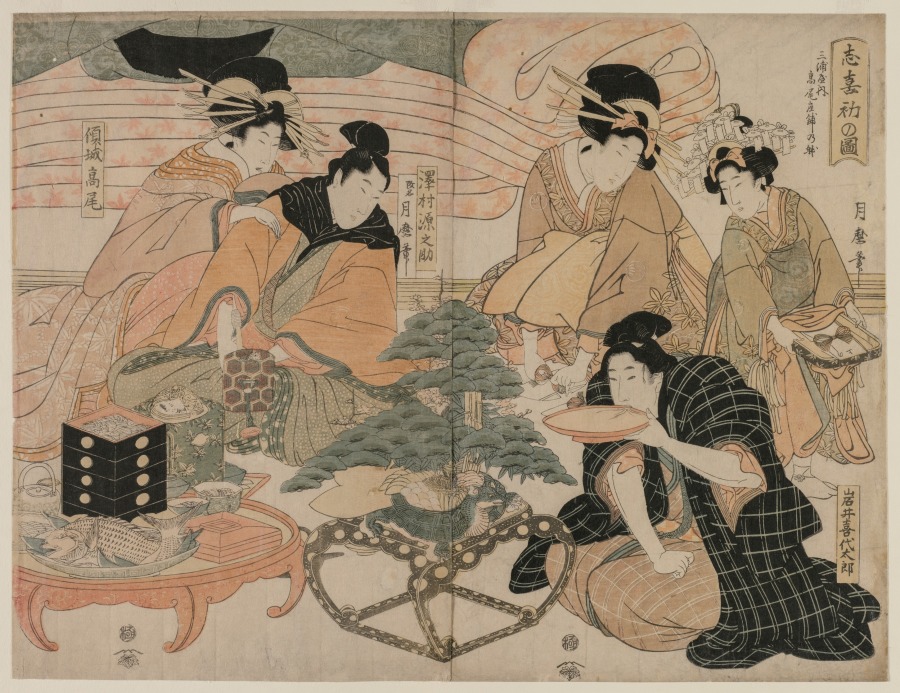
Picture of the First Visit to the Pleasure Quarters
mid 1800s
Color woodblock print
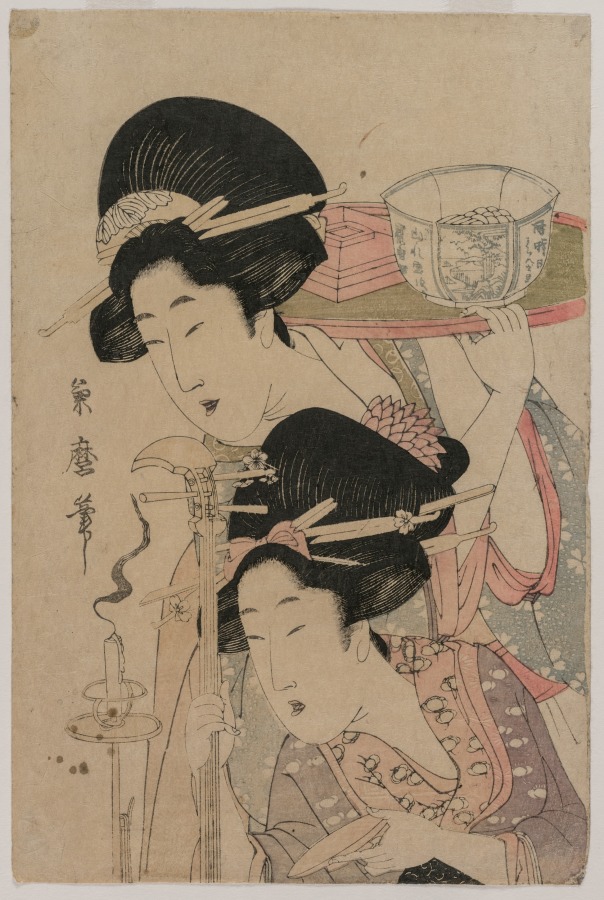
Two Geishas beside a Candle
mid 1800s
Color woodblock print

Man and Girl
early 1800s
Woodblock print; ink and color on paper
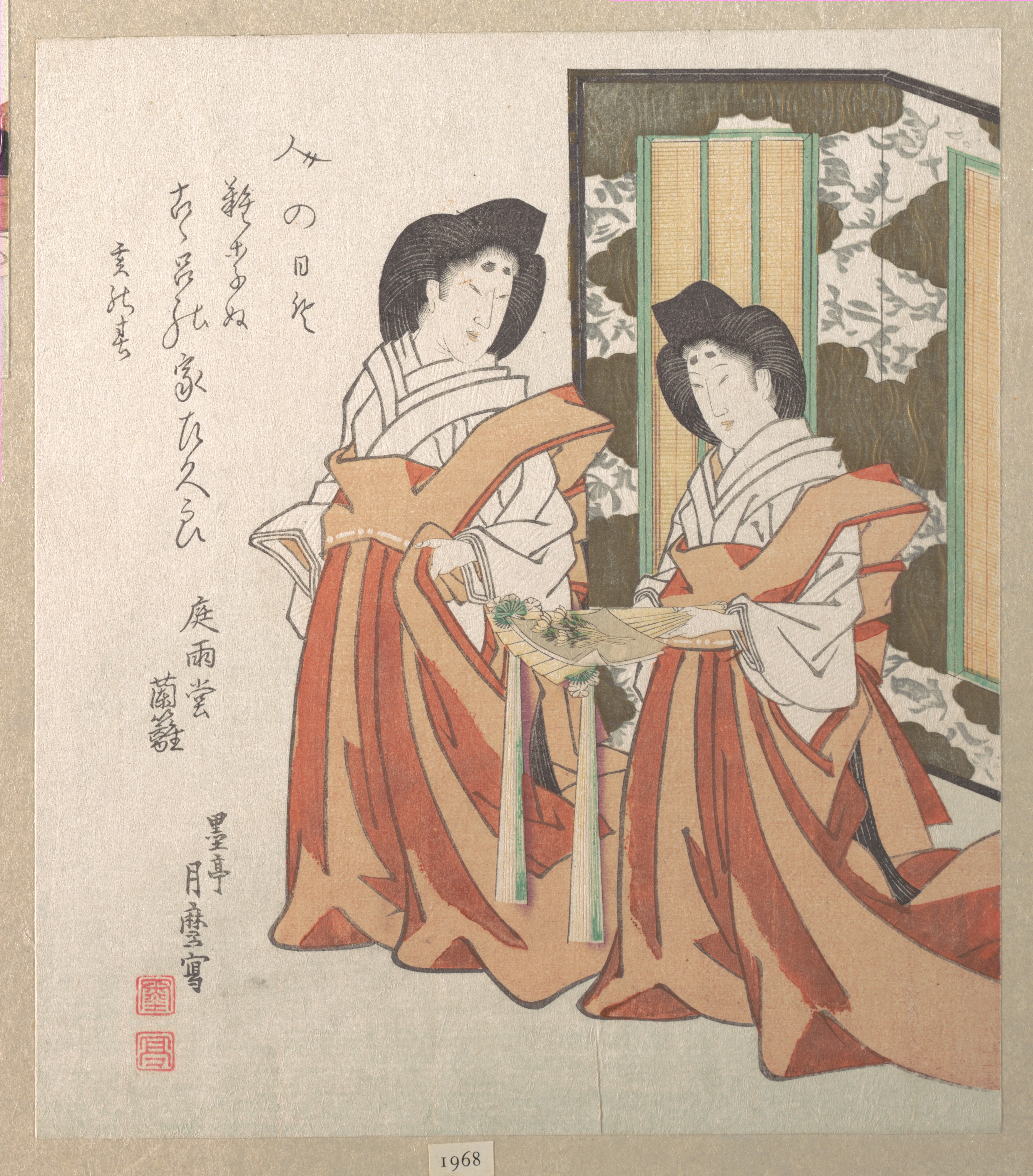
Two Court Ladies
probably 1815
Woodblock print (surimono); ink and color on paper