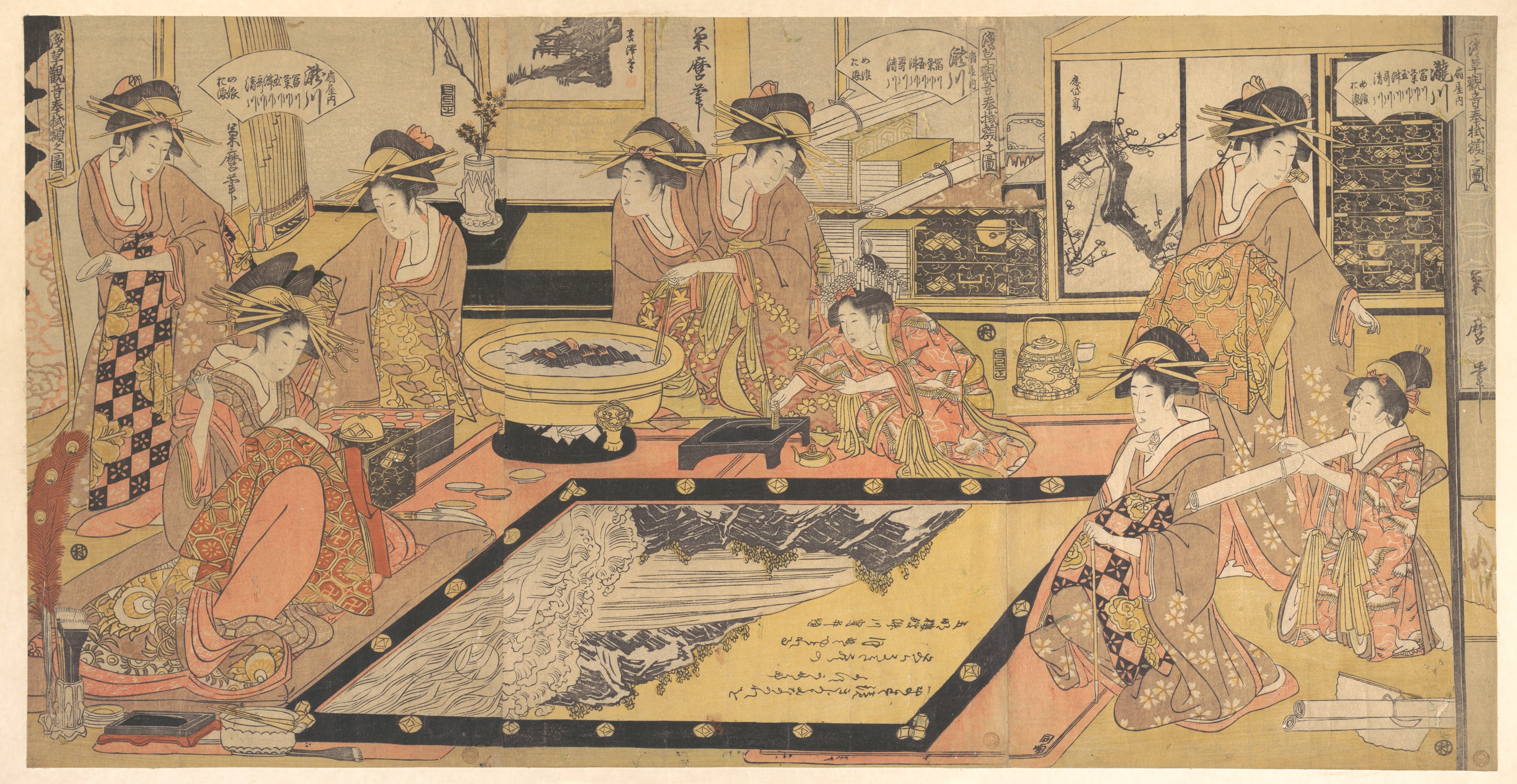
A Votive Picture to Be Donated to the Kannon of Asakusa (Asakusa Kannon hō kakegaku no zu), by Takigawa of the Ōgiya, Kamuro Menami and Onami, with Tomikawa, Kumegawa, Tamagawa, Tsugawa, Utagawa, and Kiyokawa
- Date:
- ca. 1800
- Medium:
- Triptych of woodblock prints; ink and color on paper
- Source:
- Metropolitan Museum of Art
Description
A Votive Picture to Be Donated to the Kannon of Asakusa (Asakusa Kannon hō kakegaku no zu) is an oban-format woodblock triptych by Kitagawa Tsukimaro, then signing as Kikumaro, produced around 1800. The composition depicts the high-ranking courtesan Takigawa of the Ōgiya — one of the most celebrated Yoshiwara beauties of her generation, accomplished as a painter, calligrapher, and poet — at work on a votive painting to be donated as a New Year's offering to the Kannon of Sensō-ji temple in Asakusa. She is shown surrounded by her kamuro (young attendants) Menami and Onami and a small group of fellow courtesans including Tomikawa, Kumegawa, Tamagawa, Tsugawa, Utagawa, and Kiyokawa, each identified by cartouche. The scene combines the standard bijin-ga interest in the named Yoshiwara celebrities with a relatively rare emphasis on the courtesan as artist — a theme that aligned Takigawa's reputation as a cultivated woman with the literary and religious culture of the Asakusa district. Tsukimaro's figures, rendered in his master Utamaro's elongated three-quarter manner, are arranged in a long horizontal frieze across the three sheets, with the votive panel itself as the compositional pivot. The print exemplifies Kikumaro's confident handling of multi-sheet Yoshiwara compositions in the years immediately before his change of signature to Tsukimaro. Impressions are held by the Metropolitan Museum of Art and other major collections.
More Prints by Kitagawa Tsukimaro

Frequently Asked Questions
A Votive Picture to Be Donated to the Kannon of Asakusa (Asakusa Kannon hō kakegaku no zu), by Takigawa of the Ōgiya, Kamuro Menami and Onami, with Tomikawa, Kumegawa, Tamagawa, Tsugawa, Utagawa, and Kiyokawa was created by Kitagawa Tsukimaro (喜多川月麿) in ca. 1800.