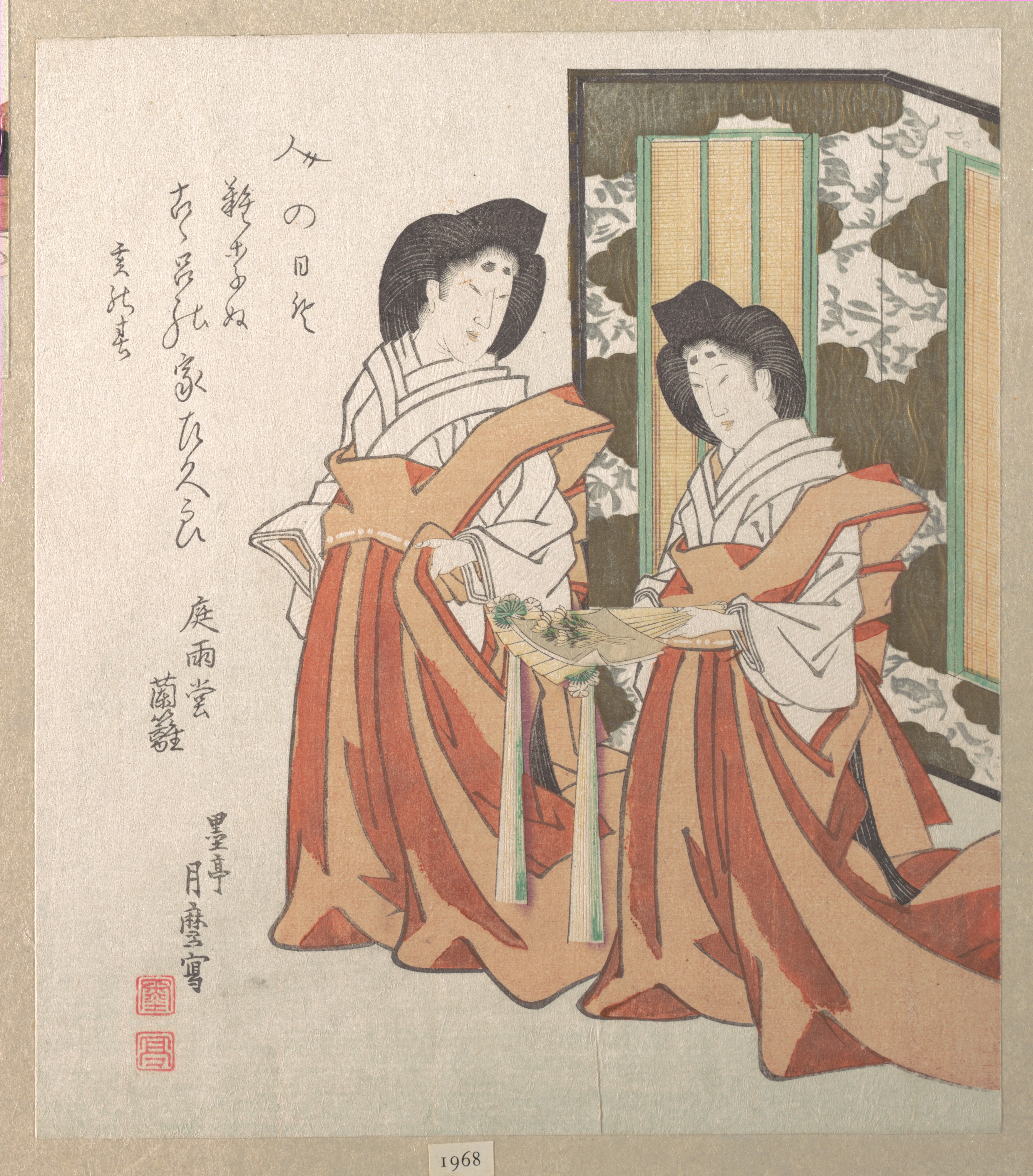
Two Court Ladies
- Date:
- probably 1815
- Medium:
- Woodblock print (surimono); ink and color on paper
- Source:
- Metropolitan Museum of Art
Description
Two Court Ladies is a surimono (privately commissioned, deluxe woodblock print) by Kitagawa Tsukimaro, signed Kikumaro and dating to about 1815. Two seated figures in heavy multi-layered court robes face one another across the composition, their hair arranged in the long flowing style associated with Heian-period courtly women rather than contemporary Edo bijin. The use of metallic pigments — silver and gold — and the deep embossing of the textile patterns identify the print as a surimono, a category of luxury print produced outside the standard commercial publishing system and circulated privately among the members of kyōka poetry clubs. Tsukimaro's surimono of the 1810s are among the finest examples of the genre, distinguished by their delicate palette, refined embossing, and a strong taste for classical literary subjects. The two court ladies pictured here are likely a mitate — a witty visual translation — referring to a specific moment in Heian-period literature, perhaps the Tale of Genji or the Ise monogatari, in which contemporary Yoshiwara women have been recast as the court figures of the classical past. The print belongs to the deeply literary half of Tsukimaro's oeuvre, and exemplifies the surimono's role as the most cultivated subcategory of late-Edo bijin-ga. The Metropolitan Museum holds an impression.
More Prints by Kitagawa Tsukimaro
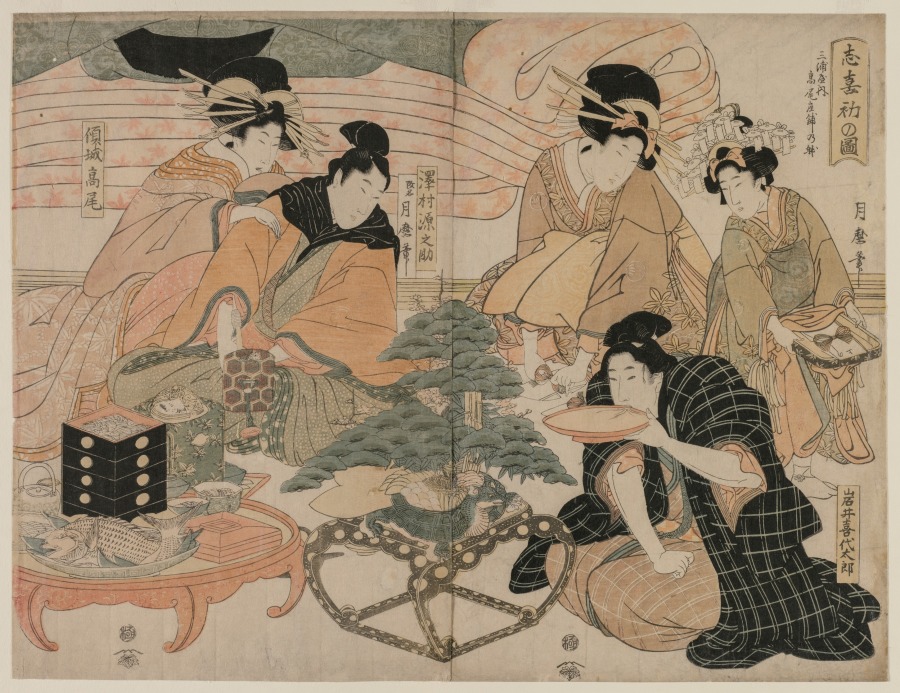
Picture of the First Visit to the Pleasure Quarters
mid 1800s
Color woodblock print
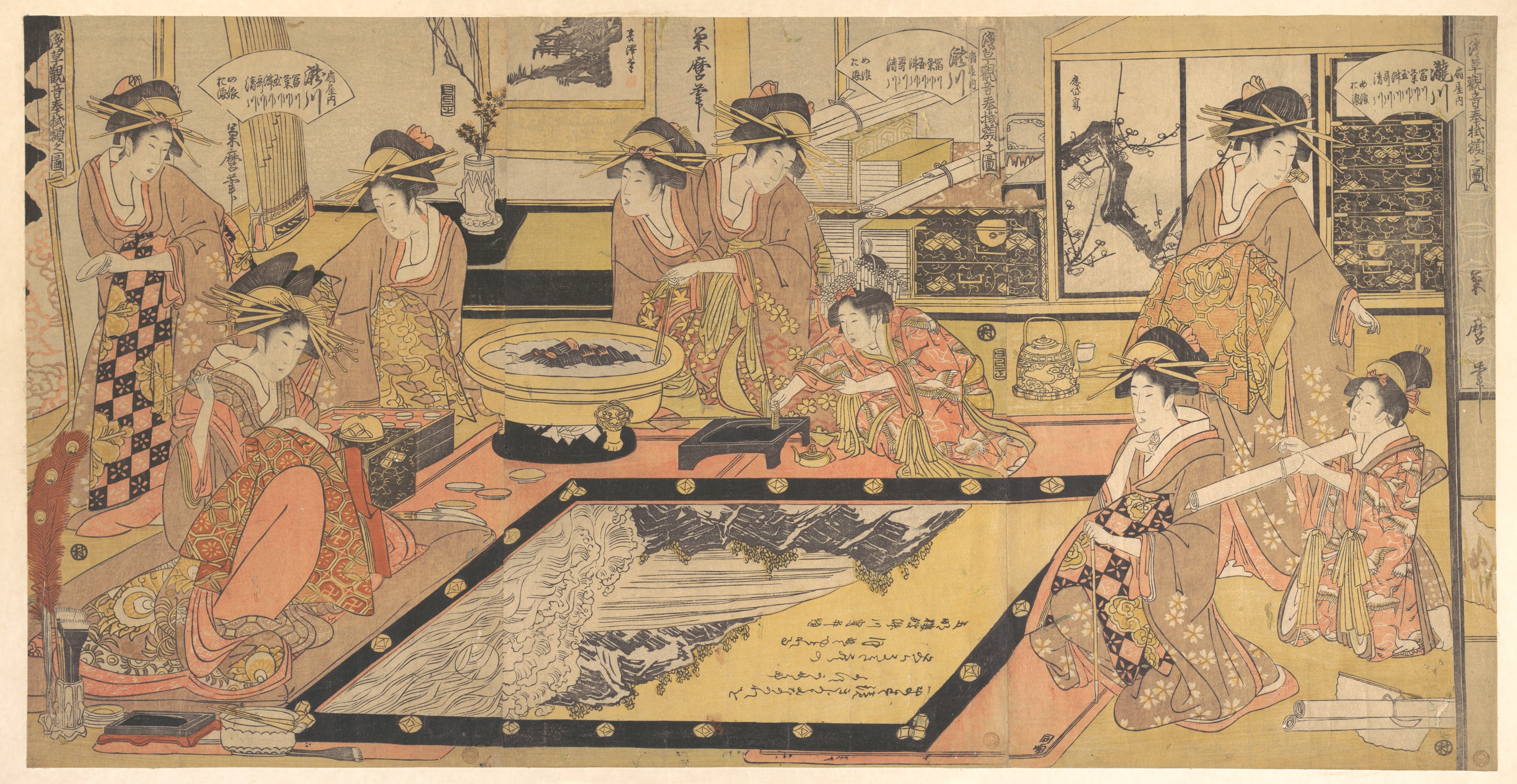
A Votive Picture to Be Donated to the Kannon of Asakusa (Asakusa Kannon hō kakegaku no zu), by Takigawa of the Ōgiya, Kamuro Menami and Onami, with Tomikawa, Kumegawa, Tamagawa, Tsugawa, Utagawa, and Kiyokawa
ca. 1800
Triptych of woodblock prints; ink and color on paper

Man and Girl
early 1800s
Woodblock print; ink and color on paper
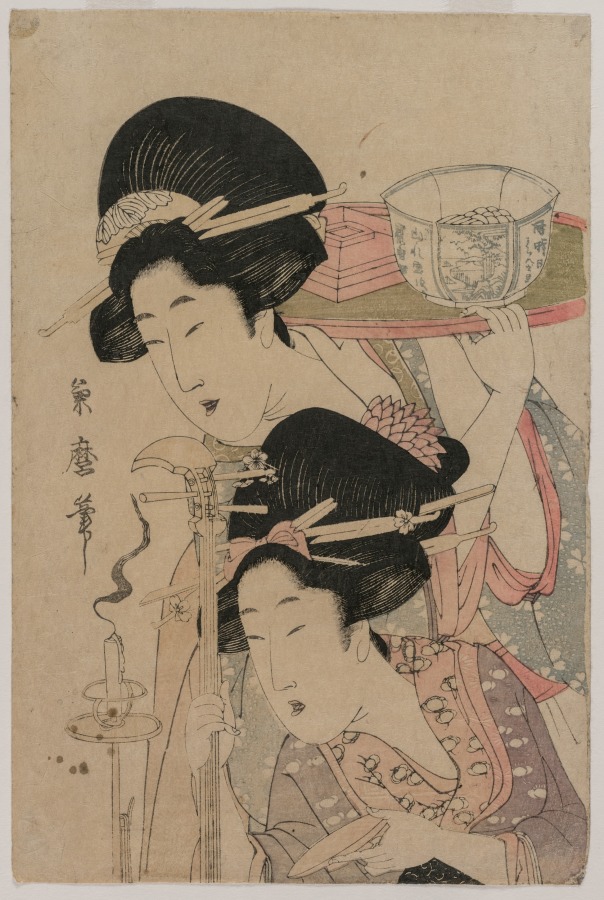
Two Geishas beside a Candle
mid 1800s
Color woodblock print
Frequently Asked Questions
Two Court Ladies was created by Kitagawa Tsukimaro (喜多川月麿) in probably 1815.