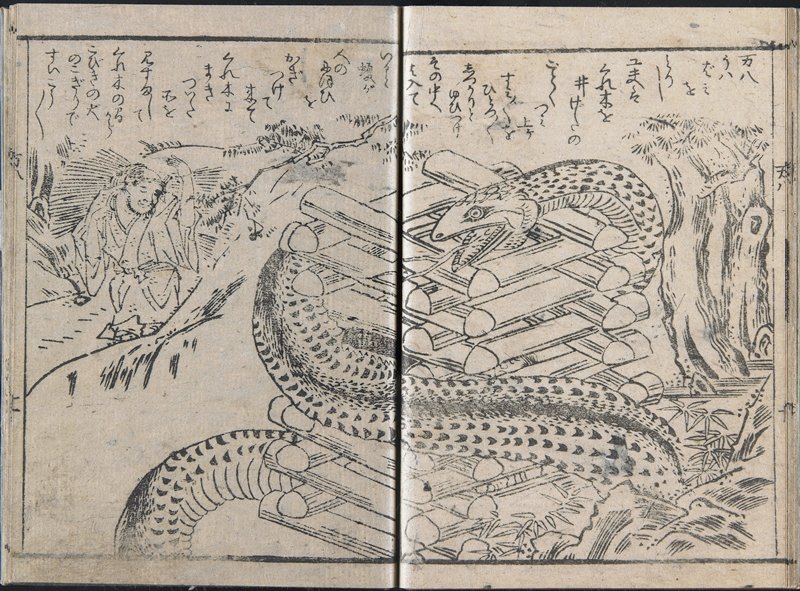
Biography
Kitagawa Utamaro (喜多川歌麿, c. 1753–1806) stands as the supreme master of bijin-ga, the art of depicting beautiful women in the Japanese woodblock print tradition. Working at the height of the ukiyo-e movement in the late eighteenth century, Utamaro transformed the genre from formulaic representations of courtesans and entertainers into penetrating psychological studies of femininity. His adaptation of the okubi-e format — large-head bust portraits that filled the picture plane with a single face — to the depiction of beautiful women represented a radical departure from existing bijin-ga conventions and produced some of the most iconic images in the history of Japanese art.
The details of Utamaro's early life remain frustratingly obscure. He was born around 1753, though some scholars place his birth as early as 1750 or as late as 1754. His birthplace is disputed, with Edo (present-day Tokyo), Kawagoe, Kyoto, and Osaka all proposed by various authorities. Even his original family name is uncertain; Kitagawa may have been adopted from his teacher or assumed later in his career. No letters, diaries, or personal documents have survived to illuminate his private life, leaving biographers to reconstruct his story almost entirely from his published works, the records of his publishers, and the testimony of contemporaries.
Utamaro's artistic training almost certainly began under Toriyama Sekien, a painter of the Kano school who had turned to ukiyo-e and was known for his illustrated books of supernatural creatures and folklore. Sekien, who was described as a cultured man with connections to both the elite painting academies and the popular world of the pleasure quarters, provided a thorough grounding in brushwork, composition, and the conventions of both classical Japanese painting and the more populist ukiyo-e tradition. By one account, Sekien described his pupil as intelligent, talented, and devoted to his studies. Utamaro's earliest known works, produced under the art name Kitagawa Toyoaki, date from the mid-1770s and consist primarily of modest illustrations for popular fiction and theatrical prints of kabuki actors — the bread-and-butter subjects of the ukiyo-e trade. By the early 1780s, he had adopted the name Utamaro and was beginning to develop a more distinctive voice.
One of the earliest signs of Utamaro's extraordinary observational powers appeared not in his portraits of women but in his illustrated books of natural history. Between 1788 and 1791, he produced a remarkable trio of albums devoted to the natural world that stand among the supreme achievements of Japanese illustrated book production. "Ehon Mushi Erabi" (Picture Book of Selected Insects, 1788) paired exquisitely detailed depictions of insects and their plant environments with witty kyoka poems that used the insects as metaphors for human love and desire. "Shiohi no Tsuto" (Gifts from the Ebb Tide, 1789) presented shells and marine life with similar refinement, the concertina-bound album allowing each image to be displayed as a continuous panorama. "Momo Chidori Kyoka Awase" (Myriad Birds Compared in Humorous Verse, 1791) completed the trio with birds rendered in astonishing naturalistic detail. These albums, produced with the finest pigments, carving, and printing available in Edo, demonstrated that Utamaro possessed powers of observation and compositional sophistication that went far beyond the conventions of bijin-ga.
The decisive turning point in Utamaro's career came through his association with Tsutaya Juzaburo, the most ambitious and artistically discerning publisher in Edo. Tsutaya's shop stood at the entrance to the Yoshiwara pleasure quarter, and he had an unerring instinct for commercial potential combined with genuine artistic ambition. The relationship between artist and publisher deepened from around 1782, when Utamaro hosted a lavish banquet attended by leading ukiyo-e artists including Kiyonaga, Kitao Shigemasa, and Katsukawa Shunsho. For approximately five years, Utamaro lived with Tsutaya, essentially serving as the house's head artist. Tsutaya provided him with the finest materials — premium pigments, skilled carvers, experienced printers, and luxurious paper — while encouraging him to pursue his most experimental ideas. It was this unique partnership that made possible the prints that would define Utamaro's legacy.
Utamaro's great innovation came in the early 1790s, when he brought the okubi-e or "large-head" format — until then used chiefly for portraits of kabuki actors — to the depiction of beautiful women. Where previous bijin-ga artists — including Torii Kiyonaga, who had dominated the genre in the 1780s — had typically shown their subjects at full length, situated within identifiable settings and defined largely by their elaborate costumes, Utamaro brought the viewer startlingly close. His bust portraits cropped the figure at the chest or shoulders and enlarged the face to fill the sheet, often against a plain ground of mica or pale color. This radical simplification directed attention entirely to the woman's face and expression, demanding that the artist convey character and emotion through the subtlest means — the angle of a glance, the set of the lips, the tilt of the head, the way a hand touched a comb or held a mirror.
In series such as "Fujin Sogaku Juttai" (Ten Studies in Female Physiognomy), "Kasen Koi no Bu" (Anthology of Poems: The Love Section), "Fujin Ninso Juppon" (Ten Types of Women's Physiognomies), and "Toji Zensei Bijin Zoroi" (Flourishing Beauties of the Present Day), Utamaro used these minimal means to suggest distinct psychological states — contemplation, longing, vanity, tenderness, quiet amusement, and melancholy — with a sophistication that had no precedent in the popular print tradition. Some of these series identified their subjects by name, depicting famous courtesans of the Yoshiwara whose beauty and accomplishments were matters of public celebrity. Others portrayed anonymous women of the townsman class engaged in everyday activities — combing their hair, reading letters, nursing infants, or working at the tasks of daily domestic life — with a dignity that elevated the mundane into something approaching portraiture.
The 1790s represented Utamaro's period of supreme achievement. His subjects ranged from named courtesans of the Yoshiwara to anonymous women of the townsman class. His series "Women Engaged in the Sericulture Industry" (Joshoku Kaiko Tewaza-gusa) depicted the stages of silk production with monumental dignity, the women's labor rendered with the same care and compositional gravity that other artists reserved for scenes of leisure and beauty. Another notable series from this decade is "Twelve Hours of the Green Houses" (Seiro Juni Toki), which depicted the daily routines of courtesans in the Yoshiwara from dawn to midnight.
Utamaro also produced accomplished shunga (erotic prints), including the celebrated "Utamakura" (Poem of the Pillow, 1788), which combined frank sensuality with extraordinary compositional refinement. Shunga occupied a significant portion of Utamaro's output — numerous books, albums, and related publications — and were not considered disreputable in Edo society but rather a natural extension of the artist's exploration of human intimacy and desire. His shunga works were produced with the same technical care as his commercial prints, featuring elaborate printing techniques including metallic pigments, blind embossing (karazuri), and burnishing (tsuyazuri) that created subtle textural effects on the surface of the paper.
Utamaro's technical mastery extended to his innovative use of mica backgrounds (kirazuri), in which powdered mica was applied to the surface of the print to create a glittering, reflective ground against which the figure was set. This technique, which was expensive and labor-intensive, gave his okubi-e portraits an almost otherworldly luminosity, elevating the subjects from the mundane world of the pleasure quarter into a realm of idealized beauty. He also made sophisticated use of gradated printing (bokashi) in his backgrounds and fabrics, and his line work achieved a fluency and subtlety that was the despair of his imitators. The carvers who translated his designs into woodblocks were among the finest in Edo, and the collaboration between designer, carver, and printer that produced Utamaro's greatest prints represented the pinnacle of the woodblock printing craft.
Utamaro's contemporaries and rivals included several formidable artists. Torii Kiyonaga had dominated bijin-ga in the 1780s before Utamaro's innovations eclipsed his full-length, architecturally staged compositions. Chobunsai Eishi, a former samurai who had taken up ukiyo-e, produced elegant but more conventional beauty prints that lacked Utamaro's psychological depth. Rekisentei Eiri briefly experimented with the okubi-e format but never matched Utamaro's mastery. Among his Utagawa school contemporaries, Toyokuni I dominated the market for actor prints but generally avoided direct competition in bijin-ga.
The death of Tsutaya Juzaburo in 1797 deprived Utamaro of his greatest champion. Though he continued to produce work for other publishers, some scholars detect a gradual change in his output after this date — prints that are technically accomplished but perhaps less daring than those produced under Tsutaya's patronage.
In 1804, Utamaro produced a print depicting the sixteenth-century military ruler Toyotomi Hideyoshi with his five consorts at a cherry-blossom viewing party — an allusion to Hideyoshi's famously lavish blossom-viewing held at Daigo-ji in 1598. Such depictions of historical military figures ran afoul of the shogunate's censorship laws, and the authorities, sensitive to any evocation of the Toyotomi whom the Tokugawa founders had supplanted, punished Utamaro along with several other artists and writers. He was sentenced to be manacled for fifty days, a punishment that prevented him from working. Though he resumed work after his release, some accounts suggest the episode took a lasting toll on him.
Utamaro died on October 31, 1806, in Edo, at the age of approximately fifty-three. The two years between his punishment and his death saw a marked decline in both the quantity and the fire of his output, and some writers have suggested that the ordeal of his arrest hastened his end. After his death, the name "Utamaro" was carried on by a pupil known as Utamaro II — the artist Koikawa Shuncho, who married Utamaro's widow — whose work was competent in technical execution but lacked the psychological depth and compositional daring of the master's greatest prints. Utamaro II continued to produce bijin-ga for several years, but the era of Utamaro's supreme innovations in the genre had passed.
The Kansei Reforms of the 1790s, enacted by the senior councilor Matsudaira Sadanobu, had already cast a shadow over the culture of the pleasure quarters during Utamaro's most productive decade. These reforms restricted the naming of courtesans in prints and imposed various censorship requirements on publishers, leading to the practice of identifying subjects through rebus puzzles and allusive titles rather than direct naming. Utamaro navigated these restrictions with characteristic ingenuity, producing series that ostensibly depicted "anonymous" women but were readily identifiable to knowledgeable viewers through their distinctive features, hairstyles, and accessories.
Utamaro's work was among the first Japanese art to reach Europe in significant quantities after Japan opened to international trade in the 1850s. His flattened pictorial space, bold outlines, and subtle color harmonies exerted a powerful influence on Western modernism. Edgar Degas, who collected his prints, drew on the unconventional vantage points and asymmetric compositions of Japanese prints in his own work. Mary Cassatt's tender studies of mothers and children likewise reflect the influence of Japanese woodblock compositions. Toulouse-Lautrec's posters for Parisian cabarets owe much to the bold outlines and flattened color areas of the ukiyo-e tradition, and Art Nouveau designers found in the flowing lines and decorative sensibility of Japanese prints a model for their synthesis of fine and applied art.
Among Utamaro's most remarkable achievements are the three monumental paintings known collectively as "Snow, Moon, and Flowers," produced for the wealthy merchant Zenno Ihe. "Fukagawa no Yuki" (Snow at Fukagawa), "Shinagawa no Tsuki" (Moon at Shinagawa), and "Yoshiwara no Hana" (Flowers at Yoshiwara) are large-format paintings, each depicting scenes from the pleasure quarters of Edo. The three works were separated in the late nineteenth century after they reached the Paris art market. "Moon at Shinagawa" was acquired by Charles Lang Freer and entered the Smithsonian's Freer Gallery of Art in Washington, D.C. "Flowers at Yoshiwara" passed through several hands in France before being purchased by the Wadsworth Atheneum in Hartford, Connecticut. "Snow at Fukagawa" was missing for nearly seventy years before it resurfaced at the Okada Museum of Art in Hakone, Japan, which announced its rediscovery in 2014. In 2017, the three paintings were reunited for the first time in nearly 140 years at the Smithsonian's Freer Gallery of Art in the exhibition "Inventing Utamaro."
Utamaro's prints are held in major museum collections worldwide, including the Metropolitan Museum of Art, the British Museum, the Museum of Fine Arts Boston, the Art Institute of Chicago, the Bibliothèque nationale de France, and the Tokyo National Museum. His work continues to be the subject of major exhibitions and scholarly study.
Edmond de Goncourt's influential monograph "Outamaro, le peintre des maisons vertes" (Utamaro, Painter of the Green Houses), published in Paris in 1891, was one of the first Western studies devoted to a single Japanese artist and helped establish Utamaro's reputation in Europe as the supreme master of the feminine ideal. While Goncourt's romanticized account contained numerous factual errors and was shaped by Orientalist assumptions, it played a crucial role in bringing Utamaro's name to the attention of Western artists and collectors at the height of Japonisme.
Utamaro's achievement was to bring the full resources of artistic genius to the depiction of beautiful women, transforming what had been commercial entertainment into penetrating human portraiture. In an era when women in ukiyo-e were typically rendered as interchangeable types distinguished only by costume and coiffure, Utamaro insisted on their individuality — their moods, their thoughts, their inner lives. His legacy extends beyond the world of fine art into fashion, graphic design, and advertising, where his bold compositions and elegant line work continue to influence visual culture. His images have appeared on Japanese commemorative postage stamps and are reproduced on merchandise, textiles, and decorative objects worldwide. This insistence on psychological truth within a popular medium remains his most enduring contribution to the history of art.
Key Facts
- Active Period
- 1753–1806
- Movement
- Ukiyo-e
- Works Indexed
- 381
Frequently Asked Questions
Kitagawa Utamaro (喜多川歌麿, c. 1753–1806) stands as the supreme master of bijin-ga, the art of depicting beautiful women in the Japanese woodblock print tradition. Working at the height of the ukiyo-e movement in the late eighteenth century, Utamaro transformed the genre from formulaic representations of courtesans and entertainers into penetrating psychological studies of femininity. His adaptation of the okubi-e format — large-head bust portraits that filled the picture plane with a single face — to the depiction of beautiful women represented a radical departure from existing bijin-ga conventions and produced some of the most iconic images in the history of Japanese art.
Kitagawa Utamaro was active from 1753 to 1806. They were associated with the Ukiyo-e movement.
Kitagawa Utamaro's work was shaped by the Ukiyo-e tradition in Japanese woodblock printmaking. Ukiyo-e: ## What is ukiyo-e? Ukiyo-e ([浮世絵](/glossary/ukiyo-e)) — literally "pictures of the floating world" — is the Edo-period Japanese print and painting tradition that flourished from roughly 1660 to 1868, depicting the pleasures of urban life in Edo (modern Tokyo): courtesans, kabuki actors, sumo wrestlers, famous landscapes, and seasonal beauties.
Kitagawa Utamaro's prints frequently feature bijin-ga, children, birds & flowers, figures, yoshiwara, mount fuji.
Original prints by Kitagawa Utamaro can be found in collections including Art Institute of Chicago, Harvard Art Museums, Minneapolis Institute of Art, AGGV.
External Resources
Series by Kitagawa Utamaro
Ten Studies in Female Physiognomy
1792–1793 · 10 prints
Ten Classes of Women's Physiognomy
1 print
Tailored Journeys of Couple's Crests
1 print
Ten Aspects of the Physiognomy of Women
1 print
Treasury of Loyal Retainers
1 print
Guide to Contemporary Styles
1 print
Triptych of Beauties Before Blinds
1 print
Seven Komachis of Yoshiwara
1 print
Selections from Six Houses in Yoshiwara
1 print
Twelve Hours in Yoshiwara
1 print
Anthology of Poems: The Love Section (Kasen koi no bu) (Mono-omou koi)
1 print
Five Shades of Ink in the Northern Quarter
2 prints
Comparing the Charms of Five Beauties (Gonin bijin aikyo kurabe)
1 print
Fashionable Patterns in Utamaro Style
1 print
Snow
1 print
Renowned Beauties Likened to the Six Immortal Poets
1 print
Fashonable Patterns in Utamaro Style
1 print
Female Geisha Section of the Yoshiwara Niwaka Festival
1 print
Seven Beautiful Women
1 print
Model Young Women Woven in Mist
1 print
Woodblock Prints by Kitagawa Utamaro (381)
Yūgiri and Izaemon, from the series Tailored Journeys of Couple's Crests (Hiyoku mon michiyuki shitate)
early 19th century
Woodblock print (nishiki-e); ink and color on paper

Kisegawa of the Matsubaya, from the series "Comparing the Charms of Five Beauties (Gonin bijin aikyo kurabe)"
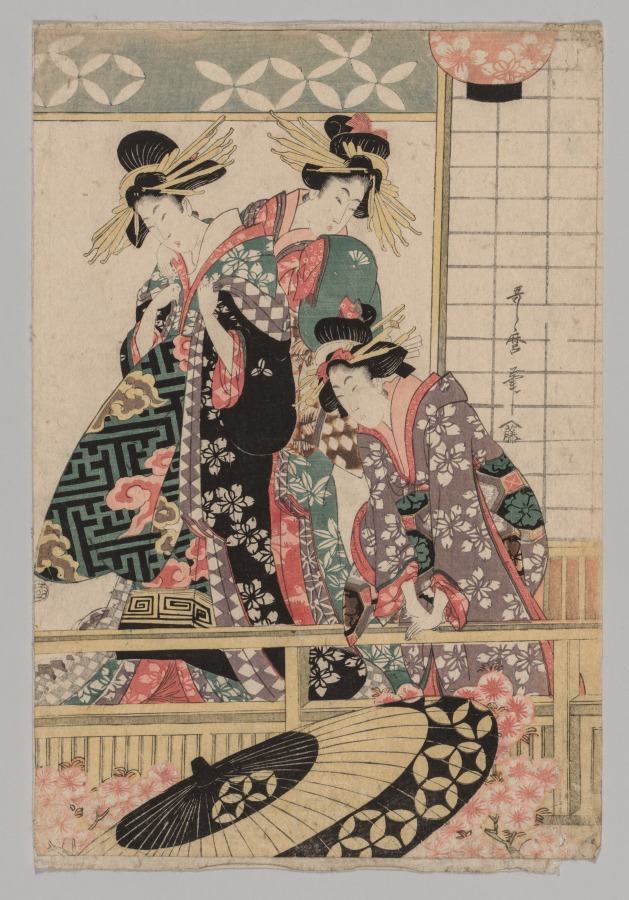
Yoshiwara Women Looking into the Street at Springtime
1753–1806
color woodblock print

Peonies
n.d.
Color woodblock print; surimono
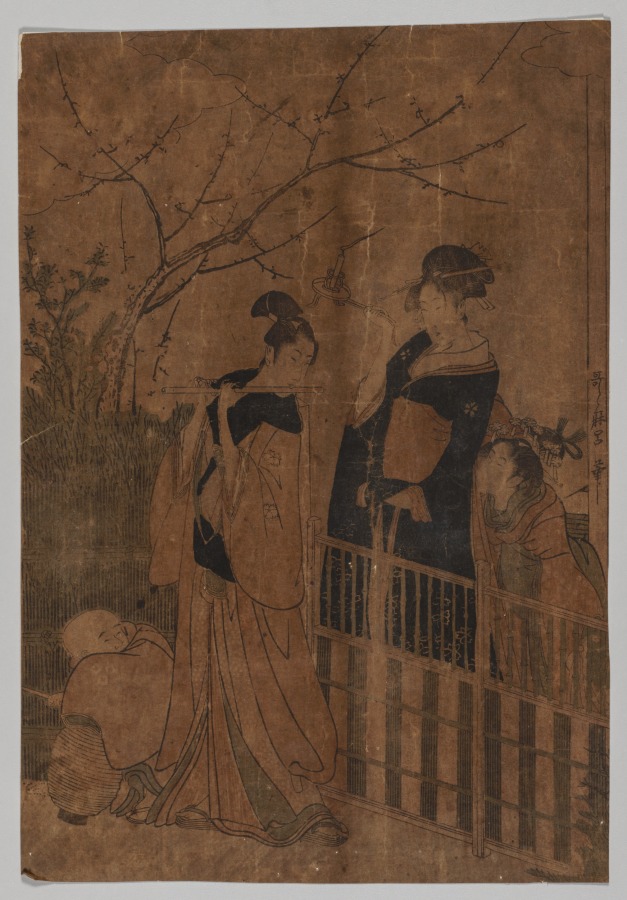
Serenade
1753–1806
color woodblock print
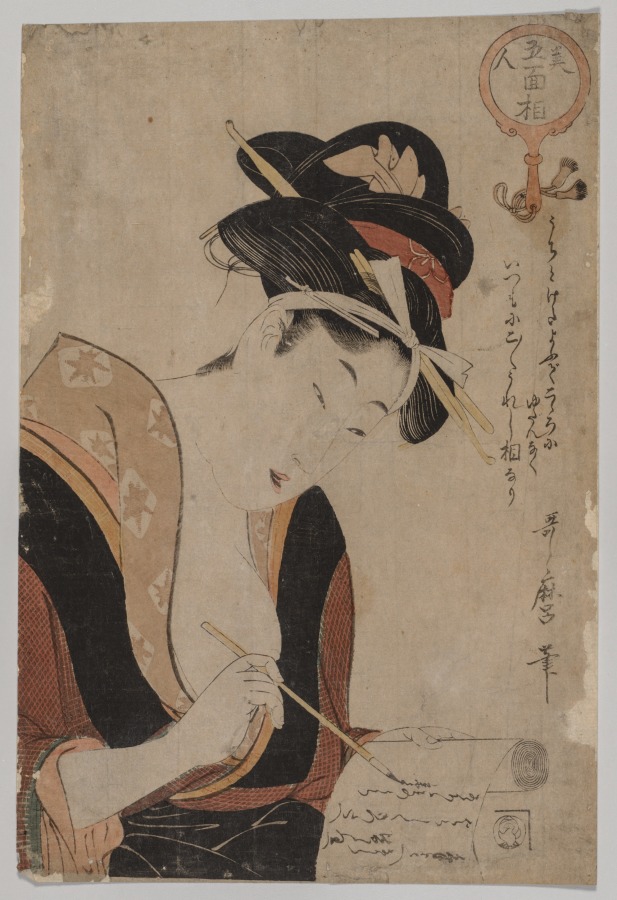
Woman Writing
1753–1806
color woodblock print
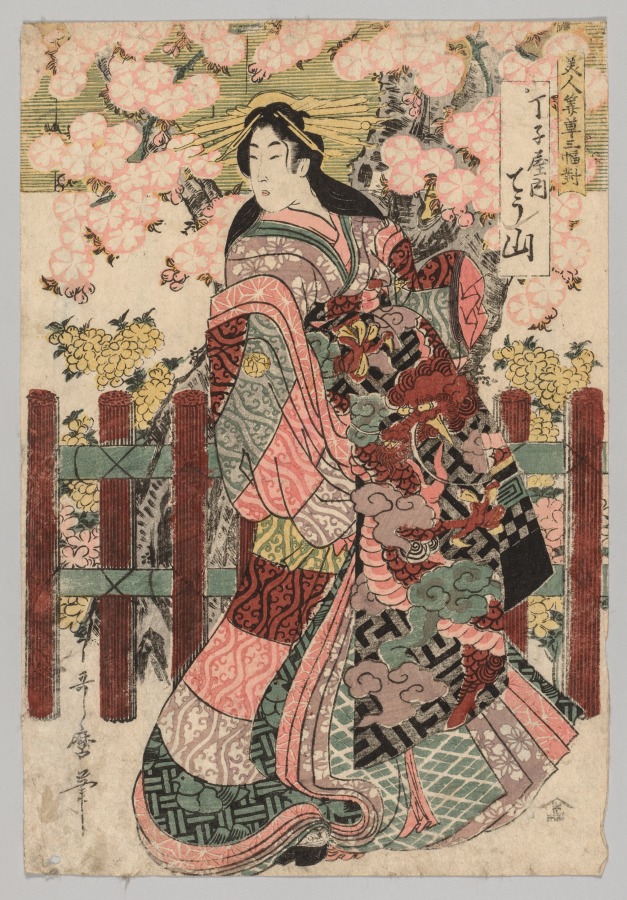
Chōzan of Chōjiya from the series Triptych of Beauties Before Blinds
1753–1806
color woodblock print
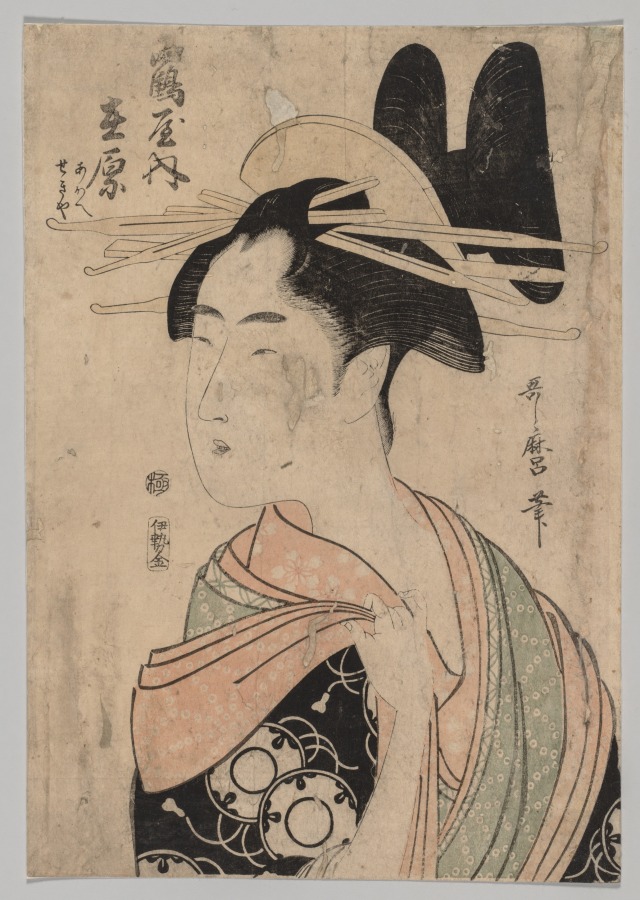
Woman of the Yoshiwara
1753–1806
color woodblock print
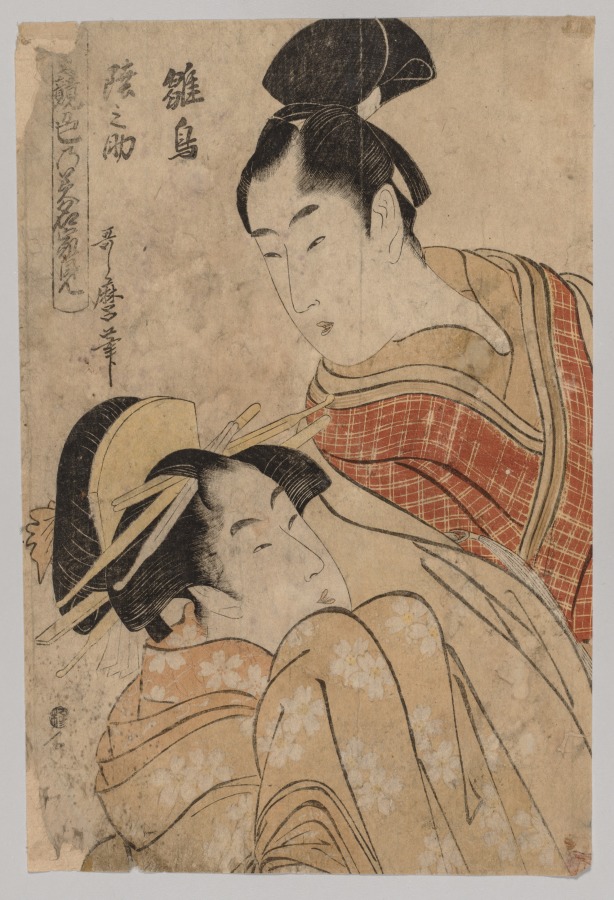
Making Love
1753–1806
color woodblock print
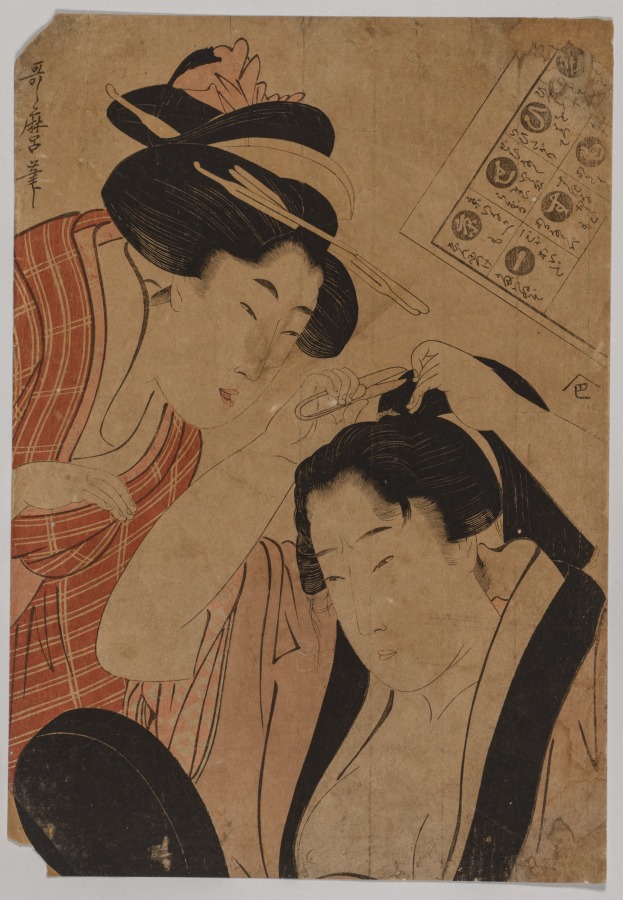
No Title
1753–1806
color woodblock print
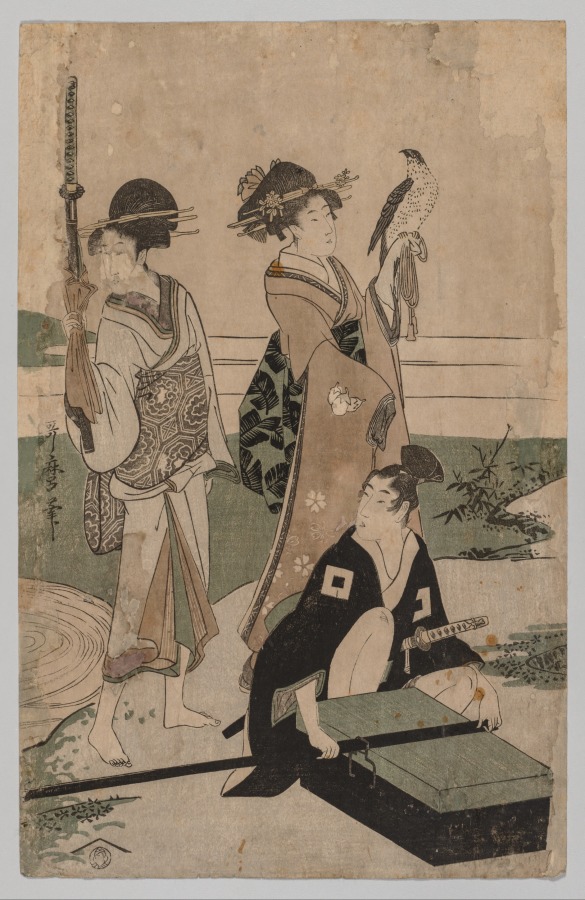
Daimyō and his Retinue Crossing a Stream in Plain Near Fuji
1753–1806
color woodblock print
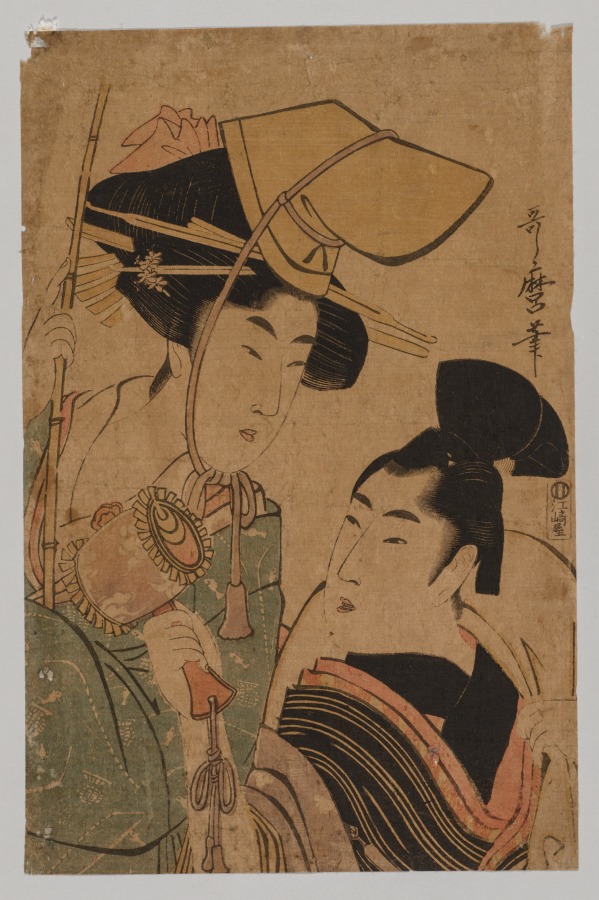
Woman Representing Good Fortune
1753–1806
color woodblock print

Snow, Moon, and Flowers in the Pleasure Quarters (Seiro setsugekka) : Hanamurasaki of the Tamaya with Attendants Shirabe and Teriha
n.d.
Color woodblock print; oban

Geisha Style (geisha fū) from the series Guide to Contemporary Styles (Tōsei fūzoku tsū)
1801
Color woodblock print; oban
Kayoi, from the series Seven Beautiful Women (Fūryū nana komachi)
Late Edo period, late 18th to early 19th century
Ukiyo-e woodblock print in "ōban" format; ink and color on paper, with printed signature reading "Utamaro hitsu"

Hidematsu, Yasokichi, Izukiyo of the Otsuya (Otsuya uchi Hidematsu, Yasokichi, Izukiyo), from the series "Female Geisha Section of the Yoshiwara Niwaka Festival (Seiro niwaka onna geisha no bu)"
1783
Color woodblock print; oban

Matsumoto Koshiro IV and Nakayama Tomisaburo, the left hand sheet of a triptych entitled “Six Actors Likened to the Immortal Poets" ("Yakusha Rokkasen")
Pheasant (Kiji) and Swallows (Tsubame), detached page from the book Myriad Birds: A Kyōka Competition (Momo chidori kyōka awase)
c. 1790 (Kansei 2)
Detached page from woodblock-printed book; ink and color on paper
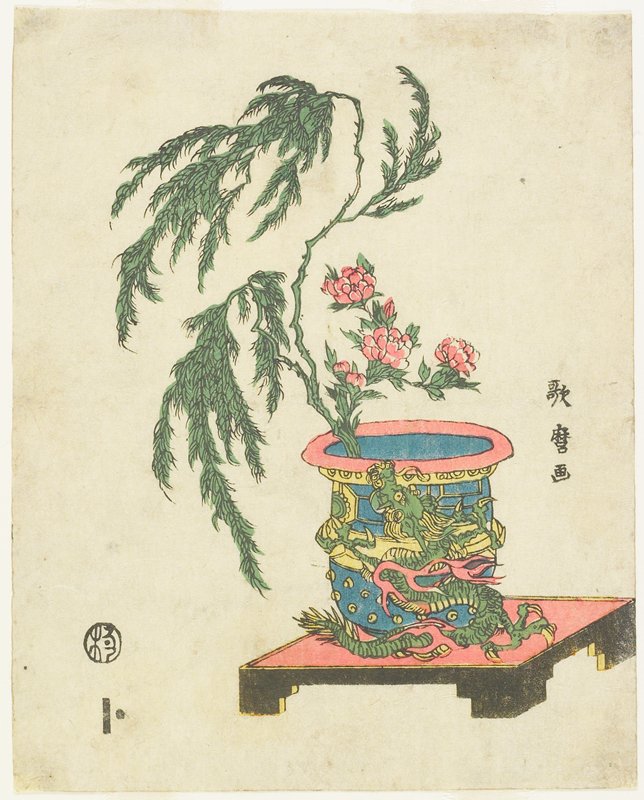
Ikebana arrangement of Peony and Willow in Dragon Pot
1781–1806
Woodblock print (nishiki-e), ink and color on paper

Ikebana arrangement of Chrysanthemums, Bamboo in Basket
1781–1806
Woodblock print (nishiki-e), ink and color on paper
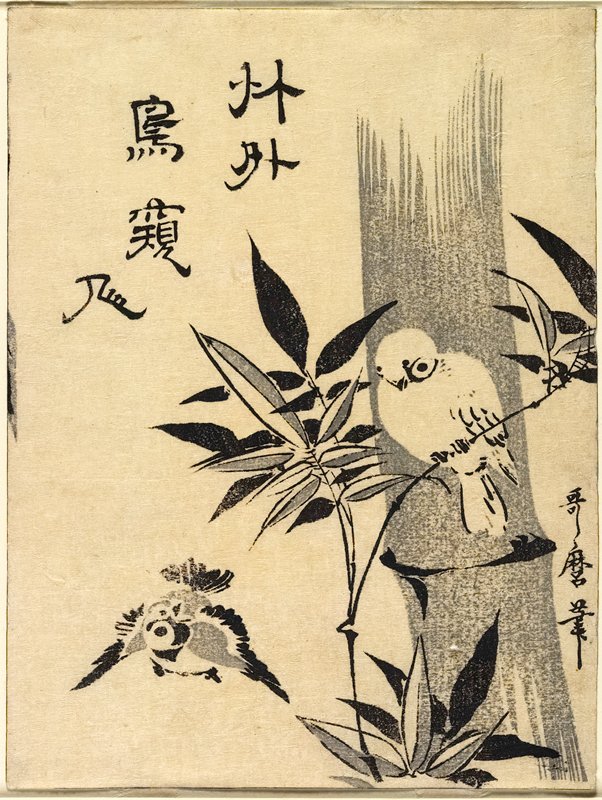
Sparrows on Bamboo Branch
c. 1781–1806
Woodblock print (sumizuri-e), ink on paper

Pleasures of the Four Seasons: Colors and Scents of Flowers, left (Shiki no asobi hana no iroka, ge)
c. 1783
Color woodblock print; left sheet of oban diptych

Omando: Ochie, Onokichi of the Matsuya, from the series Female Geisha Section of the Yoshiwara Niwaka Festival (Seiro niwaka onna geisha no bu) (Omando, Matsuya uchi Ochie, Onokichi)
1783
Color woodblock print; oban
