
Biography
Kitao Masayoshi (1764-1824), better known by his art name Kuwagata Keisai, was an Edo print designer, illustrator, and painter whose innovative sketch albums reshaped Japanese pictorial design and helped lay the conceptual groundwork for what would later be called manga. Although he began his career squarely within the ukiyo-e tradition, designing color prints and book illustrations for the commercial publishers of Edo, he gradually transformed himself into a draftsman of brilliant pictorial shorthand whose compressed, witty drawings of people, animals, fish, plants, and landscapes influenced a generation of Japanese artists, including Katsushika Hokusai.
Born in 1764 in Edo (modern Tokyo) into a townsman family, he is recorded under the personal name Akabane Sanjiro. As a young man he entered the studio of Kitao Shigemasa, one of the most respected figures of the late eighteenth-century Edo art world and the founder of the Kitao school. Shigemasa was a versatile master who designed bijinga (pictures of beautiful women), illustrated kibyoshi (yellow-cover) novels, and produced printed picture books that combined elegant figure drawing with refined book design. Under Shigemasa's mentorship, Masayoshi absorbed both the technical craft of woodblock production and the broader Edo culture of literary illustration. He took the name Kitao Masayoshi in keeping with the Kitao school tradition, and by the early 1780s he was already producing book illustrations and single-sheet ukiyo-e prints.
The first phase of his career saw him working in the established commercial genres. He designed bijin prints in the Kitao manner, illustrated popular fiction of the day, and contributed to the fashionable uki-e (perspective picture) format that used borrowed European one-point perspective to render theatrical scenes and urban views. His perspective prints depicting scenes from Kanadehon Chushingura, the canonical story of the forty-seven loyal retainers, place him within the Edo print culture of the late eighteenth century, when uki-e enjoyed renewed popularity as a way of dramatizing kabuki narratives. These works show a designer fluent in the conventions of his day, comfortable with bright color palettes and the dramatic compositions the commercial market demanded.
The pivotal shift in his career came in the 1790s, when he turned away from the ukiyo-e single-sheet market and concentrated on the format that would become his lasting contribution: the ryakugashiki, or sketch-style picture book. The Japanese word ryakuga literally means "abbreviated picture," and these books were collections of figures, animals, plants, and landscapes rendered in a deliberately reductive, calligraphic line that captured the essence of a subject with extraordinary economy. The first, Ryakugashiki, appeared in 1795, and over the following decade and more he extended the idea across a series of thematic volumes devoted to people, to birds and animals, to landscapes, to fish and shellfish, and to plants and flowers. Taken together, these volumes constitute a comprehensive visual encyclopedia of the natural and human world, rendered with a compositional shorthand that had little precedent in Japanese book illustration.
The historical importance of these albums extends beyond their inherent charm. Masayoshi's ryakugashiki predated Katsushika Hokusai's famous Manga, the first volume of which appeared in 1814, by roughly two decades, and contemporaries observed that Hokusai drew inspiration from Keisai's earlier sketchbooks. The Manga's miscellany format, its willingness to range freely across subjects, its delight in caricature and abbreviated form, and its very status as a sketchbook for popular consumption all build on foundations Masayoshi helped lay. Modern scholars of Japanese print history routinely identify him as one of the most important formal innovators of the late Edo period.
Masayoshi's gifts as a draftsman did not go unnoticed by the samurai elite. In the mid-1790s he became official painter (goyo-eshi) to the daimyo of the Tsuyama domain in Mimasaka Province, an unusual honor for a townsman artist of the Edo print world, since most ukiyo-e designers remained outside the structures of feudal patronage. Around this time he adopted the art name Kuwagata Keisai, by which much of his most celebrated work is signed, and worked increasingly in a more classical manner, studying the Kano tradition under Kano Yosen'in Korenobu. The position gave him both prestige and a measure of stability, allowing him to continue producing his sketch albums and illustrated books alongside more formal painted commissions.
Beyond the ryakugashiki series, Keisai produced an extensive corpus of illustrated books. Many of these volumes circulated widely, were reprinted, and exerted influence on a generation of younger illustrators; his pictures of artisans, performers, and travelers carry an ethnographic dimension that has made the works valuable to historians of Edo material culture as well as to art historians of Japanese prints.
Kitao Masayoshi died in 1824 and is buried at Mitsuzo-in temple. His prints and sketch albums are held by major museum collections, including the Art Institute of Chicago. Among collectors of Japanese woodblock prints, his work is prized for its formal inventiveness, its calligraphic verve, and its central place in the prehistory of Japanese manga. For students of the broader history of Edo print culture and the Kitao school, Kuwagata Keisai remains an indispensable figure: the draftsman who, more than any other artist of his moment, taught Japanese pictorial art to draw quickly, wittily, and with the radical economy that would shape printed images in Japan for the next century.
Key Facts
- Active Period
- 1764–1824
- Nationality
- 🇯🇵Japan
- Movement
- Ukiyo-e
- Works Indexed
- 38
Frequently Asked Questions
Kitao Masayoshi (1764-1824), better known by his art name Kuwagata Keisai, was an Edo print designer, illustrator, and painter whose innovative sketch albums reshaped Japanese pictorial design and helped lay the conceptual groundwork for what would later be called manga. Although he began his career squarely within the ukiyo-e tradition, designing color prints and book illustrations for the commercial publishers of Edo, he gradually transformed himself into a draftsman of brilliant pictorial shorthand whose compressed, witty drawings of people, animals, fish, plants, and landscapes influenced a generation of Japanese artists, including Katsushika Hokusai.
Kitao Masayoshi was active from 1764 to 1824. They were associated with the Ukiyo-e movement.
Kitao Masayoshi's work was shaped by the Ukiyo-e tradition in Japanese woodblock printmaking. Ukiyo-e: ## What is ukiyo-e? Ukiyo-e ([浮世絵](/glossary/ukiyo-e)) — literally "pictures of the floating world" — is the Edo-period Japanese print and painting tradition that flourished from roughly 1660 to 1868, depicting the pleasures of urban life in Edo (modern Tokyo): courtesans, kabuki actors, sumo wrestlers, famous landscapes, and seasonal beauties.
Kitao Masayoshi's prints frequently feature winter, bridges, mythology, spring.
Original prints by Kitao Masayoshi can be found in collections including Victoria and Albert Museum, Art Institute of Chicago, Cleveland Museum of Art.
Woodblock Prints by Kitao Masayoshi (38)
Sunday
2002
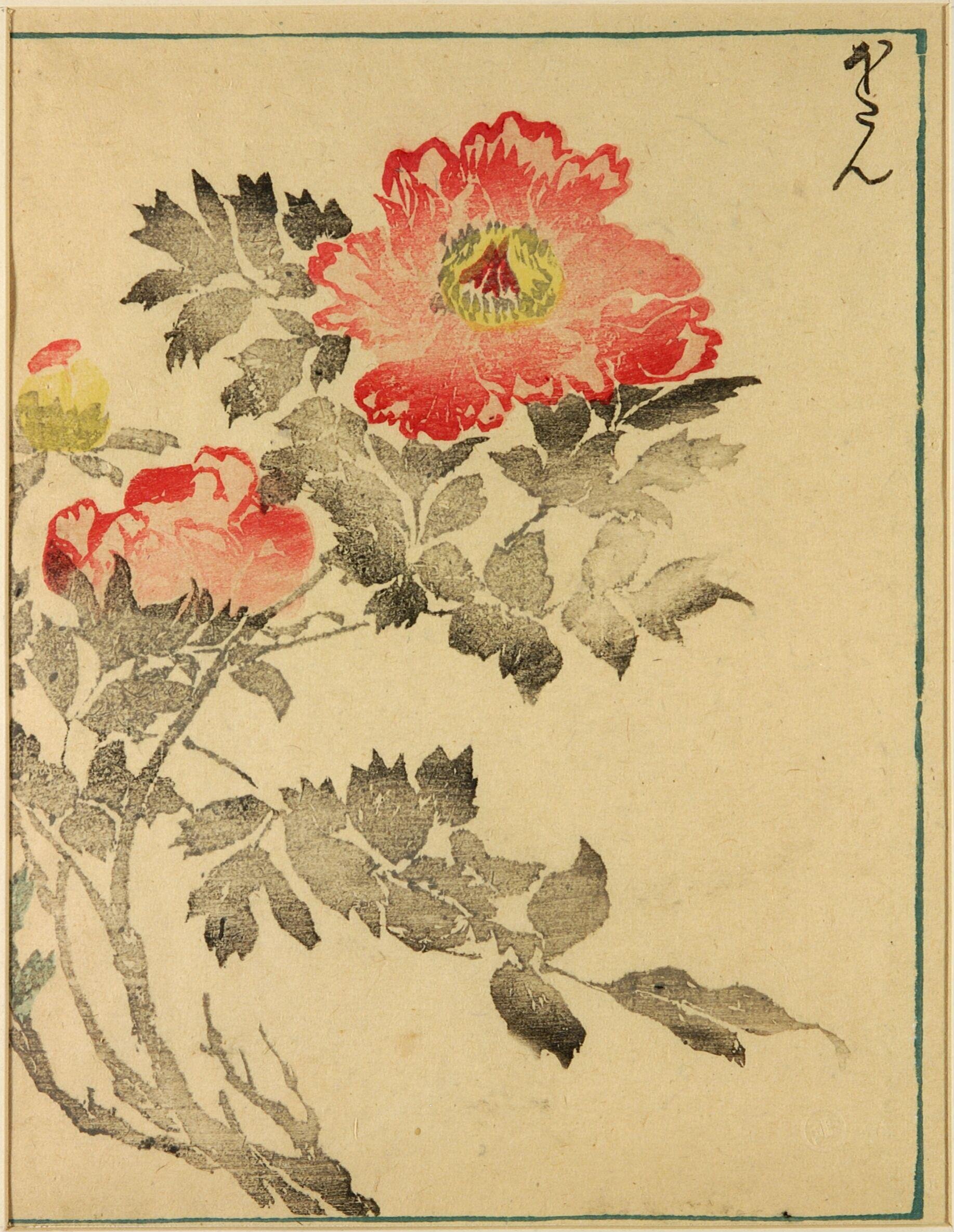
<i>Keisai gafu</i> (Album of Drawings by Keisai)

Keisai ryakuga hyakunin (handwritten)
1815
Woodblock- printed book; 1 vol.

Keisai ryakugaen
c. 1764-1824
Woodblock- printed book; 1 vol.

Chōjū ryakugashiki
1797
Woodblock- printed book; 1 vol.

Sansui ryakuga shiki
1800?
Woodblock- printed book; 1 vol.

Enjoying the Evening Cool at Ryôgoku Bridge in Edo (Edo Ryogokubashi yusuzumi no kei)
Unknown
Color woodblock print, horizontal ô-ôban

Soga monogatari
n.d.
Woodblock- printed book; 1 vol.

Gyokai ryakugashiki
1802
Woodblock- printed book; 1 vol.

Ryakugashiki
1795
Woodblock- printed book; 1 vol.

Shoshoku ekagami
1795
Woodblock- printed book; 1 vol.

Jinbutsu ryakugashiki
n.d.
Woodblock- printed book; 1 vol.

Ryakugashiki (a)Formerly listed as Jinbutsu ryakugashiki (a)
1799
Woodblock- printed book; 1 vol.

Sōka ryakugashiki
1813?
Woodblock- printed book; 1 vol.