Biography
Kobori Tomone (小堀鞆音, 1864-1931) was a leading modern master of rekishi-ga, the historical-narrative branch of nihonga that took as its subjects the great episodes of Japanese history — from the Nara court and the Heian aristocracy through the Genpei War and the Meiji Restoration. Trained in the Tosa school and in the antiquarian discipline of yūsoku-kojitsu — the historical study of court and warrior costume, ceremony, and precedent — he taught for many years at the Tokyo School of Fine Arts (Tokyo Bijutsu Gakkō), was appointed Imperial Household Artist (Teishitsu Gigeiin) in 1917, serving in that capacity until his death, and became a member of the Imperial Art Academy (Teikoku Bijutsuin) at its founding in 1919. He is remembered today both for his large historical paintings and for the kuchi-e (frontispiece) woodblock prints he designed for the literary magazine Bungei Kurabu and other Meiji periodicals. Among his pupils was Yasuda Yukihiko, one of the central figures of twentieth-century nihonga.
Tomone was born on 26 March 1864 in the village of Konaka in Hatagawa, Aso District, Shimotsuke Province — the area now incorporated into the city of Sano in Tochigi Prefecture, a region whose long memory of medieval warrior houses would later furnish much of his subject matter. His birth name was Keisaburō, and he came from a family of the Sano area with samurai connections. He trained in Tokyo under Kawasaki Chitora (川崎千虎), a Tosa-school painter and yūsoku-kojitsu scholar, absorbing the antiquarian discipline — the close study of court costume, armour, and ceremonial equipment — that would characterise his mature work.
The 1880s and 1890s were a period of fundamental institutional reorganisation for Japanese painting. The patronage system that had supported the Kanō and Tosa schools through the Edo period had collapsed with the abolition of the domains; the new Meiji state, under the influence of Ernest Fenollosa and Okakura Kakuzō (Tenshin), was assembling a new framework — the Kangakai (Painting Appreciation Society), the Tokyo Bijutsu Gakkō (Tokyo School of Fine Arts), and the Nihon Bijutsuin (Japan Art Institute) — in which painters trained in the old schools were expected to develop a modern "Japanese-style painting" (nihonga) as a national art form. Working in the Tosa-yamato-e idiom, Tomone joined the faculty of the Tokyo School of Fine Arts in the 1890s, teaching historical painting and later serving there as a professor. When Okakura's circle founded the Nihon Bijutsuin in 1898, Tomone was among its founding members, alongside such figures as Yokoyama Taikan, Hishida Shunsō, and Shimomura Kanzan.
Tomone's historical paintings established a canonical mode for rekishi-ga in the early-modern nihonga tradition. He worked from the close study of classical handscrolls together with the antiquarian examination of surviving court costume, armour, and ceremonial equipment, and his paintings reconstruct the dress, gesture, and architectural setting of Japanese historical scenes with a precision that gave them the authority of documentary evidence. His preferred subjects were drawn from the Heike and Genpei narratives — Taira no Tadanori the warrior-poet, Minamoto no Yoshitsune, Nasu no Yoichi, Shizuka Gozen, Taira no Kiyomori — and from the Heian and Nara courts, presenting the medieval warrior neither as a romanticised hero nor as a documentary specimen but as a historically dense figure whose costume, weapons, and gesture carry the meaning of the scene.
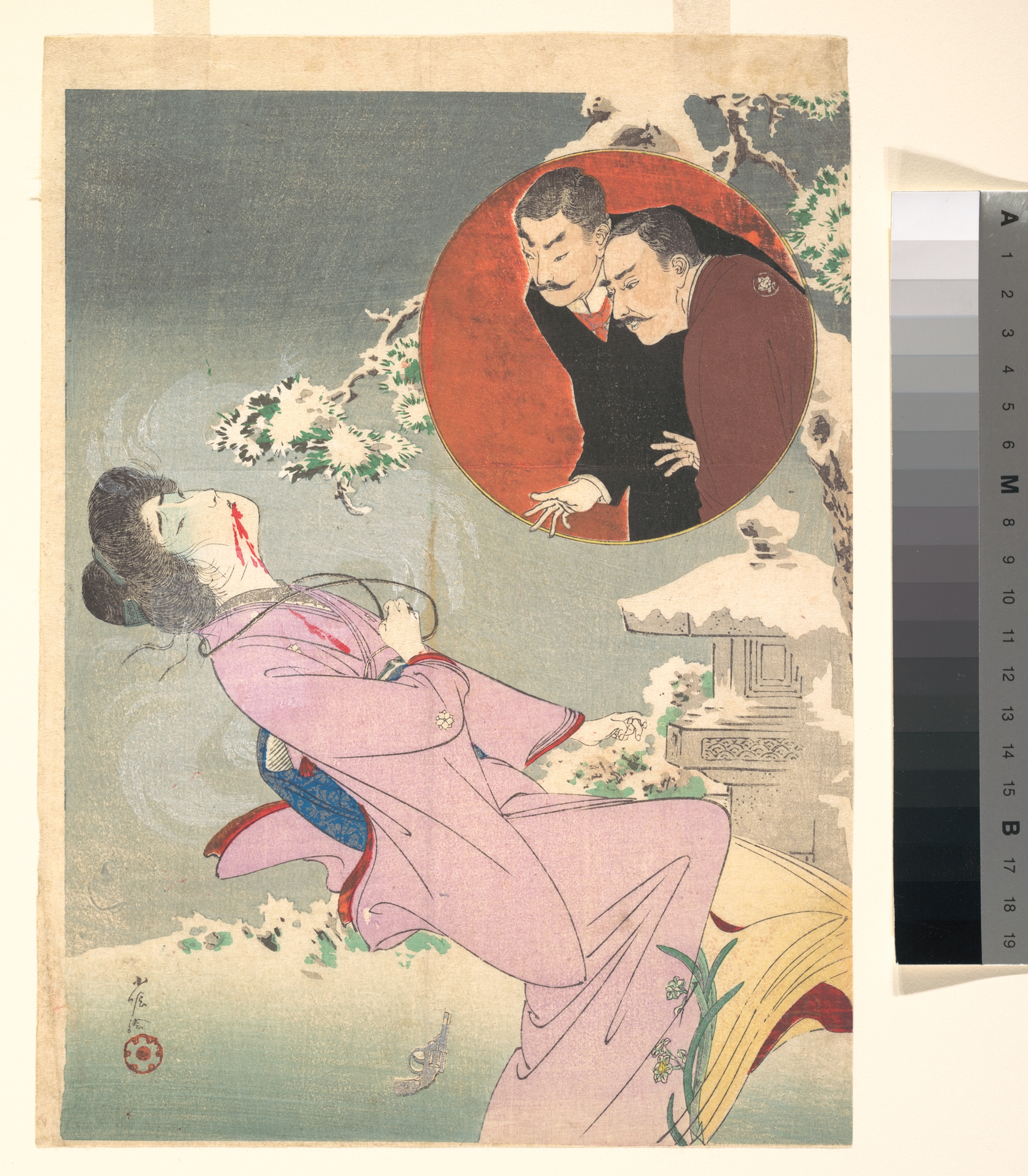
From the late 1890s through the early 1910s Tomone also designed a substantial body of kuchi-e (口絵, frontispiece) woodblock prints, most of them commissioned by Bungei Kurabu, one of the most popular literary magazines of the Meiji era. The kuchi-e was a small folded woodblock print bound as the opening illustration of a serialised novel or short story; Tomone's were typically historical or pseudo-historical compositions — bijin in Heian court dress, Heike warriors, episodes from the chronicles — and circulated widely as collectible items in their own right. They are now held in a number of Western museum and library collections and form one of the most accessible bodies of his work outside Japan. Where his hanging-scroll and screen paintings demanded large exhibition spaces, the kuchi-e were intimate domestic objects that reveal him working at the smaller scale of book illustration with the same fidelity to historical costume and gesture that characterises his major paintings.
The great commission of Tomone's later career was the Meiji Memorial Picture Gallery (Seitoku Kinen Kaigakan) at the Meiji Jingū Gaien in Tokyo, built through the 1920s to house a permanent cycle of eighty large-format murals — forty in nihonga and forty in yōga — depicting the major events of the reign of the Emperor Meiji. For the gallery Tomone painted The Abolition of the Han Domains and Establishment of Prefectures (廃藩置県, Haihan Chiken), his contribution to a series installed over the decade from 1926 to 1936. He was among the commissioned painters who died before the gallery was completed, and work he left unfinished was carried on by his pupils, among them Yasuda Yukihiko.
Tomone died on 1 October 1931 in Tokyo, at the age of sixty-seven. He had taught for many years at the Tokyo School of Fine Arts, and among the painters trained under him Yasuda Yukihiko became one of the leading figures of the next generation of nihonga. His work is preserved in Japanese public collections — including in his home prefecture of Tochigi and at the Meiji Memorial Picture Gallery, where his mural remains in situ — as well as in a number of Western institutions. He is buried at Tama Cemetery (Tama Reien) in Tokyo.
Key Facts
- Active Period
- 1864–1931
- Nationality
- 🇯🇵Japan
- Movement
- Meiji/Taishō Prints
- Works Indexed
- 4
Frequently Asked Questions
Kobori Tomone (小堀鞆音, 1864-1931) was a leading modern master of rekishi-ga, the historical-narrative branch of nihonga that took as its subjects the great episodes of Japanese history — from the Nara court and the Heian aristocracy through the Genpei War and the Meiji Restoration. Trained in the Tosa school and in the antiquarian discipline of yūsoku-kojitsu — the historical study of court and warrior costume, ceremony, and precedent — he taught for many years at the Tokyo School of Fine Arts (Tokyo Bijutsu Gakkō), was appointed Imperial Household Artist (Teishitsu Gigeiin) in 1917, serving in that capacity until his death, and became a member of the Imperial Art Academy (Teikoku Bijutsuin) at its founding in 1919. He is remembered today both for his large historical paintings and for the kuchi-e (frontispiece) woodblock prints he designed for the literary magazine Bungei Kurabu and other Meiji periodicals. Among his pupils was Yasuda Yukihiko, one of the central figures of twentieth-century nihonga.
Kobori Tomone was active from 1864 to 1931. They were associated with the Meiji/Taishō Prints movement.
Kobori Tomone's work was shaped by the Meiji/Taishō Prints tradition in Japanese woodblock printmaking. Meiji/Taishō Prints: Meiji and Taishō era prints (1868–1926) bridge the transition from traditional ukiyo-e to the modern shin-hanga and sosaku-hanga movements.
Original prints by Kobori Tomone can be found in collections including Tochigi Prefectural Museum of Fine Arts (study for the Meiji Memorial Picture Gallery mural; via Wikimedia Commons), Meiji Memorial Picture Gallery (Seitoku Kinen Kaigakan), Meiji Jingū Gaien, Tokyo (via Wikimedia Commons), The Metropolitan Museum of Art, New York; accession JP3202 (Gift of Lincoln Kirstein, 1959; via Wikimedia Commons, CC0 Public Domain).
Woodblock Prints by Kobori Tomone (4)
Frontispiece Print (Kuchi-e) for a Literary Magazine
口絵
c. 1906
Polychrome woodblock print (kuchi-e); ink and colour on paper

Abolition of the Han Domains and Establishment of Prefectures
廃藩置県
c. 1927 (study for the Meiji Memorial Picture Gallery commission)
Colour on paper; hanging scroll (study)

The Emperor's Visit to the Dajōkan
二条城太政官代行幸
dedicated 1933 (painted late 1920s–early 1930s)
Wall painting; mineral pigments on canvas

The Emperor Arriving in Tokyo
東京御着輦
dedicated 1934 (painted late 1920s–early 1930s)
Wall painting; mineral pigments on canvas