
The Emperor's Visit to the Dajōkan
二条城太政官代行幸
- Date:
- dedicated 1933 (painted late 1920s–early 1930s)
- Medium:
- Wall painting; mineral pigments on canvas
Description
The Emperor's Visit to the Dajōkan (二条城太政官代行幸) is the second of Kobori Tomone's two great wall paintings for the Meiji Memorial Picture Gallery (Seitoku Kinen Kaigakan) at the Meiji Jingū Gaien in Tokyo. Dedicated in 1933, two years after Tomone's death in 1931, the painting depicts the young Emperor Meiji's visit to the Dajōkan, the council of state, at Nijō Castle in Kyoto in early 1868 — one of the founding ceremonial acts of the new imperial regime, in which the Emperor formally received the new government in the audience hall of the castle that had been the symbolic seat of Tokugawa authority for two and a half centuries. Tomone's composition uses the elaborate Tosa-yamato-e conventions for court ceremonial — the carefully reconstructed Heian-style costume worn by the Emperor and the senior court nobles, the precise architectural detailing of the Nijō audience hall with its decorated sliding doors and the cedar ceiling of the inner chamber, the diagonal recession of the floor matting that situates the figures in correct ceremonial relationship to one another. The painting was executed in mineral pigments on canvas at the wall-format scale of the Memorial Picture Gallery (approximately three by two and a half metres) and remains installed in the gallery's permanent display. Together with The Emperor Arriving in Tokyo, it constitutes Tomone's contribution to the canonical state-sponsored visual record of the Meiji Restoration, and represents the culmination of his career-long project of historical reconstruction in the yamato-e idiom.
More Prints by Kobori Tomone

Abolition of the Han Domains and Establishment of Prefectures
廃藩置県
c. 1927 (study for the Meiji Memorial Picture Gallery commission)
Colour on paper; hanging scroll (study)

The Emperor Arriving in Tokyo
東京御着輦
dedicated 1934 (painted late 1920s–early 1930s)
Wall painting; mineral pigments on canvas
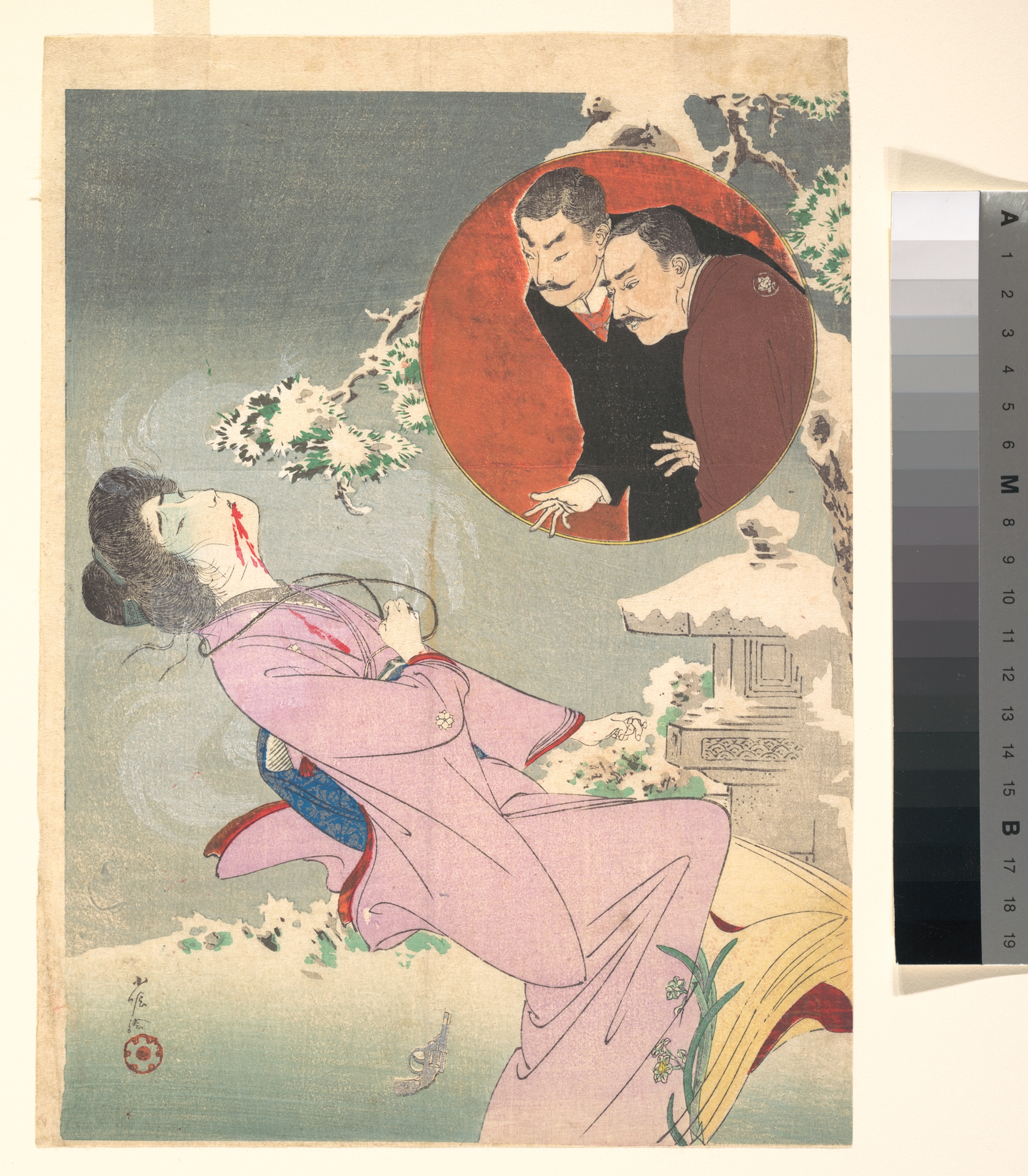
Frontispiece Print (Kuchi-e) for a Literary Magazine
口絵
c. 1906
Polychrome woodblock print (kuchi-e); ink and colour on paper
Frequently Asked Questions
The Emperor's Visit to the Dajōkan (二条城太政官代行幸) was created by Kobori Tomone (小堀鞆音) in dedicated 1933 (painted late 1920s–early 1930s).