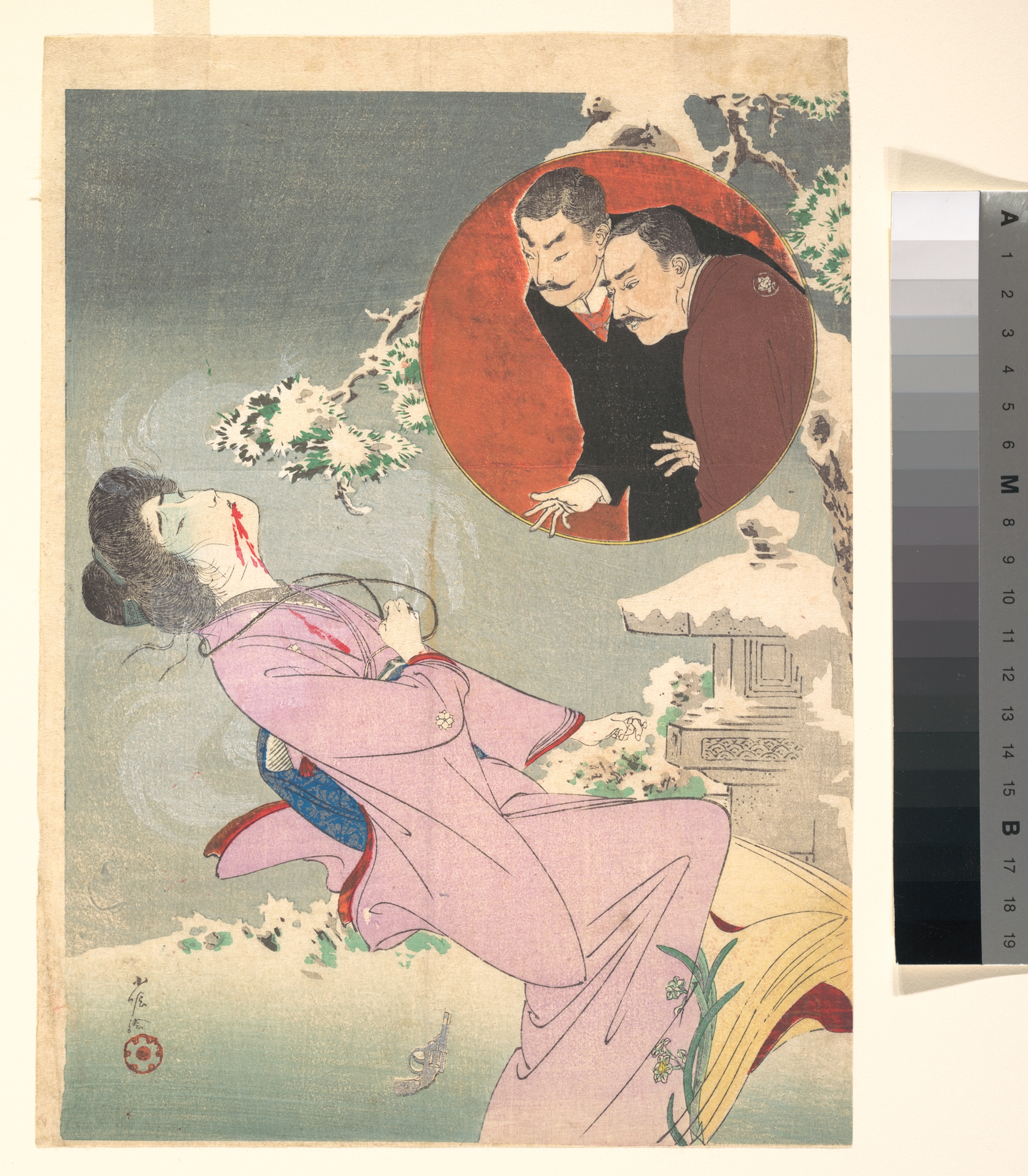
Frontispiece Print (Kuchi-e) for a Literary Magazine
口絵
- Date:
- c. 1906
- Medium:
- Polychrome woodblock print (kuchi-e); ink and colour on paper
Description
A woman in a pale purple kimono lies collapsed backward in a snowy garden, her head thrown back and a streak of blood running from her forehead down her neck; a revolver rests on the ground near her outstretched hand. Beside her, snow-covered pine boughs and a stone lantern frame the scene, and above her, set within a red circular inset, two mustached men in Western dress lean close together in conversation. This polychrome woodblock kuchi-e frontispiece by Kobori Tomone, made in 1906 for a literary magazine, is rendered in muted grays and blues against the pink of the kimono and the red of the inset roundel.
More Prints by Kobori Tomone

Abolition of the Han Domains and Establishment of Prefectures
廃藩置県
c. 1927 (study for the Meiji Memorial Picture Gallery commission)
Colour on paper; hanging scroll (study)

The Emperor's Visit to the Dajōkan
二条城太政官代行幸
dedicated 1933 (painted late 1920s–early 1930s)
Wall painting; mineral pigments on canvas

The Emperor Arriving in Tokyo
東京御着輦
dedicated 1934 (painted late 1920s–early 1930s)
Wall painting; mineral pigments on canvas
Frequently Asked Questions
Frontispiece Print (Kuchi-e) for a Literary Magazine (口絵) was created by Kobori Tomone (小堀鞆音) in c. 1906.