Biography
Morikawa Chikashige (守川周重, active c. 1869-1882) was a Meiji-era ukiyo-e print designer in Tokyo whose specialty was yakusha-e, the actor portrait, and whose career maps almost exactly onto the first decade and a half of the Meiji period. His exact birth and death dates are not recorded, but the signed body of work he left behind — well over one hundred kabuki triptychs along with smaller numbers of kaika-e (enlightenment prints), newspaper illustrations, and book illustrations — places him among the most prolific Tokyo actor-print designers of the 1870s and very early 1880s.
Chikashige trained as a pupil of Toyohara Kunichika (1835-1900), the leading kabuki print designer of the early Meiji era. The Kunichika studio, based in Tokyo and tightly connected to the city's commercial publishers, was at the center of the Meiji yakusha-e trade, and Chikashige's training gave him both the visual vocabulary of late-Edo actor portraiture and access to the publishers who supplied the kabuki theaters of the new capital with souvenir prints. His earliest signed works appear from around 1869, just after the political settlement of the Meiji Restoration, and he continued to design prints steadily through 1881 and into early 1882. After that date he disappears from the documentary record. The conventional shorthand "active 1869-1882" reflects this signed-output evidence rather than confirmed biographical dates.
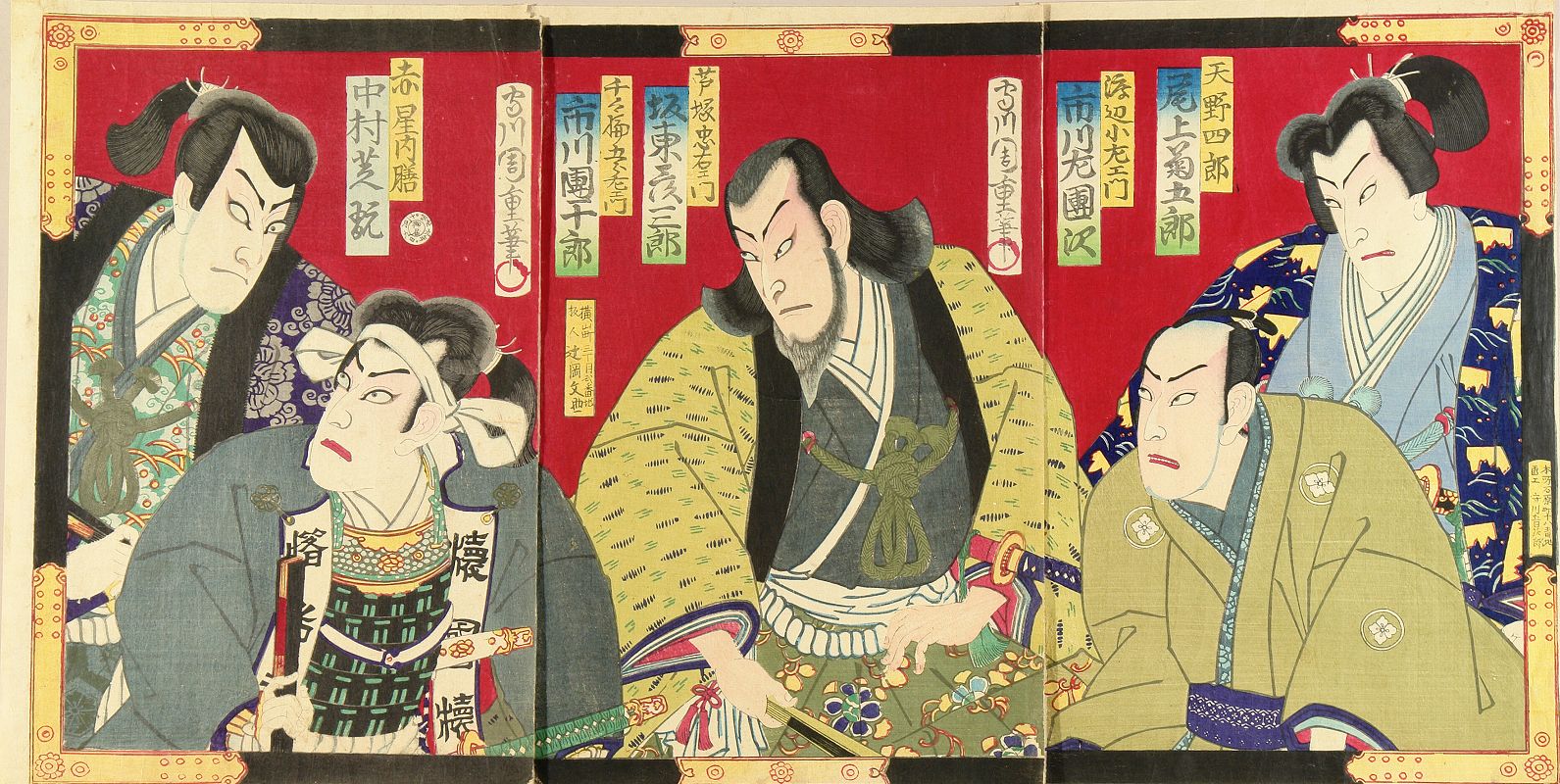
His chosen medium was the ōban triptych, the three-sheet horizontal format that had become the dominant vehicle for staged kabuki scenes in the late Edo period and that continued to dominate Meiji yakusha-e. The triptych allowed an entire stage tableau to unfold across the sheets, with central protagonists framed by supporting actors, painted backdrops, and the elaborate prop architecture characteristic of mid-Meiji kabuki productions. Chikashige's triptychs typically identify individual actors by name in the inscriptions and depict them in the costume and pose of specific roles in identified plays, a convention that made the prints function as both visual souvenirs and a kind of theatrical reference work for audiences who attended performances at the Shintomi-za, Ichimura-za, Haruki-za, and the other principal kabuki houses of Tokyo.
Chikashige's prints are visually distinguished by the strong, sometimes raw use of aniline dyes, the synthetic pigments imported from Germany and England that flooded the Japanese print market from the late 1860s onward and that defined the palette of early Meiji ukiyo-e. Brilliant magentas, acid greens, and saturated purples replaced or supplemented the older mineral and plant-based colorants of Edo-period printing, producing the high-contrast, slightly garish look that contemporary collectors associate with Meiji actor prints. Aniline reds in particular tended to bleed and darken over time, and Chikashige's surviving works show varying degrees of this characteristic chromatic shift. The Tokyo print firms that catered to the kabuki market supplied the technically demanding multi-block color separations that aniline printing required.
Beyond his core yakusha-e production, Chikashige worked across several adjacent Meiji genres. He produced a smaller number of kaika-e, the prints that documented and celebrated Japan's adoption of Western technology, architecture, and political institutions — the sort of subject exemplified by the Second National Industrial Exhibition, the great state-sponsored fair that ran in Ueno Park for 122 days in 1881, drew more than eight hundred thousand visitors, and made use of the newly completed museum building designed by the English architect Josiah Conder. Landmark events of this kind drew a wave of contemporary visual reporting from Meiji print designers, among them Hiroshige III and Yōshū Chikanobu. Chikashige also contributed illustrations to the illustrated newspapers (nishiki-e shinbun) and produced inset plates (sashi-e) for kabuki-themed novels.
His subject matter sat squarely inside the world of mid-Meiji Tokyo kabuki. He depicted the leading actors of the day — Ichikawa Danjurō IX, Onoe Kikugorō V, Nakamura Shikan IV, Sawamura Tosshō, Bandō Kakitsu, Iwai Hanshirō VIII, Suketakaya Takasuke, and others — in roles from the standard kabuki canon: the chūshingura cycle of the forty-seven loyal retainers, the Kumagai-Atsumori cycle from Ichinotani futaba gunki, sword-fight scenes (tachimawari), spectacle pieces involving the lion dance (shakkyō), and the chivalrous-commoner narratives of plays like Banzuiin Chōbei. His triptychs record productions staged at the Shintomi-za, Ichimura-za, and Haruki-za through the late 1870s and early 1880s. He also produced a few notable prints reflecting current events, including a triptych on the Satsuma Rebellion of 1877 known as "Two Bloody Heroes" that participates in the wave of visual reportage on that conflict.
Chikashige's exit from the documentary record after early 1882 has prompted speculation that he died young, withdrew from the printmaking trade, or shifted into other illustration work that did not carry his ukiyo-e signature. No evidence settles the question. What survives is a substantial signed corpus, preserved today in the Lavenberg Collection of Japanese Prints and in various other Japanese and international museum and private collections. His prints document the Tokyo kabuki theater of the 1870s and the first years of the 1880s with a specificity, in actor identification and role, that makes them valuable to historians of Meiji theater and Meiji visual culture. They sit alongside the work of his teacher Kunichika and his fellow Kunichika pupils as part of the late-ukiyo-e generation that kept the woodblock-printed actor portrait commercially viable into the photographic and lithographic era.
Key Facts
- Nationality
- 🇯🇵Japan
- Movements
- Meiji/Taishō PrintsUkiyo-e
- Works Indexed
- 5
Frequently Asked Questions
Morikawa Chikashige (守川周重, active c. 1869-1882) was a Meiji-era ukiyo-e print designer in Tokyo whose specialty was yakusha-e, the actor portrait, and whose career maps almost exactly onto the first decade and a half of the Meiji period. His exact birth and death dates are not recorded, but the signed body of work he left behind — well over one hundred kabuki triptychs along with smaller numbers of kaika-e (enlightenment prints), newspaper illustrations, and book illustrations — places him among the most prolific Tokyo actor-print designers of the 1870s and very early 1880s.
Morikawa Chikashige's work was shaped by the Meiji/Taishō Prints and Ukiyo-e traditions in Japanese woodblock printmaking. Meiji/Taishō Prints: Meiji and Taishō era prints (1868–1926) bridge the transition from traditional ukiyo-e to the modern shin-hanga and sosaku-hanga movements. Ukiyo-e: ## What is ukiyo-e? Ukiyo-e ([浮世絵](/glossary/ukiyo-e)) — literally "pictures of the floating world" — is the Edo-period Japanese print and painting tradition that flourished from roughly 1660 to 1868, depicting the pleasures of urban life in Edo (modern Tokyo): courtesans, kabuki actors, sumo wrestlers, famous landscapes, and seasonal beauties.
Original prints by Morikawa Chikashige can be found in collections including Edo-Tokyo Museum, ukiyo-e.org, Art Gallery of Greater Victoria.
Woodblock Prints by Morikawa Chikashige (5)
Scene of a Kabuki Performance (triptych)
1876
Color woodblock print; ōban triptych

Actors in a Kabuki Performance (triptych)
1880
Color woodblock print; ōban triptych
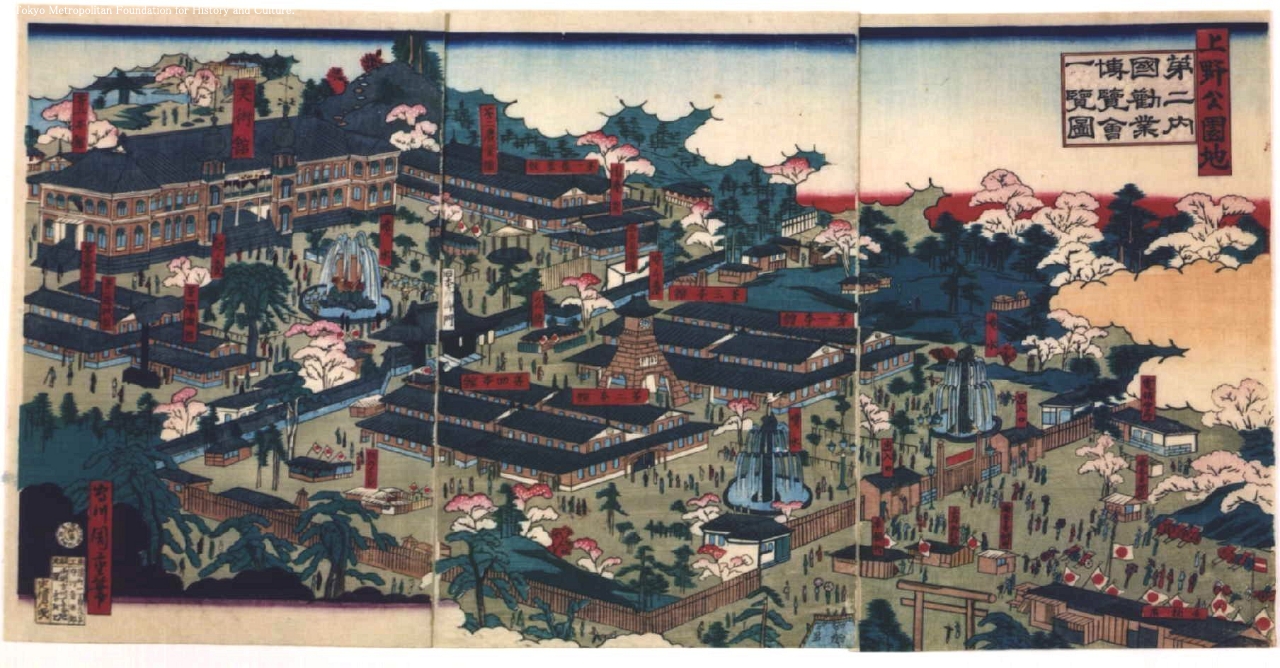
Ueno Park: 2nd National Industrial Exhibition
1881
Color woodblock print
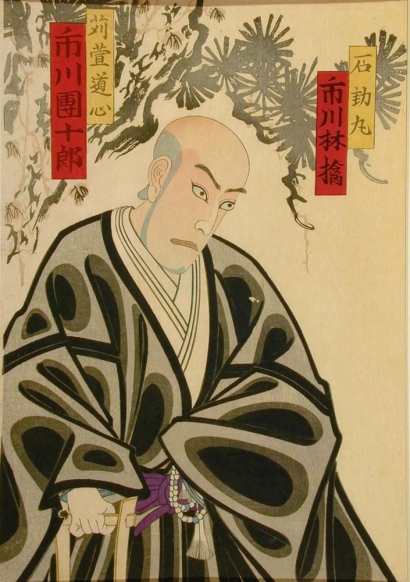
The Actor Ichikawa Danjurō
1881
Color woodblock print
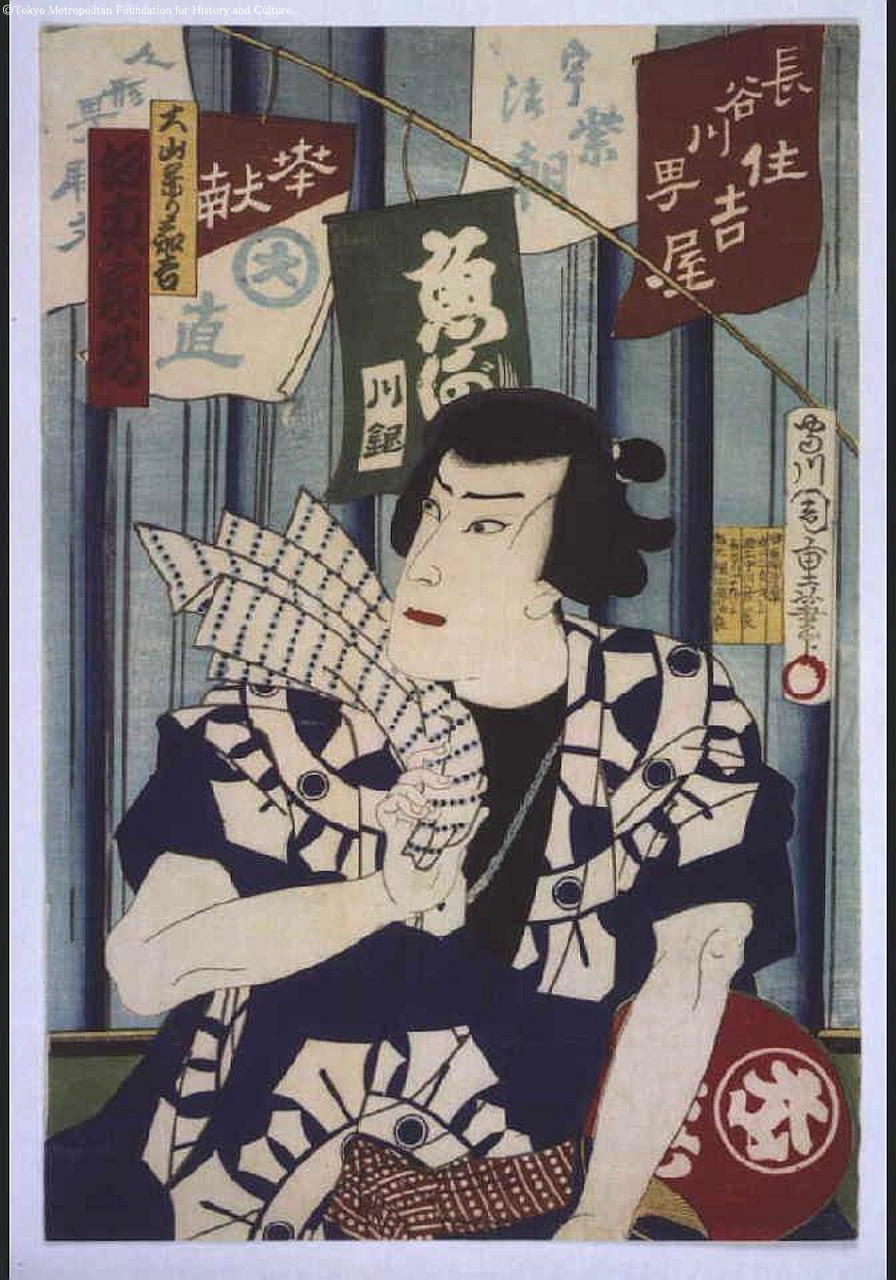
An Actor Sets out on Pilgrimage to Oyama: Bando Kakitsu as Kakichi
大山参り嘉吉 坂東家橘
c. 1869–1882
Color woodblock print