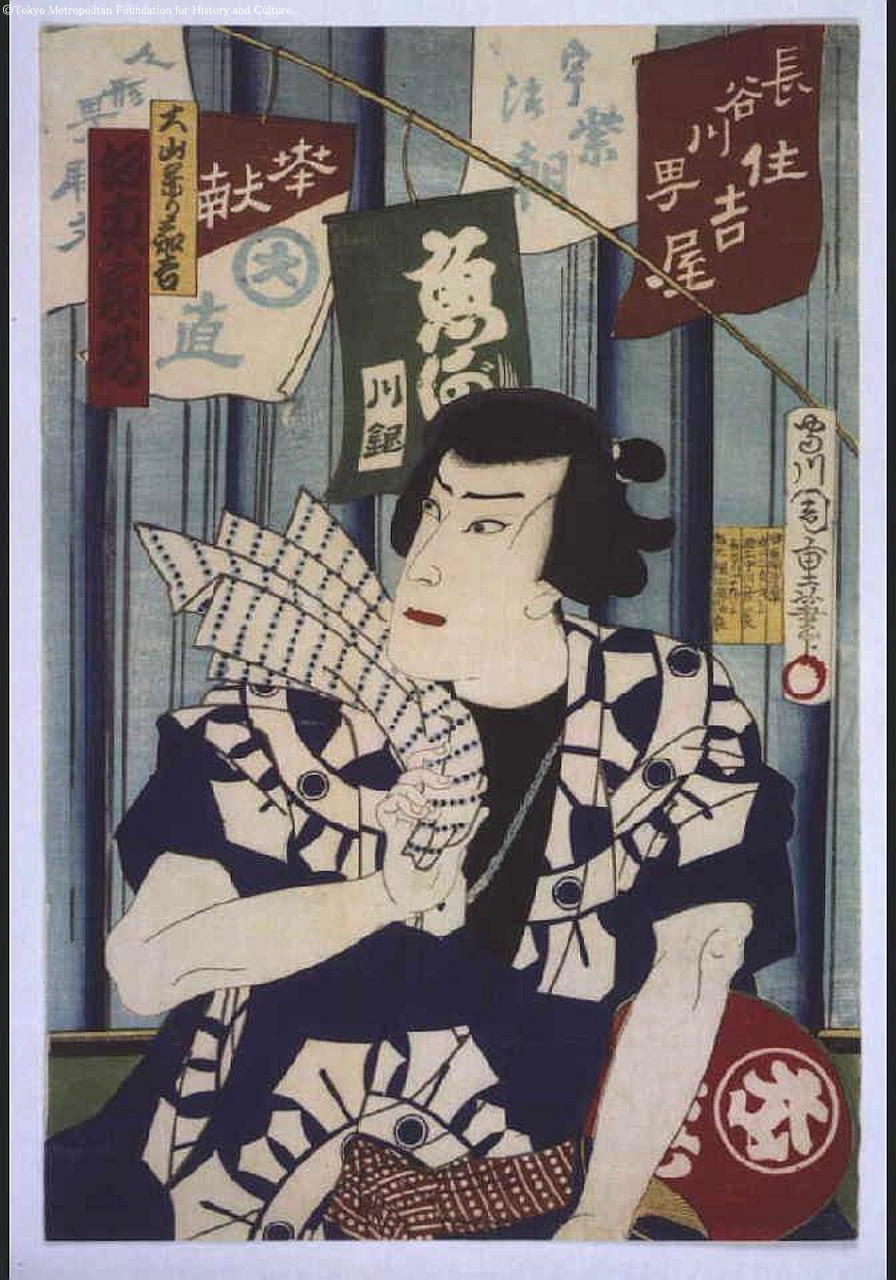
An Actor Sets out on Pilgrimage to Oyama: Bando Kakitsu as Kakichi
大山参り嘉吉 坂東家橘
- Date:
- c. 1869–1882
- Medium:
- Color woodblock print
- Source:
- Edo-Tokyo Museum
Description
This color woodblock print, held by the Edo-Tokyo Museum, is an example of Morikawa Chikashige's core production: a yakusha-e (actor portrait) identifying the kabuki actor Bandō Kakitsu in the role of Kakichi, a character making a pilgrimage to the sacred mountain Ōyama in the Tanzawa range west of Edo. Ōyama-mairi, the pilgrimage to Ōyama and its Afuri Shrine, was a beloved popular religious practice of Edo-period Tokyo, frequently depicted in art and frequently dramatized on the kabuki stage. The print belongs to Chikashige's broader engagement with the kabuki repertoire of the 1870s and early 1880s, and is characteristic of his use of brilliant aniline-dye reds and greens, the synthetic pigments that defined the early Meiji palette. Bandō Kakitsu was a prominent stage name in the Bandō lineage, used by several actors active in the mid-Meiji theater, and Chikashige's design identifies the role with the standard inscriptional conventions of yakusha-e. The composition places the actor in costume, with the visual attributes of a religious pilgrim, against a stylized landscape suggesting the road to Ōyama. The print is part of the Edo-Tokyo Museum's holdings of Meiji woodblock prints and is a representative example of Chikashige's individual actor portraits, the format he produced alongside his much more numerous kabuki triptychs.
More Prints by Morikawa Chikashige

Frequently Asked Questions
An Actor Sets out on Pilgrimage to Oyama: Bando Kakitsu as Kakichi (大山参り嘉吉 坂東家橘) was created by Morikawa Chikashige (森川周重) in c. 1869–1882.